The 2026 World Cup Will Bring The Biggest Wave of New Players
Every World Cup produces a surge of new bettors. However every World Cup also produces a problem that is ignored among the post-tournament reports. The problem is the most predictable pattern in sports betting: people leaving after the big event and never coming back. 2026 is going to deliver the largest version of it.
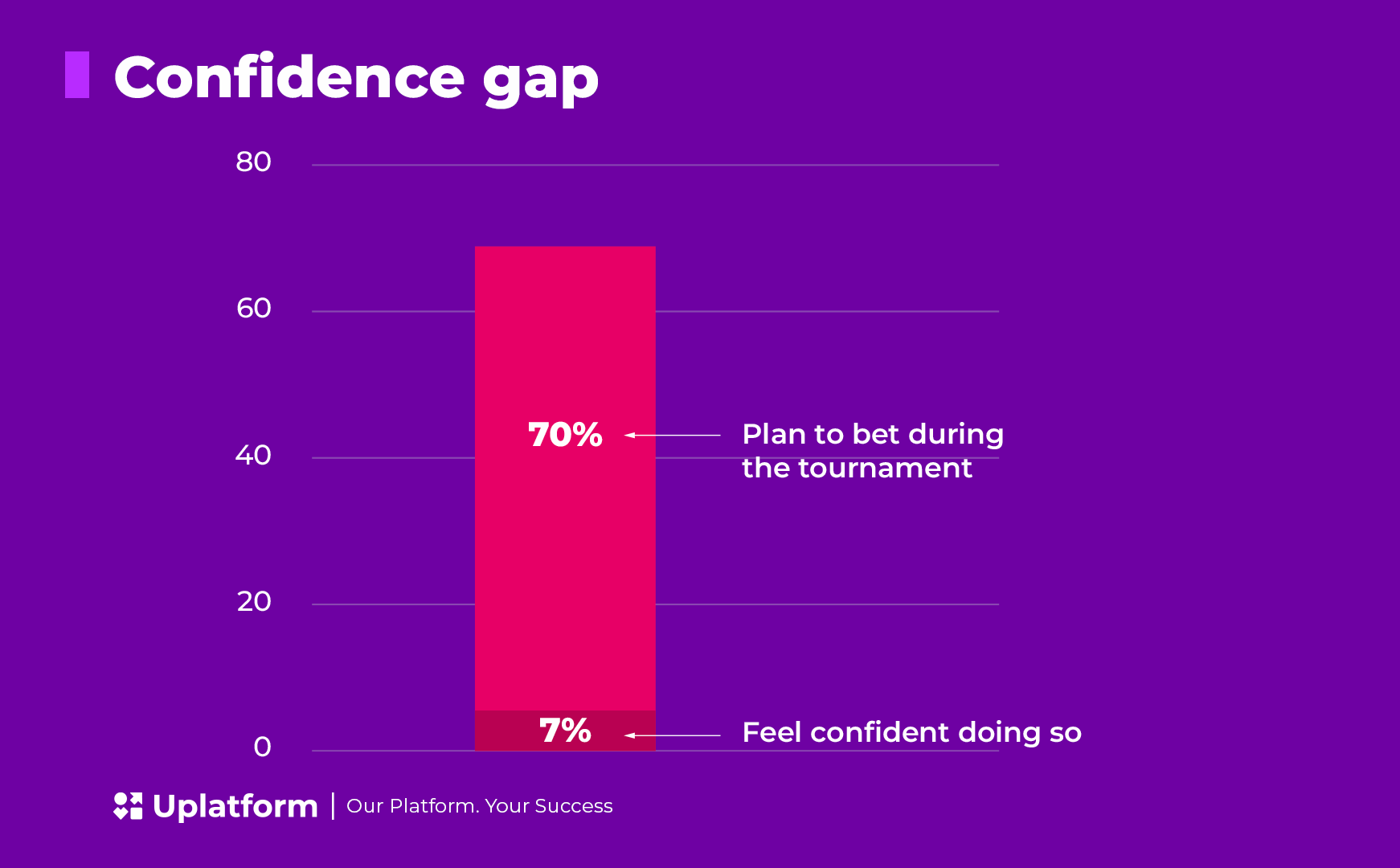
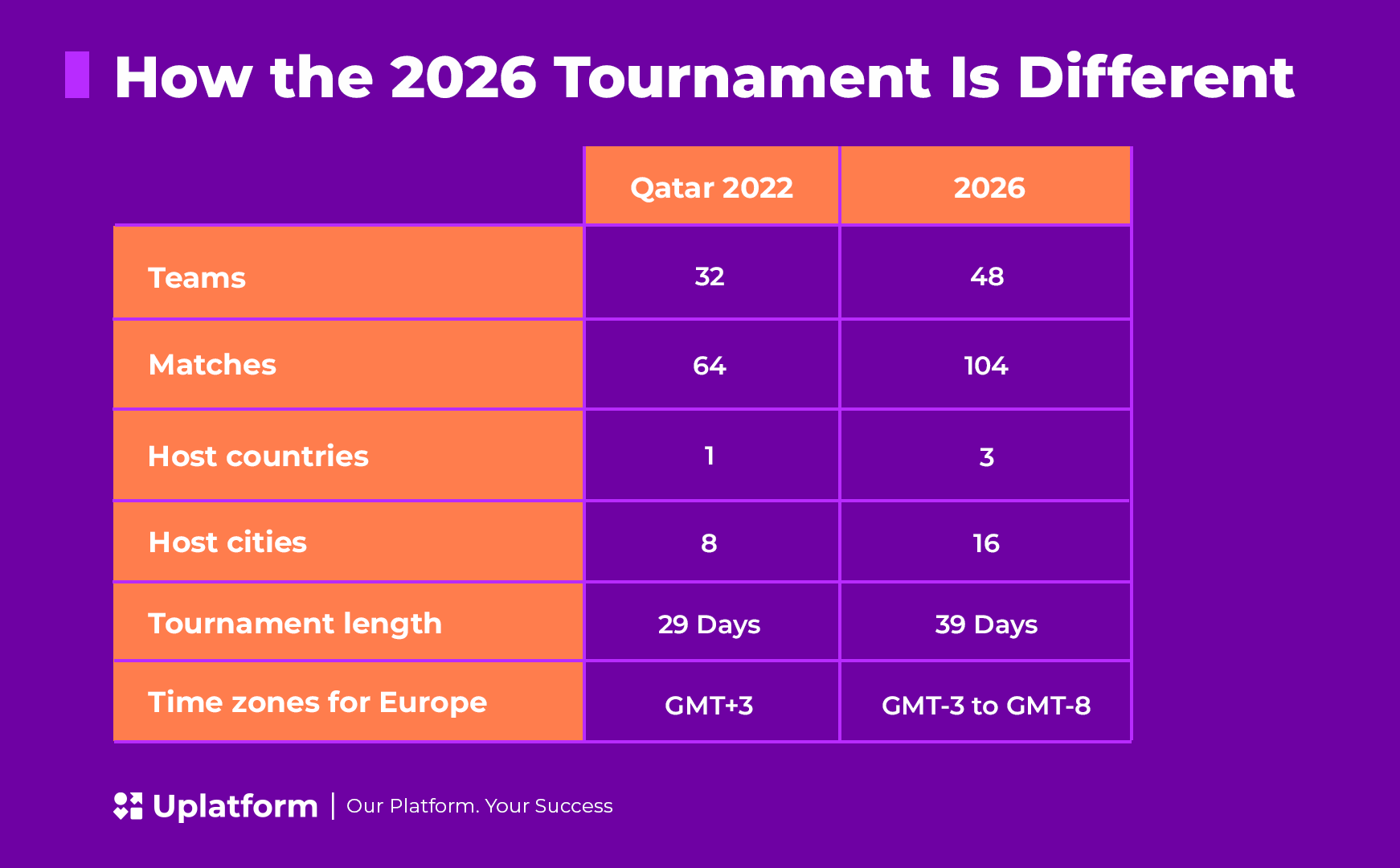
The numbers around the tournament are familiar to anyone working in the space by now. 48 teams, 104 matches, three host countries, and 66% of those planning to bet on the tournament have never wagered on a World Cup before, according to research from Spotlight Sports Group published in late 2025. The same study found 70% of fans plan to place a bet, but only 7% feel confident doing so.
That acquisition window is going to take care of itself. The marketing budgets are allocated, the affiliates are on standby, and most operators will have an excellent chart of player acquisition through July. What matters, the question that actually decides whether 2026 will be a good year for an operator, is what will happen in August.
Acquisition and retention are normally treated as two separate conversations. Well they are not. Whatever a first-time bettor experiences during the tournament is the retention strategy. It is about how they were brought in, the first betting experience they’ve had, and what’s waiting for them when it ends. There’s no fixing it later.
The second screen
Start with the simplest observable fact about how this World Cup will be consumed.
People are going to watch the matches on a television, or a streaming feed, or a bar projector. And while they are watching, they will be holding a phone, and the phone will have a sportsbook app open on it. The match is on the big screen. The phone is in the hand. The two are running in parallel for ninety minutes plus added time, and the bettor is switching between them constantly.
It is how a substantial share of sports betting happens, and the World Cup is going to make it the default mode rather than the secondary one.
For operators, this is more significant than it first appears, because it changes when betting decisions actually get made. The traditional model of engagement assumed sequential attention. They researched the match. They placed the bet. They watched the game. They collected or they didn’t. The pre-match window was the moment of commercial value, and the match itself was passive entertainment.
Live streaming betting closes that timeline. The pre-match decision is no longer the high-value moment. The high-value moment is the 34th minute, when a team that was supposed to win is suddenly losing, and the players look down at the phone in their hand. The app or a website either gives them a reason to act, or it doesn’t. Multiply that by 104 matches, by hundreds of in-match moments, by millions of players with their phones open, and the implication is clear enough. The match itself is a commercial event.
This is the part most operators understand but haven’t fully built around. In today’s world live betting is more important than pre-match betting. The market depth, the latency, the speed at which odds adjust, the interface clarity. These are the things that determine whether the bettor with the phone in their hand places the wager, or just watches the moment pass and goes back to the match.
The Uplatform sportsbook was built with live betting as an important part of the product rather than as a layer on top of pre-match. That shows up in market depth during a match. Not just the next goal or final result, but the detailed live markets players reach for when they’re watching: minute of the next card, total and next corner, multi goals, total time and many others. The operators who treat the live experience as the main focus, and the pre-match as the supporting layer around it, are the ones positioning themselves correctly for how players will behave in this tournament.
The time zone
The other reality of this tournament, particularly for operators serving European and Asian markets, is the time zone gap. The 2026 World Cup is hosted across the United States, Canada, and Mexico. For European audiences, that means a kick-off schedule running from late evening into the early hours of the morning, with the deepest tournament rounds landing well after midnight in most markets. For Asia it will be even later with first matches starting well after midnight and running all the way through the night.
This is usually treated as a problem of total viewership. Late kick-offs mean smaller audiences, lower engagement, reduced commercial value. This framing is incomplete and probably wrong.

The audience that stays up until 2am to watch a quarter-final is not the casual viewer who flips on the TV during dinner. It is a committed fan with a real stake in the outcome. These types of players have lower energy, shorter attention, and less patience for friction than the same person watching at 8pm. They are not reading a thousand-word preview before kick-off, they are ready to bet on whatever feels right in the moment.
Which is, again, a live betting problem rather than a viewership one. The European audience for this tournament is going to be smaller in raw numbers than past World Cups, but the share of that audience reachable through live betting rather than pre-match is going to be higher than ever before.
The mobile experience and user interface (UI) matters here. As we’ve discussed before, most of the players are betting from the phone. The full path from match event to placed bet has to be inside the mobile app or on a mobile browser, in two or three taps, with no issues in between. The operator who builds that path well captures the late-night European audience.
The wave of players
This point gets lost in the strategic planning about the tournament. A World Cup acquisition wave is not a smooth curve. It is a series of sharp peaks aligned with high-interest matches, surrounded by relatively flat periods. The opening match produces a spike. Every match involving the US, Mexico, or Canada produces a spike. Every late-stage match involving a major nation produces a spike. The final produces the largest spike in the history of the operator.
What every one of those spikes has in common is that they arrive at the same time across the entire player base. Hundreds of thousands of bettors, in some cases millions, opening the app within the same five-minute window. Placing bets in the same minute. Hitting the same markets. Trying to cash out at the same moment after the same goal.
The product that handles those moments smoothly is the product that will keep their player base the most. The one that freezes, throws errors, or loses a bet in the system, will lose their players as they will walk away from and never come back to. A first-time bettor whose first World Cup bet fails to settle because the website stalled at full time is not going to give the operator a second chance. They are going to close the website or an app and tell their friends what happened. The reputational damage of an outage during a major moment is far greater than the technical issue, and it lands precisely on the audience the operator was trying to acquire.
Uplatform’s approach to this has been shaped by years of running sportsbook operations through high-volume periods across multiple regions. We have placed a lot of effort into creating a fast, stable and scalable product that will keep up with the busiest operations.
Don’t forget about the retention
Which brings the argument back to the framing.
The new player acquired during the World Cup is not a separate group from the player retained after the tournament. They are the same player. What determines whether they convert from the first into the second is what happens during the six weeks of the tournament itself.
The first-time bettor arriving in June is not arriving with low expectations. They are arriving with the expectations set by every other consumer product they use. The streaming services that load instantly. The food delivery apps that confirm in two taps. The messaging platforms that never lose a message. Their bar for what a digital product should feel like is calibrated by experiences far outside of iGaming, and they will judge a sportsbook by the same standards whether the operator likes it or not.
A first bet that goes through cleanly, on a match the player understands, with a clear and honest experience around it, produces a returning player. A first bet that involves friction, confusion, technical errors, or a sense that the product is not built for them produces a deleted app. There is very little in between. The bettor does not return to a sportsbook that they had a bad first experience with, regardless of how much was spent on the marketing that acquired them in the first place.
So the operators who win the long game in 2026 are not going to be the ones who spent the most on acquisition. They will be the ones who built clear paths through their product for players who didn’t really know what they were doing. The ones who made the live experience feel natural for people. The ones who made sure the website held up at the moments when the entire player base tried to act at once.
Everything else, the marketing campaigns, the bonus structures, the affiliate deals, the brand work, is supporting context for what actually matters, which is the experience of the betting itself.
This is what Uplatform was built to deliver. The in-house Sportsbook API gives operators deep coverage that helps sustain players engagement and revenue well beyond major sporting events, with 1.5M+ events a year across 200+ sports and 60+ Esports, with our own bookmakers setting the odds that ensure stable profits. And the live betting that holds up when the whole player base decides to bet in the same minute. It’s an amazing opportunity for the operators who already run a platform and just need a different sportsbook or want to expand their offering.
For operators building from less, our Turnkey solution carries even more: widest coverage sportsbook, extensive casino portfolio, 550+ payment methods, support in 68+ languages, Localization tools, In-depth analytics, Player segmentation, Back office, and many other much needed tools to make your project a successful one.
Either way the point is the same: spend the tournament acquiring players. That’s the game in 2026.
Other news
-

- Case 1: The Growth Investigation
09.06.2026
-
-
- Uplatform lands four EGR B2B nominations
05.05.2026




Head of B2B Projects: Why Conversions Mislead Operators

In iGaming, it is easy to mistake short-term performance for real success. Sudden spikes in conversion, deposit activity, or campaign outcomes can make a product appear more effective than it truly is. Evaluating only the present, or focusing exclusively on short-term results, can create a false sense of achievement.
Among the many metrics operators use to gauge performance, conversion remains the most popular — and, according to Uplatform’s Head of B2B Projects Dina, also the most overvalued and often misinterpreted.
“In my view, conversion is rightfully considered one of the most fundamental and earliest metrics by which you can judge whether a product is developing correctly. I would even say it is one of the most obvious indicators. When conversion grows, it is quite natural to think that we are moving in the right direction.”
Why does the industry rely so heavily on conversion?
In iGaming, conversion is often the most visible metric, as it responds quickly to product updates, UX changes, and promotional campaigns. Teams rely on it as immediate feedback, which can bias short-term decision-making.
These metrics reward what is valued by a rapid response. Fast, flexible teams that respond to changes are drawn in by what they see as immediate feedback.
The easy and quick measurement metrics can reward short-term efforts, but often at the cost of more valued goals. It is not the metric, but the emphasis placed on it that is the issue.
“They often fall into the trap of focusing on short-term metrics. It may sound blunt, but to me, an excessive focus on short-term numbers is a sign of limited foresight. In iGaming, it is extremely important to be able to work not only with short distances, but also with long ones. I understand why some operators lean on short-term indicators. The current environment is highly event-driven. Things can change instantly, so relying on what is happening right now is logical. You can work with this data immediately, build new logic, adjust quickly, and move on.”
The issue is not the metric itself; it is how much weight it carries in decision-making.
“Our industry is very dynamic. However, focusing too heavily on short-term metrics, like conversion, can hide less effective work in other areas. For example, user loyalty may drop, or continuous engagement may decline, but these problems stay behind the curtain and are not immediately visible. After some time, the operator may face unpleasant surprises, such as a sudden outflow of the audience, which is obviously not ideal,”
Dina added.
The hidden cost of short-term thinking
An overemphasis on short-term success metrics can mask gradual, less visible signals of long-term performance decline.
Metrics like overall engagement or player loyalty may appear stable until sudden drops occur, often signaling retention issues.
“It is difficult for me to give large, specific examples, perhaps because as a platform we work closely with our operators and can warn them about risks in advance. We often help highlight areas that need attention, so we can prevent such situations. Still, there have been cases where teams, excited by short-term conversion success, focused too heavily on one particular section or direction.”
Dina explained.
“Meanwhile, they overlooked other areas that might have had less impressive numbers but were stable and showing steady, consistent growth. These parts do not shine as brightly, but their long-term value can be much greater. If you look a little deeper, the picture can turn out to be far less bright and much more grounded. For example, an operator might have a strong registration to deposit conversion. But at the same time, their cost of acquiring a single user could be inflated, and the returns from that user may not be enough. In practice, they end up doubling their spend per player. ”
This creates a familiar pattern in the industry: strong acquisition performance followed by unstable retention.
When strong conversion hides weak economics
A great conversion rate shows that you have acquired a lot of new players, but what many in iGaming overlook is whether or not you have a healthy conversion rate.
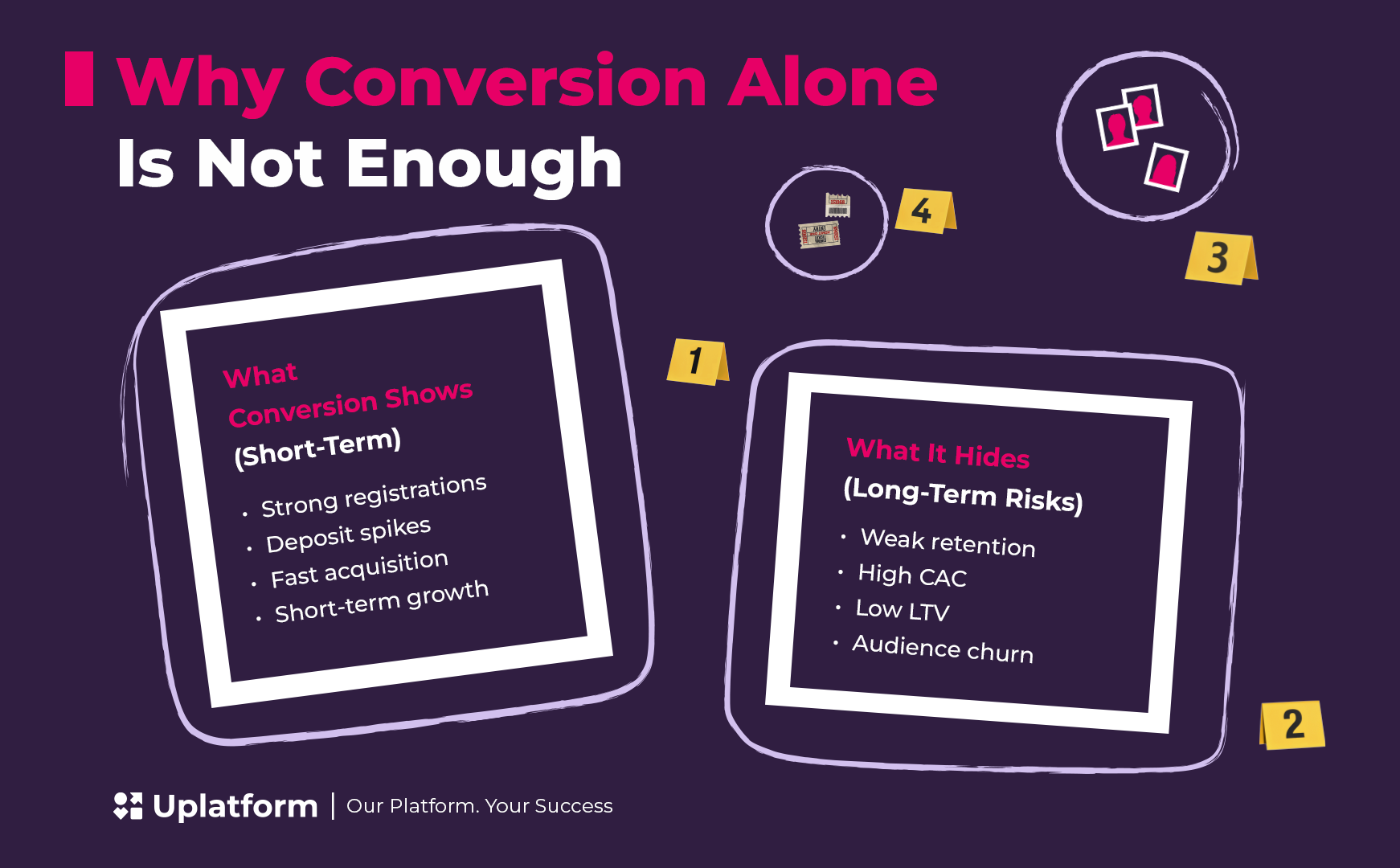
It’s possible for conversions to increase and profitability to decrease, especially in cases where player acquisition costs escalate faster than the player’s lifetime value.
The result is dashboards that show positive momentum while the underlying economics keep getting worse, giving a false sense of success.

“So on paper the traffic looks “high quality” thanks to the conversion rate, but in reality the LTV may not cover the CAC. On the surface it looks like growth, high conversion, nice charts, a success story. In the long run though, the operator is essentially buying losses. They are paying more than they earn. You can catch these issues through other metrics, especially behavioral ones. As a result, the operator may face the effect of lost potential revenue. Therefore, it becomes a strong reminder of the importance of predictive thinking: not everything that shines right now is actually what brings the greatest value. Sometimes the real potential lies deeper, and you have to dig a little to find it. That is often what brings the most value in the long run.”
This disconnect is one of the most common hidden risks in performance-driven growth models.
What actually defines sustainable growth
Sustainable growth in iGaming is not driven by a single metric. Instead, it emerges from the balance between product quality, market fit, user experience, and timing.
Operators often underestimate how important timing is, especially when scaling or optimizing based on incomplete data.
“This might not be the most popular opinion, and I will not dive deep into the technical side like AI and personalization, though they matter. But I believe it is essential to look at everything holistically. An operator might have a strong expert team, a well-built product, proper localization for specific markets, deep understanding of its players, and the ability to retain them. But even if all of that is in place, there is still one key factor: the ability to focus on what matters in a balanced way. Not jumping from side to side, but acting consciously and consistently. Another crucial factor is timing. It is strange to try extracting maximum value from metrics when a product is not ready. If a feature exists but there is no analytical foundation, or if the data sample is too small for objective conclusions, it is premature to push for results. And finally, everything comes down to clearly defined goals. Depending on whether you are targeting short-term or long-term results, both the metrics and the way you evaluate success will differ completely.”
When teams optimize too early or without enough data, they risk building strategies on unstable foundations.
Why retention and ARPU matter more than conversion
If conversion measures how players enter the system, retention and ARPU measure whether the system actually works.
They determine whether acquired players generate ongoing value or disappear after initial activity.
“No project or brand can survive relying only on incoming traffic, just as it cannot function without understanding the cost of each acquired player. Retention and ARPU are two key indicators that show how the product evolves, how stable it is, and they help guide future decisions. “It is important not just to track these numbers, but to connect them in a chain and build them into the strategy. You must understand why a player stays, what keeps them engaged, and then build on that foundation. All product metrics are interconnected. You can map out their influence on lifetime value, and from there, on the overall stability of the business. New user acquisition is important, of course, but without strong retention, it loses its meaning. True brand growth is not built on registrations, it is built on engagement, loyalty, and trust between the user and the product.”
Without this connection, conversion becomes a shallow indicator rather than a growth driver.
Where operators typically fail in retention?
Retention challenges are rarely caused by a single mistake. Instead, they usually result from misalignment across product design, segmentation, and player acquisition strategy.
Common issues include targeting the wrong audience, lack of personalization, and over-reliance on bonuses instead of experience-driven engagement. Dina explained:
“I would not generalize too much, because retention issues tend to be very individual. Sometimes the problem is incorrect segmentation, the chosen retention mechanics may not match the actual user cohort. Sometimes the issue is a lack of personal approach: even with a strong product, if the operator cannot work with users individually, they risk losing them. In other cases, new operators try to overload their product with features and bonuses. The idea is good, but it is easy to lose sight of fundamental things like proper analysis of the user journey. These basics get pushed aside in the pursuit of a “richer” product. Another common mistake is acquiring the wrong traffic. When a product attracts an audience that is not a good fit, retaining them becomes extremely difficult. This tends to affect newer operators more, while mature ones already understand what traffic works for which product. And of course, tools matter. If the product lacks the technical ability to quickly make changes or test hypotheses, it slows everything down and reduces retention efficiency. In this industry, speed is key. Overall, every situation is unique. A product is always a complex structure where every small gear matters. Missed opportunities usually stem from not seeing retention as a unified mechanism where product, communication, analytics, and the team are all interconnected.”
Retention, in this sense, is not a tactic. It is a system. Check out our latest ebook about Coversion vs. Long Term value and find out more.
Can churn be predicted before it happens?
Churn is rarely sudden. In most cases, it is the final stage of gradual behavioral decline.
Operators who monitor engagement patterns closely can identify early warning signs before players fully drop off.
These signals include reduced activity, lower deposit frequency, and changes in usage behavior over time.
“Today the event landscape changes daily. Any global or local event can affect audience behavior. Staying aware and able to interpret external influences is extremely important. It is also essential to maintain contact with users, not just by answering questions, but by analyzing their requests and understanding why they come at certain moments. You can often spot early churn signals there,” Dina explained. “Then there is continuous analysis, including predictive analysis: behavior patterns, dips in activity, changes in deposit frequency, session duration shifts. You observe, analyze, and try to implement preventive measures. And you need proper tools, a strong CRM system that allows quick detection, fast reaction, and effective retention mechanics. Having the right tool is crucial, it makes all the difference.”
Predictive analytics and CRM systems play a central role in this shift from reactive to preventive retention.
Moving from reactive metrics to strategic thinking
The shift from short-term optimization to long-term strategy is not about abandoning conversion metrics. It is about reinterpreting them.
Conversion becomes a diagnostic tool rather than a definition of success.
Operators need to understand what each metric actually represents in the broader system of growth./p<>
“Strategic thinking is not about dreams, it is about assessing your current state, resources, and capabilities realistically. You must know where you stand relative to competitors and clearly see both your strengths and, crucially, your weaknesses,” Dina explained. “There are many frameworks that help form vision and build steps toward both short-term and long-term goals. The key is being ready to rethink and rebuild your strategy when the market demands it. And the market may require that suddenly. Another important point: always understand why you are doing something and what value each decision is supposed to bring.”
Sustainable growth comes from connecting immediate performance signals with long-term business outcomes.
Building Loyalty in iGaming: Dina’s Practical Advice for Operators
One of the most common challenges for iGaming operators is not acquisition — but retention. Turning first-time players into loyal, engaged players requires more than campaigns or bonuses. It demands a deeper understanding of product, audience, and timing.
We asked Dina, Head of B2B Projects at Uplatform, what operators should focus on when struggling to build a loyal customer base. Here’s her perspective:
“I would start with the basics. First, check whether the product matches the market and current trends. Sometimes the issue is not marketing, the product simply does not resonate with the audience. Localization of both the product and related services can be crucial.We’ve prepared a detailed guide on this topic, which may be helpful: Real Localization, Real Insights. Second, evaluate the user experience honestly. Understand what challenges the player faces, what irritates them, where negative triggers appear, where they may get lost. It is vital to listen to players, stay flexible, and respond quickly to feedback. Third, segmentation. Every cohort requires its own approach. You cannot effectively work with the entire user base using a single template, someone will inevitably slip through. For this, a customer journey–focused approach works especially well — we covered it in our CJM guide. Fourth, a unique offer. Do not just know your player, understand what they want here and now, in this exact moment, what is interesting for them at this exact second. In today’s oversaturated market, players are more sophisticated than ever. That is why finding points of connection and offering something personal and relevant is critical. There are real examples where improving onboarding or adjusting local communication had a dramatic effect on retention. This dialogue with the players matters, people want to feel understood, and gaming is no exception.”
Dina explained.
Conclusion
Conversion will always remain an important metric in iGaming. It is fast, visible, and useful for measuring immediate response. But it is not a measure of success on its own. Real growth is defined after conversion in retention, engagement, and lifetime value. With Uplatform, operators can move beyond acquisition and systematically build long-term player value.
Or as Dina summarized:
“We, at Uplatform, work holistically and build relationships with clients as partners. It is important for us to understand exactly what the operator wants, what goals they set, and then provide the right solutions, tools, and opportunities. We know our markets well, we understand their nuances, and we act not just as a service provider, but as a full expert partner who is ready to share experience and help when needed. We are genuinely invested in our operators’ success. We constantly monitor industry trends, evolve ourselves, and give our clients access to the same opportunities so we can grow together. We localize extremely well. We can adapt our product to specific markets and to the operator’s needs, while maintaining high quality and speed, and constantly improving and optimizing. And of course, we provide strong, modern solutions, high-quality software and a strong product that we continuously develop and enhance with new approaches, mechanics, tools, and features. Constant growth, constant development. Both ours and our clients’.”
Other news
-
- Case 1: The Growth Investigation
09.06.2026
-
-
- Uplatform lands four EGR B2B nominations
05.05.2026

Case 1: The Growth Investigation
TL;DR
A spike in conversion can make an online gaming business look healthier than it really is. In this case, registrations and first-time deposits increased, but players did not return, ARPU and LTV stayed flat, and engagement failed to improve. Uplatform, an iGaming software provider, explains why operators should treat conversion as a clue, not proof of growth.
The KPI Misdirection
The dashboard was smiling as conversions rose and registrations kept moving. First-time deposits looked stronger than last month. The campaign report chart seemed flawless, with a clean, upward line that was easy to understand, easy to defend, and easy to celebrate.
So at first glance, it made sense to believe the case was almost closed. The campaign had gone live, and the audience was responding. The funnel looked active, and the numbers seemed to confirm that the strategy was working.
But every good investigator knows one thing: the obvious clue is rarely the whole truth.
So the question had to be asked.
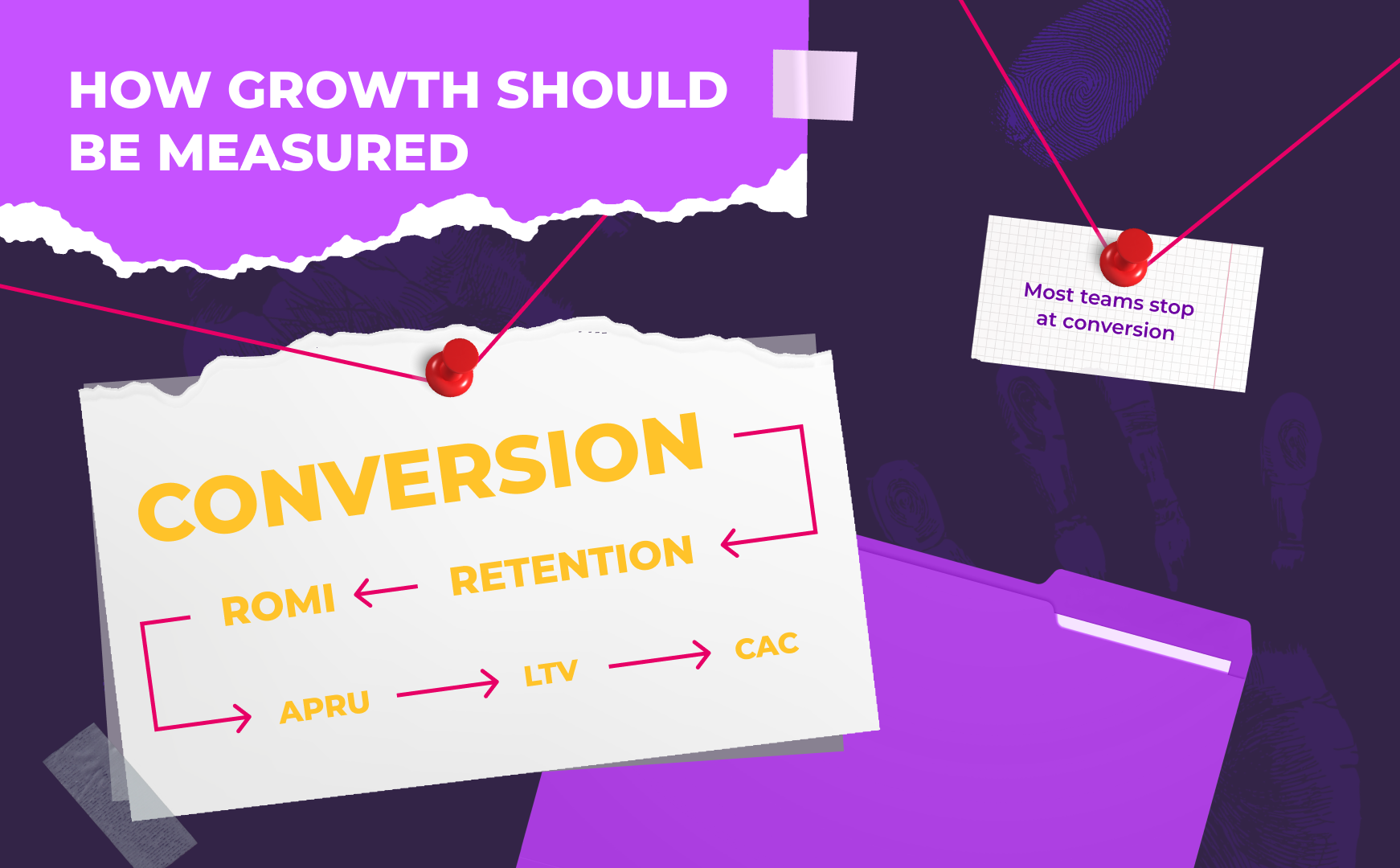
If conversion is rising, why does the business still feel unstable?
That was the first crack in the case.
Dina, Head of B2B Projects at Uplatform, puts it clearly:
“Conversion is the first and most noticeable signal that a given strategy is working. But it is crucial to remember: even though conversion appears to be the main sign of success, it is only an indicator of reaction.”
And that is where the misdirection begins.
KPI misdirection happens when a team gives the loudest metric the highest authority, even when that metric is only showing part of the business reality.
Conversion tells you that something worked now. It does not automatically tell you that the business is building long-term value.
Conversion is just a clue; it’s not the answer you are looking.
The Scene: A Healthy Dashboard With Something to Hide
One won’t really blame the operator for feeling confident. A new campaign had gone live, and traffic responded quickly. Registration-to-deposit conversion improved. The numbers seemed to prove that the strategy was working.
But that is not the full story. Something still did not sit right.
Players were converting, but not staying. Nothing had collapsed. Nothing looked obviously wrong. But the growth had started to feel harder to explain.
The numbers were saying one thing, but the business was beginning to feel like something else was happening underneath.
No one could call it failure, not yet. But the case was no longer clean.
So the detective’s question changed.
What if the dashboard is not lying, but it is leaving something out?
At this stage, no conclusion could be made, only suspicion.
So let’s examine the scene more closely.
The First Clue: Behavioral Indicators Start Weakening Behind the Scenes
The first clue was really not much of a big deal.
It did not appear as a dramatic collapse on the dashboard, nor did it look like an obvious warning sign. In fact, the headline numbers still looked strong enough to keep the room calm.
But behind the visible movement, smaller signals began to shift.
Some users completed the first action, then became quiet. Some cohorts looked less active after the initial response. Deposit patterns were not as steady as expected. Session activity started to feel uneven.
Nothing seemed broken, but something no longer looked fully convincing either.
Dina explains why this kind of moment can be easy to miss:
“Focusing too heavily on short-term metrics, like conversion, can hide less effective work in other areas. For example, user loyalty may drop, or continuous engagement may decline, but these problems stay behind the curtain and are not immediately visible.”
The dashboard was still telling a convincing story, but a few details refused to stay quiet. Nothing pointed to a clear answer, not yet. It was only the first hint that the case had another layer.
Are we attracting users who want the product, or users who only want the offer?
That should be the question on every operator’s mind.
The Second Clue: Retention, Cohort Quality, and Efficiency Metrics Contradict the Headline Result
The sustainability metrics began to disagree with the headline. Retention did not support the conversion story, ARPU did not justify the excitement, and LTV could no longer defend the cost. That changed the direction of the investigation.
The campaign still looked successful from one angle, but from another angle, the picture had become less convincing. A conversion increase can create excitement. But if the players behind that increase do not stay, do not engage, and do not generate enough value, the result becomes harder to trust.
Two campaigns can produce the same conversion rate but deliver completely different business outcomes. One may bring in users who return, deposit again, and grow in value. The other may attract users who convert once, claim the offer, and leave. Looking at the dashboard, both may look similar
Dina gives a direct example:
“An operator might have a strong registration to deposit conversion. But at the same time, their cost of acquiring a single user could be inflated, and the returns from that user may not be enough.”
The promotion had created movement, yet the story behind that movement was beginning to look less certain. Something was hidden inside the success signal, and the case was starting to feel bigger than the dashboard first suggested, which begs the question
What if the team is not scaling growth, but scaling inefficiency?
The real diagnosis: The product is generating reaction, not long-term value.
The mystery was not in the dashboard. It was in how the dashboard was being read.
The rising conversion, the weakening behavior, the uneven cohorts. The rising player acquisition costs pressure. None of them looked dangerous alone. But together, they pointed to one hidden problem: the team was not reading growth in motion. They were reading one metric in isolation.
This situation can be referred to as KPI misdirection.
KPI misdirection happens when the loudest metric is mistaken for the most important one. It leads teams to optimize for what looks successful on the dashboard, rather than what creates real business value.
A single metric can be true and still be incomplete. Conversion can rise while retention weakens. Registrations can increase while ARPU declines. Acquisition can scale while CAC increases. A growth push can look successful in the first week and still create pressure on profitability later.
In this case, conversion showed that players were responding, but it did not prove that the strategy was creating lasting business value. The numbers had moved. But movement alone was not proof of progress.

What Should Operators Do Next?
The right KPI stack helps operators separate visible growth from real growth.
Visible growth says:
- Conversion is up.
- Campaigns are working.
- Traffic looks strong.
- The funnel is moving.
Real growth asks:
- Are players staying?
- Is ARPU stable or rising?
- Does LTV cover CAC?
- Is ROMI healthy?
- Is this growth repeatable, profitable, and sustainable?
That is the difference between reading the headline and solving the case.
Dina, Head of B2B Projects at Uplatform, captures this clearly when discussing sustainable growth:
“True brand growth is not built on registrations, it is built on engagement, loyalty, and trust between the user and the product.”
Conversion should lead into retention. Retention and engagement should strengthen ARPU. ARPU should support LTV. LTV should justify CAC. And then ROMI can reveal whether growth is truly sustainable.
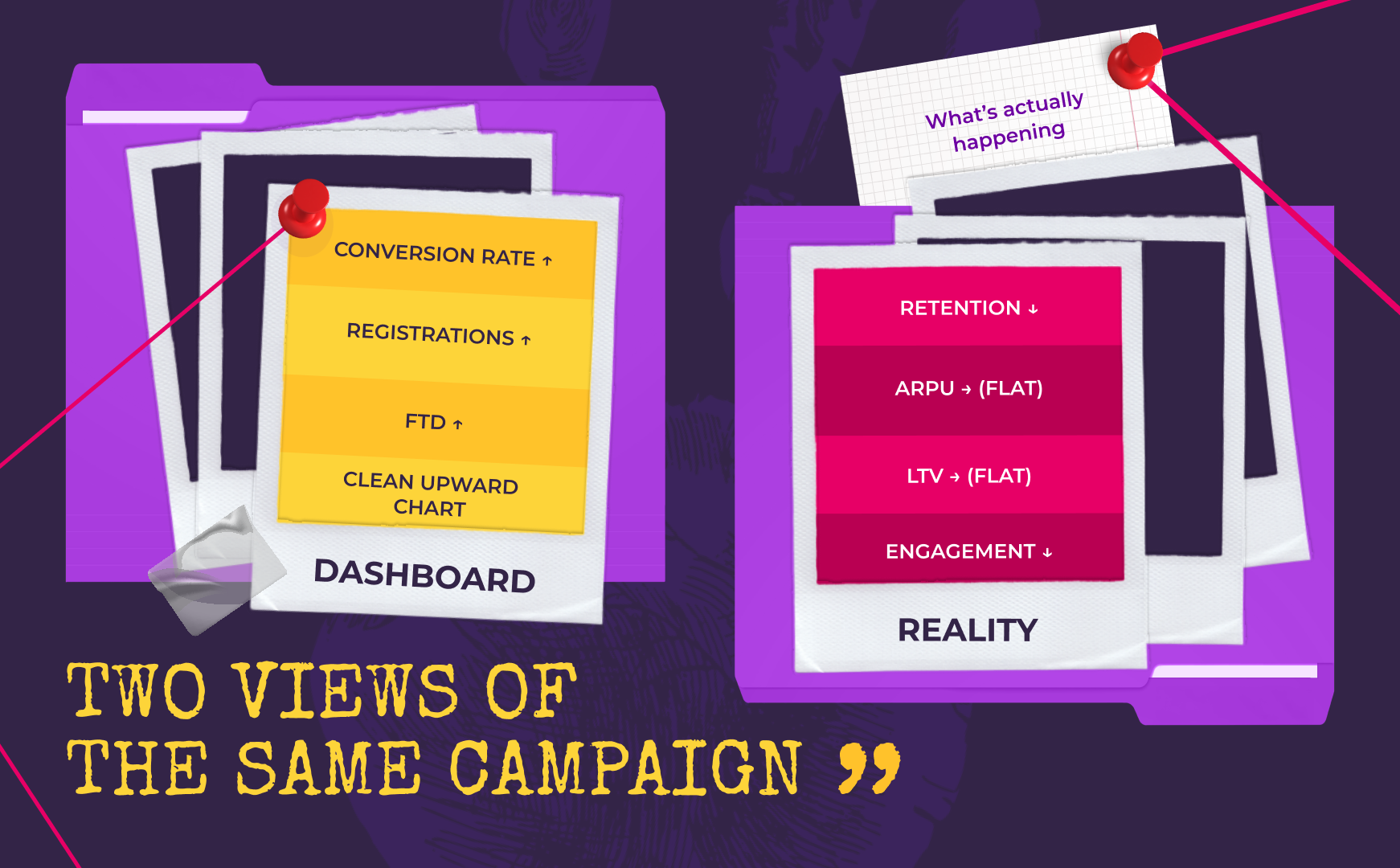
Only then does the picture become clear.
A healthier KPI hierarchy looks like this:
- Conversion shows immediate audience reaction.
- Retention shows whether players return and form habits.
- ARPU shows whether engagement produces value.
- LTV shows the long-term worth of the player.
- CAC shows the cost of acquiring that player.
- ROMI shows whether the whole campaign investment makes commercial sense.
A better review rhythm would look like this:
Daily, operators can monitor immediate reaction signals such as conversion, deposit activity, and session starts.
Weekly, they should review behavioural indicators such as early retention, session duration trends, ARPU movement, and changes in player activity.
Monthly, they should assess sustainability metrics such as D30 retention, LTV, CAC versus LTV, ROMI, and cohort performance.
This creates a living view of growth.
Not a snapshot or a celebration of one number but a full-on investigation.
Closing the Case
By the end of the investigation, the dashboard no longer looked as simple as it did at the start. Conversion was still rising, but now the team understood what it meant and what it did not mean.
The real takeaway is that when operators give the wrong metric too much authority, they end up optimizing the wrong outcome and that’s a straight way to loosing your business.
To learn more about KPI Misdirection, read Dina’s full interview and explore Uplatform’s ebook on “Conversion Is the Clue, Not the Answer: Read Between the Metrics.” It breaks down how operators can move beyond surface-level reporting and build a KPI stack that reveals whether growth is real, profitable, and sustainable.
So, before the next campaign is called successful, operators should review whether the KPI hierarchy matches business reality.
How Player Behavior Changes Casino Aggregator Selection
TL;DR:
Player behavior now directly shapes how operators evaluate a casino aggregator. Speed, content relevance, localization, and retention tools are no longer optional. This guide explains what players expect in 2026 and how those expectations translate into specific aggregator requirements that affect engagement, conversion, and long-term growth.
Throughout the years, player expectations and gambling patterns have changed by a lot. Just a couple of years ago people used to be more passive at choosing which website to use but in today’s world it has become an active comparison of everything the website has to offer. Now players move across projects, weigh up speed, content variety, and personalization, and they do it fast. If something feels subpar or irrelevant, then you have just lost a client.
That shift changes what it means to choose a casino aggregator. It’s no longer just a backend decision made by a dev team. It directly shapes how your casino performs, how long players stay, and whether they come back. At Uplatform, we see this play out every day and it’s why we’ve built our aggregator around real player behavior, not just provider counts and API specs.
Here’s what’s driving that change, and what it means for operators evaluating their options in 2026.
How is player behavior changing in online casinos?
Our world is much faster than before. The attention span is much shorter than before. Players are moving faster, expecting more, and it’s not about loyalty, it is about picking the best project. In the abundant world of iGaming only the best projects thrive, while there are thousands that you have never even heard about. Sessions are shorter but more frequent. Content cycles turn over quicker. And personalization, something players barely noticed five years ago, is now a necessity, not a nice-to-have.
If you want your project to be recognised, then you should focus on what the player expects. Which is instant loading, localized content, and relevant recommendations. They’re less loyal to brands and more responsive to experience quality. That puts real pressure on operators to deliver consistency across every touchpoint, every session, every device.
Why does player behavior affect casino aggregator choice?
Because the aggregator controls the experience. Content delivery, performance, availability, all of it flows through the aggregator layer. If it can’t match what players expect, operators feel it immediately: lower engagement, shorter sessions, higher churn rate.
Aggregators cannot be just a bridge between content and the player. It has to define how the casino experience performs under real users. That’s a big responsibility, and it’s one that’s easy to underestimate when you’re focused on provider counts and integration speed.
1. The Shift from Content Quantity to Content Relevance
“10,000+ games” used to be a headline feature. It’s not anymore. Players don’t scroll through thousands of titles, they want the right game to surface quickly. Discovery has become more important than volume.
Short session patterns amplify this. If a player opens your lobby and doesn’t find something worth clicking within a few seconds, they’ll close it.
What should operators evaluate?:
- Content performance analysis by region and player segment
- Game tagging, categorization, and catalog structure
- Data-backed recommendations on sorting and lobby configuration
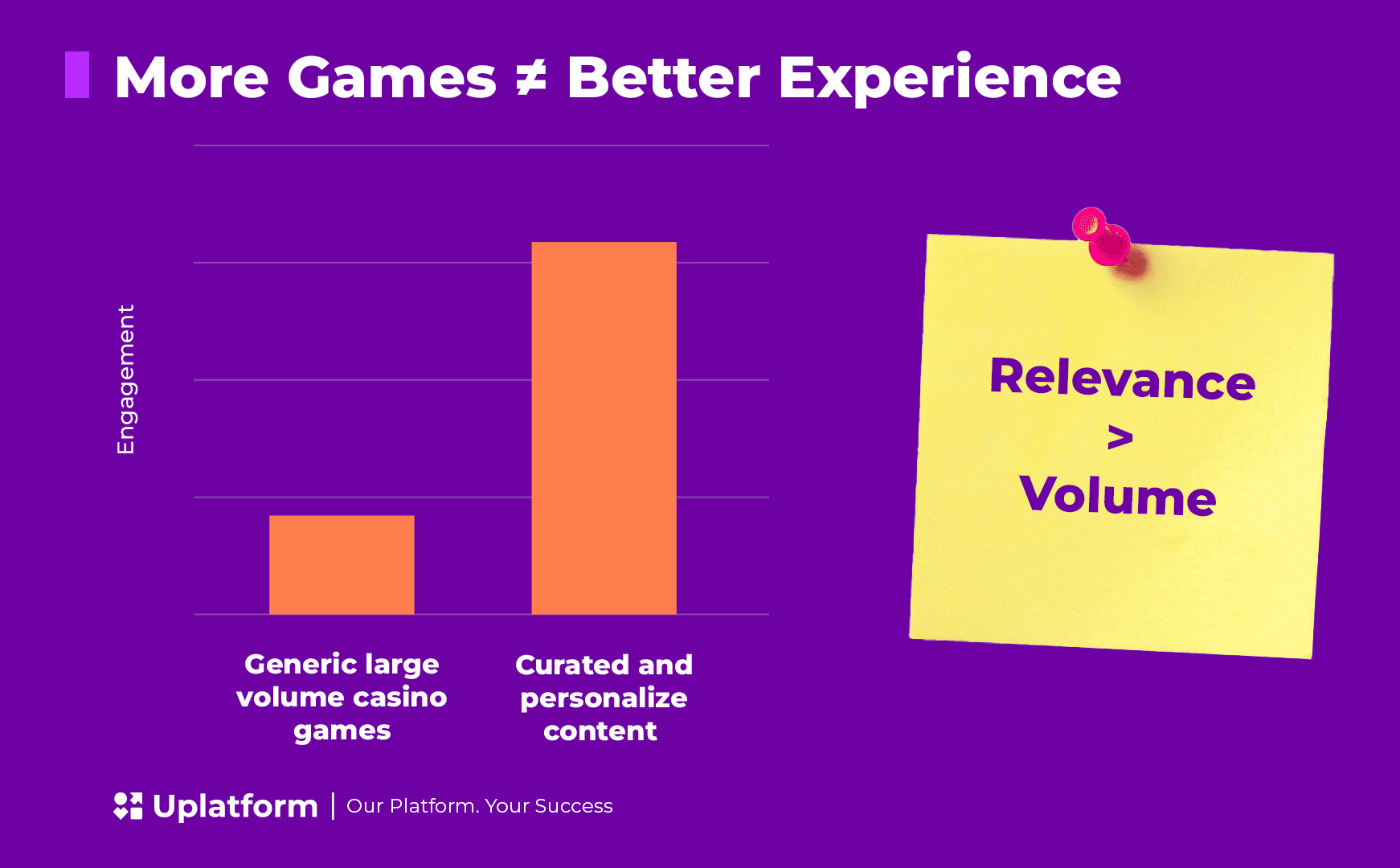
At Uplatform, our Game Recommendation Service does this in practice: we analyze player behavior across the platform and deliver concrete recommendations on sorting logic, content surfacing, and lobby configuration. The insight is data-driven. The decision stays with the operator.
2. Speed Is a Retention Factor, Not a Technical Detail
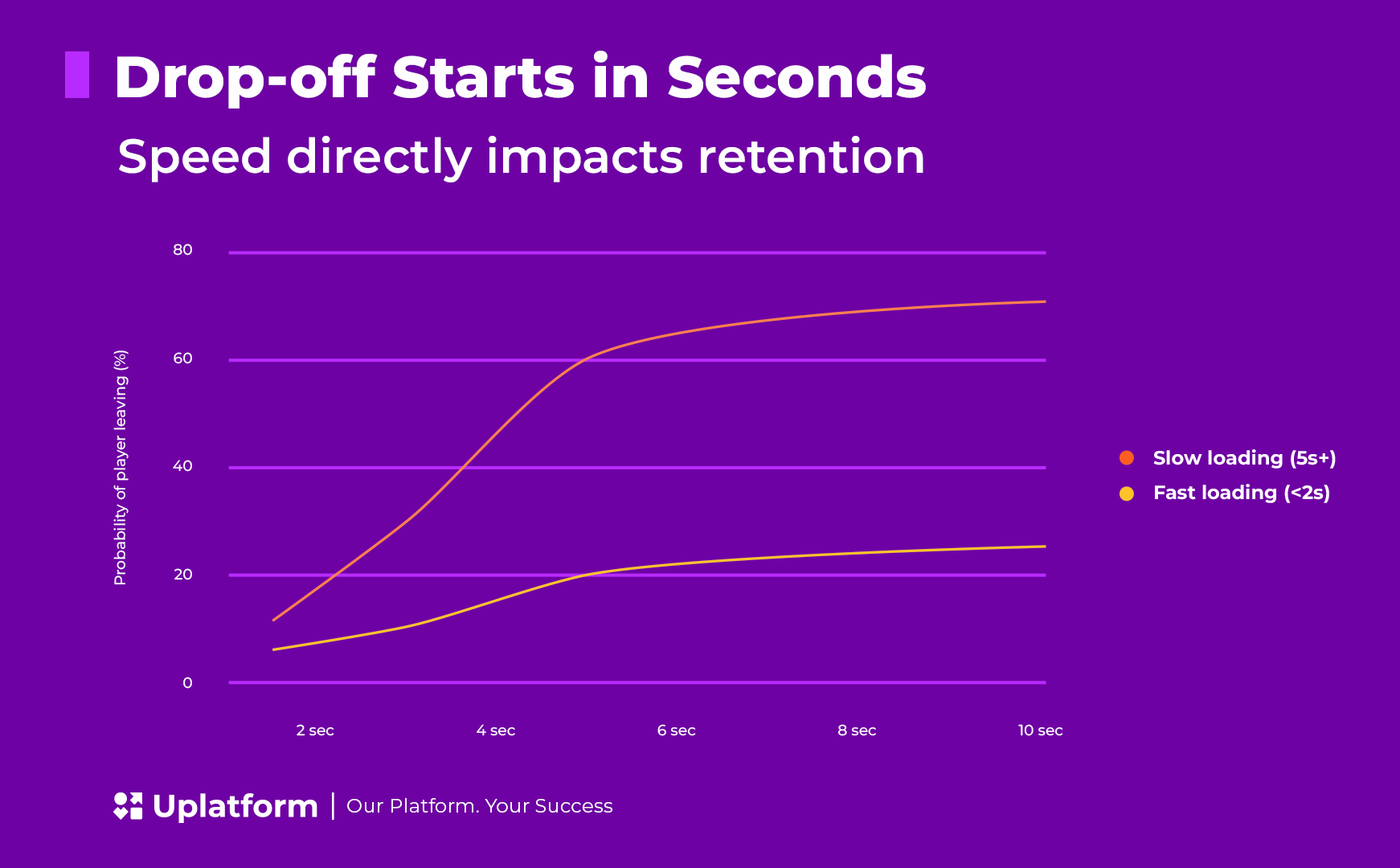
Players don’t give slow casinos a second chance. If a game takes too long to load, they’re already thinking about another website. This isn’t a niche concern, mobile-first usage dominates in most regions, and mobile players are especially unforgiving of lag.
The benchmark isn’t other online casinos. Every app player uses daily streaming services, e-commerce, social media. Those apps have trained players to expect instant response times. Your casino is competing with that standard whether you like it or not.
What to evaluate:
- Game launch speed across devices
- API response time under load
- Stability during traffic spikes
Aggregator performance directly affects session length and bounce rate. Uplatform’s aggregator is built for this, optimized delivery, stable uptime, and consistent performance across both peak and off-peak traffic. It’s not a bonus feature; it’s a baseline requirement.
3. Player Retention Depends on Content Flow
Players cycle through content faster than ever. A game that was trending last month might feel stale today. New releases and trending titles drive return visits, they give players a reason to come back. Static lobbies, on the other hand, signal to players that nothing’s changed and there’s no reason to check in.
This makes content refresh a retention strategy, not just a content management task.
What to evaluate:
- Frequency of new game releases via the aggregator
- Access to top-tier and up-and-coming providers
- Ability to surface trending or high-performing content dynamically
Through our Aggregator, operators get continuous content refresh from a broad provider network, with tools to highlight what’s trending and what’s performing. Aggregators should support continuous content refresh and prioritization, not just provide a static library.

4. Player Expectations Are Shaped by Other Industries
Your players aren’t just comparing you to other casinos. They’re comparing you to Netflix, Amazon, Instagram. Streaming websites set the standard for recommendations. E-commerce defines what personalization looks like. Social media shapes how engagement patterns work.
iGaming operators are competing in that broader context whether they acknowledge it or not. An aggregator that operates like it’s 2018, flat catalogs, no behavioral logic, generic sorting, creates friction against that backdrop.
What to evaluate:
- Personalization capabilities and data-driven content sorting
- Ability to integrate behavioral insights into lobby logic
- Modern UX patterns that match player expectations from other apps
These decisions ultimately sit with the operator. But the right aggregator gives you the backend infrastructure to make them well – behavioral signals, flexible lobby logic, and sorting capabilities that turn operator intent into player experience. Uplatform’s aggregator is built with that in mind.
5. The Risk of Choosing the Wrong Aggregator
This is where it gets concrete. A poor aggregator choice doesn’t just create technical headaches, it costs real revenue.
Poor performance means players abandon sessions within seconds. Limited content reduces your competitiveness with players who are comparing options. And weak personalization means players never feel like the website understands them, so they go somewhere that does.
The real-world impact:
- Lower session duration and engagement
- Reduced retention and repeat visits
- Increased acquisition costs as churn forces you to replace players constantly
These aren’t abstract risks. They’re outcomes operators deal with when their aggregator doesn’t keep pace with player expectations. The good news is that they’re avoidable, if you evaluate the right things upfront.
6. What a Modern Casino Aggregator Must Deliver
Use this as your evaluation checklist. A modern casino integration solution should cover all of these, not most of them.
- Single API integration that connects to a broad provider network without complexity
- High-performance delivery with fast game loading and stable uptime across traffic levels
- Broad provider network with frequent updates and access to top titles
- Cross-device consistency across mobile, tablet, and desktop
- Scalable architecture that grows with your operator ambitions without forced re-integrations
The Bottom Line
Player behavior is now the primary driver behind aggregator selection. It’s not a secondary consideration, it’s the framework through which every technical decision should be evaluated.
Operators that align their website with real user expectations improve retention, engagement, and scalability. Those that treat the aggregator as just a backend tool risk losing players at every stage of the journey, from first load to long-term loyalty.
At Uplatform, we’ve built our casino content aggregator around this reality. Fast delivery, smart content surfacing, deep localization, and a provider network that keeps refreshing, all through a single integration. Because that’s what your players expect, and it’s what your business needs to grow.
Other news
-
-
- Case 1: The Growth Investigation
09.06.2026
-
- Uplatform lands four EGR B2B nominations
05.05.2026
Content Localization in iGaming: What Operators Need to Know

TL;DR:
Operators who enter new markets with translated content and broad payment menus consistently miss revenue targets. The ones who outperform do two things differently: they build around the two or three payment methods that drive 80% of market deposits, and they deploy content that reflects genuine local operational knowledge. After the Google March 2026 update, that specificity is now a ranking variable. Uplatform’s localization and managing tools give operators the infrastructure to act on that specificity without rebuilding the website for each new market.
This article is for iGaming operators and product directors managing launches or active operations in LatAm or African markets, specifically those who have encountered FTD (first time deposit) conversion gaps they cannot explain through standard funnel analysis.
What is content localization in iGaming?
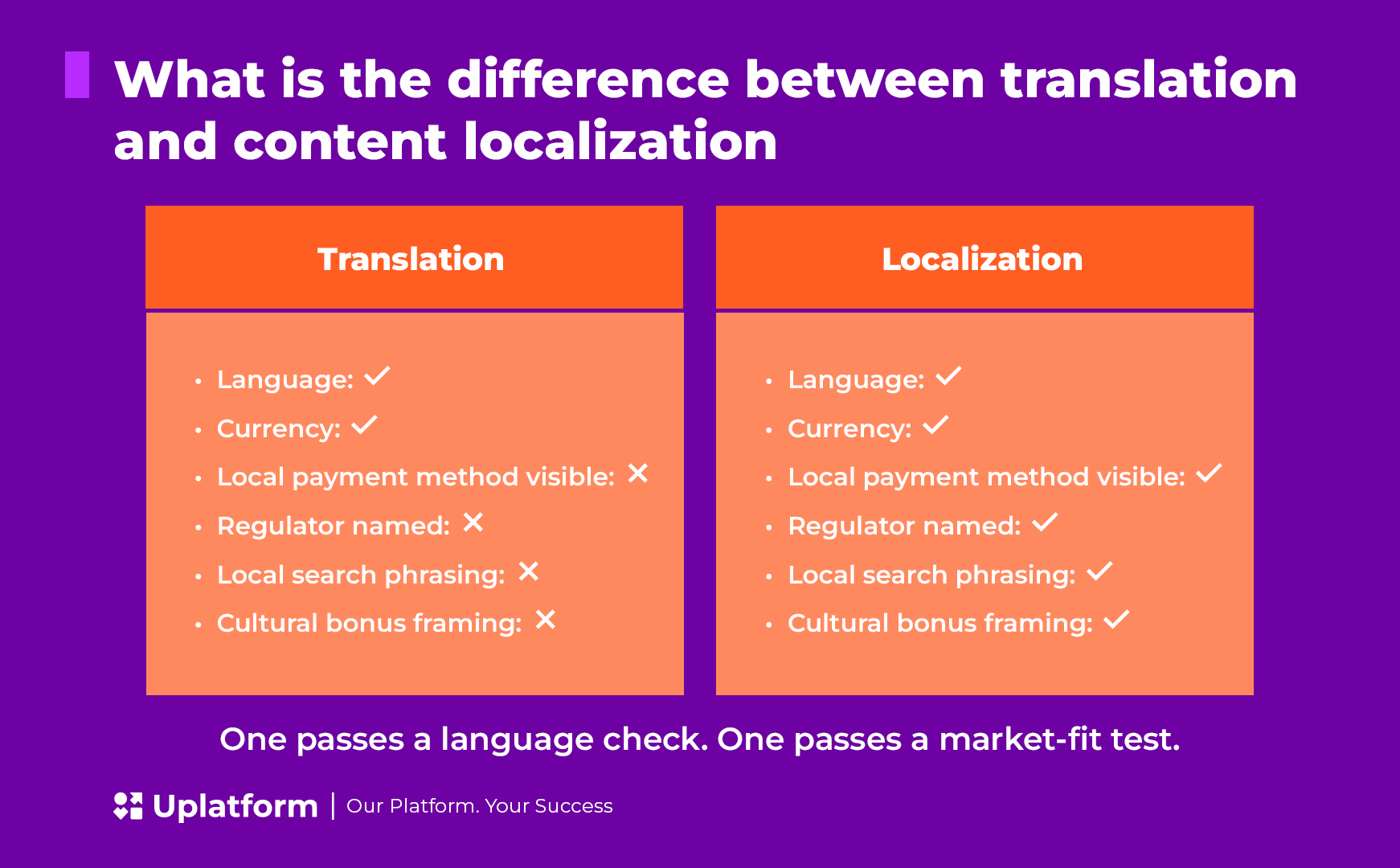
Content localization in iGaming adapts digital materials, payment pages, promotions, help content, SEO copy, to the regulatory, cultural, and behavioural expectations of a specific market. Operators who limit localization to translation produce content that passes a language check but fails a market-fit test. The distinction is not semantic. It shows up directly in deposit completion rates and first-month churn.
Why operators consistently fail at market entry, and what localization actually has to do with it
Most operators who underperform in new markets attribute the failure to the wrong cause. They point to licensing delays, marketing budget, or product fit. In the majority of cases, the actual failure point is content and payment localization, and specifically, the decision to treat both as secondary priorities that can be resolved after launch.
That sequencing error is expensive and consistent. Operators launching in LatAm with market-specific content consistently outperform those using adapted European content, particularly at the FTD (first time deposit) stage. The gap is not driven by brand or ad spend. It is driven by alignment. Whether the player, at every step of the registration funnel, encounters flows that match how they actually use financial services in that market.
Operators who treat localization as translation consistently underperform in new markets. Localization is one of the few variables that can improve both conversion and retention simultaneously. Most growth levers trade one against the other.
What operators get wrong about payment localization
Adding more payment options does not improve conversion. Identifying the two or three methods that drive 80% of market deposits and making them frictionless does. This is the payment Pareto reality that most operators only discover after launch, and it is the single most correctable mistake in a market entry strategy.
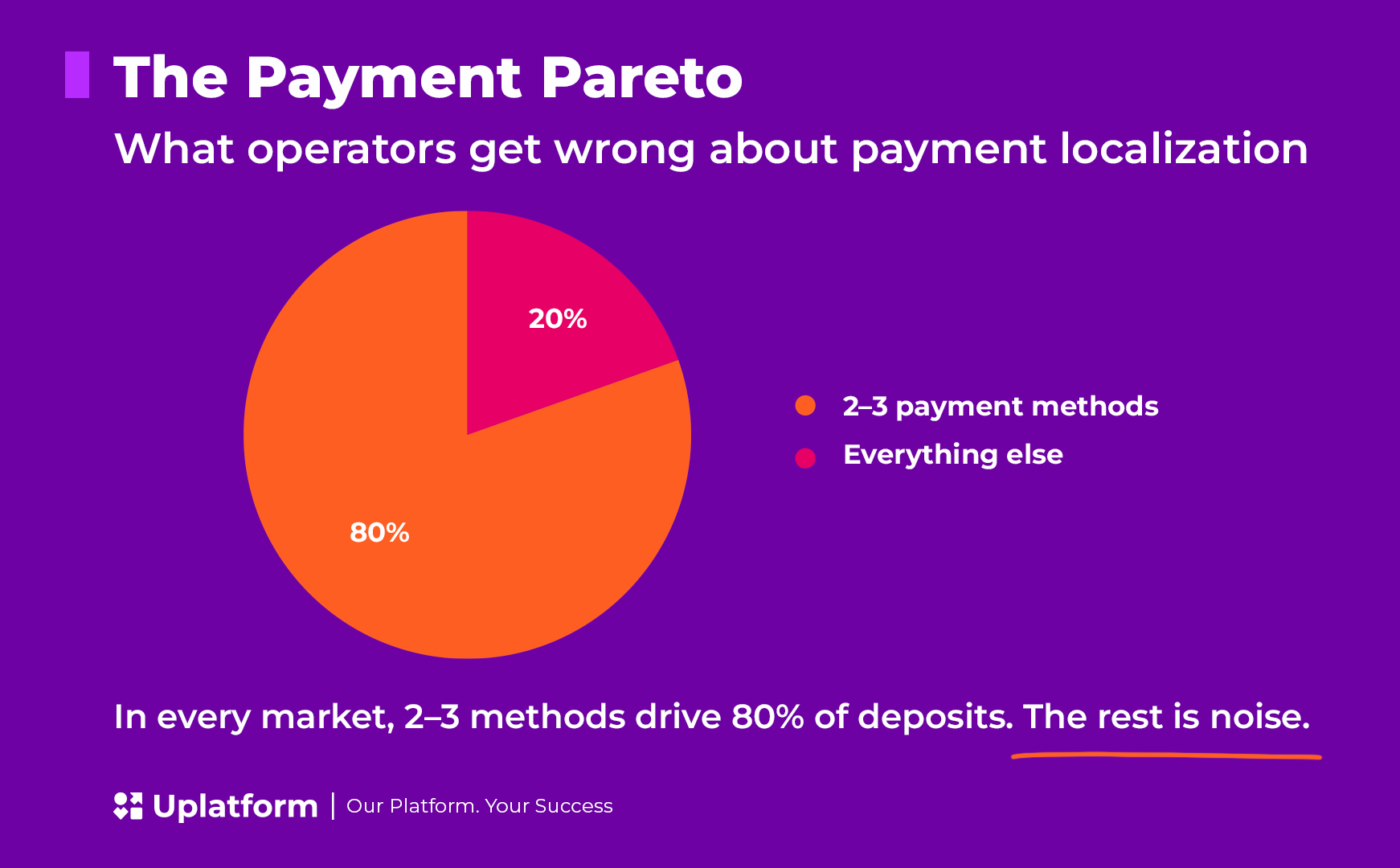
In Brazil, PIX is not a preferred payment method. It is the deposit infrastructure. Operators who configure PIX as the default path, immediately visible, zero additional steps, report deposit completion rates well above those who list PIX as one item in a ten-option payment menu. The extra options do not add choice. They add friction at the moment when a player is most likely to abandon.
In Kenya, M-Pesa holds an equivalent position. It processes the majority of mobile financial transactions in the country. An operator who treats M-Pesa as one of several mobile wallet options is reading market data about a different country. The correct approach is to build the payment experience around the dominant method and treat everything else as secondary.
The SEO implication follows directly. A player searching for online casino deposits in Brazil who lands on a page that makes PIX visually prominent converts at a higher rate than a player who has to scroll to find it. Payment visibility is a player trust signal and a conversion variable at the same time.
What the Google March 2026 update actually changed for localized iGaming contentRather than rewarding localization, the update focused on penalizing its absence, which is a different problem with a different solution.
Before March 2026, a well-structured page with correct geo-targeting signals, hreflang tags, regional subdomains, localised keyword placement, could rank adequately in a target market regardless of content depth. That approach stopped working. The update increased the weight given to market-specific entity references: named regulators, named local payment providers, specific regulatory frameworks. Pages that contain those references rank; pages that contain generic localized language do not.
In Colombia, a page that names Coljuegos, explains what a Coljuegos licence requires from an operator, and references the payment methods Colombian players actually use will outrank a technically superior page that mentions none of those specifics. In the UK, a page for a UKGC-licensed operator that treats regulatory compliance language as a formality, correct but thin, performs worse than a page that explains the UKGC’s requirements in a way that demonstrates genuine familiarity with the framework.
The practical result: operators who built multi-market SEO on translation plus technical optimisation saw measurable ranking losses in Q1 2026. Recovering those rankings requires genuine local knowledge, not better keyword placement. The March 2026 update effectively made local team capability an SEO variable.

Why a local team is not optional, it is a failure point
Most operators overbuild the website and understaff the market. This is the most consistent pattern in iGaming international expansion, and it is the one that causes the most damage because it is invisible until the data arrives.
A central team can launch a localised page with translation tools and a payments API but it cannot replace local presence. First, it cannot catch regulatory changes before they become compliance events, Coljuegos, the BCLB in Kenya, and Brazil’s Secretaria de Prêmios e Apostas all issue operational guidance that does not reach international trade press for weeks. Second, it cannot identify the cultural conventions that affect player trust in ways that do not translate from other markets, bonuses are different from one region to another and might confuse players, unless they are somewhat familiar with the mechanism, and the difference is not visible in keyword data. Third, it cannot generate the operational specificity, actual player behaviour, actual support patterns, actual payment failure points, that makes localized content accurate rather than plausible.
Operators who enter markets without local representation underestimate this dependency until it appears in churn data. By that point, the cost of correcting it is substantially higher than building it in from the start. Local team is not an operational luxury. It is a prerequisite for the content quality the post-March 2026 environment requires.
Why AI-generated content fails specifically in localized iGaming markets
The failure stems from operational gaps rather than grammatical errors.
AI tools produce content that is accurate about what is generally known and wrong, or silent, about what is specifically true in a given market at a given point in time. That gap between general accuracy and operational specificity is exactly where regional iGaming rankings are decided after the March 2026 update.
A page about online gambling licensing in Brazil generated from public sources will correctly describe the existence of a regulatory framework. It will not reflect that the Secretaria de Prêmios e Apostas issued updated guidance on bonus promotion language in late 2025, or that a specific payment processor integration created compliance friction that operators had to resolve before launch. That kind of operational detail, the kind that comes from running a business in the market, is what the current ranking environment rewards and what AI tools cannot produce.
The result is a content quality ceiling. AI-generated localized content can be grammatically correct, structurally sound, and keyword-complete. It will still underperform against content produced with genuine local operational input, because it lacks the entity specificity that both ranking algorithms and players now use to assess whether an operator actually knows the market.
The correct use of AI in a localization workflow is structural: outline generation, FAQ skeletons from keyword research data, sentence-level editing, entity gap identification in existing drafts. The claims that carry E-E-A-T weight, regulator-specific language, payment behaviour specifics, market-condition accuracy, require a human who is actually operating in the market.
What a localization workflow that produces results actually looks like
Four roles are required, and none of them is optional. A market specialist provides current regulatory and cultural input. A native-language writer produces the draft from that input, not from translated material. An SEO manager checks entity coverage, keyword distribution, and structural compliance. A legal or compliance reviewer confirms regulatory disclosures are accurate and formatted to the current requirements of the target jurisdiction.
The refresh cycle matters as much as the production process. Regulatory frameworks in active growth markets change at a pace that makes 18-month-old content a compliance risk. Brazil, Colombia, and Kenya have all issued significant regulatory updates in the past 24 months. Every localized page needs a six-month audit trigger and an immediate review protocol for any regulatory event in its target market. An article that was accurate in 2024 may create liability in 2026 if the licensing requirements it describes have since changed.
Uplatform’s solutions are built to run multiple regions at the same time, with each one configured independently inside the same website. Payment methods, bonus logic, and page content can be updated for one market without affecting any other. For operators managing several active markets, this removes one of the main risks in localisation at scale. Changes stay contained. Updating content, payments, or promotions in one region does not create unintended issues elsewhere. In practice, that means teams can move faster without adding layers of checks or duplicating setups for every market.
The broader lesson from operators who have built this well: localization is an ongoing operational function, not a launch task. The operators who treat it as something to solve once, then manage, are the ones who lose rankings when regulators update requirements and lose conversions when payment behaviour shifts.
Other news
-
-
- Case 1: The Growth Investigation
09.06.2026
-
- Uplatform lands four EGR B2B nominations
05.05.2026
Uplatform lands four EGR B2B nominations
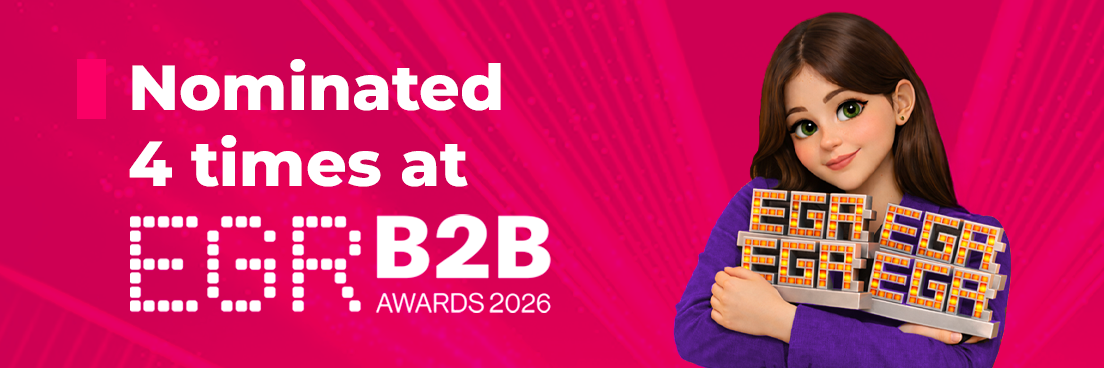
EGR B2B is one of the most prestigious awards in the iGaming space. It has been for years. And our presence on the shortlist is not new — this year, we’re there four times.
The first two nominations, Sports Betting Supplier and Sportsbook Platform Supplier, speak to our strongest product: the sportsbook. Developed fully in-house, with dedicated bookmakers monitoring matches and setting up markets, with the widest coverage and localisation. It is the pinnacle of what we do. Even under the largest events with massive traffic, our sportsbook holds its ground and delivers the best player experience today’s iGaming space can offer. Being nominated only supports what we’ve always said, and is a testament to the work that went into building it.
Alongside the sportsbook nominations, we’re also recognised as an Esports Betting Supplier. Esports is a completely different beast: matches are faster, players are more demanding, events are shorter and results less predictable. Everything has to be accounted for. We built our Esports solution with the player in mind from the start. What would they actually want to use? Is it visually appealing? Do the odds work? How easy is it to navigate? All the important questions were answered before we wrote a single line of code. Many iterations later, we have a standalone product we’re genuinely proud of. It was always about building the best possible product for operators and the players behind them.

Last, and in no way least, is Full Service Platform of the Year — the most validating nomination of the four. This one isn’t about a single solution. It’s about the full package. How does everything work together once you go live? Does the sportsbook talk to the casino? Do payments, back office, CRM and customer support all operate as intended? Because if one part falls short, the entire player experience suffers. We made sure it works like clockwork. And localisation wasn’t an afterthought either — we didn’t just translate the platform, we went all the way: different languages, currencies, sportsbook views, casino games and payment methods, so operators can scale into new markets without a long rework. And if anything comes up during operation, our 24/7 two-line support is on standby, for operators and their players alike.
Individually, each nomination reflects a team that took its part of the product seriously. Together, they reflect something harder to manufacture: consistency across the whole thing. Different areas, same standard. The results will be announced later this year, and we’ll be there.
Uplatform is heading to Nairobi
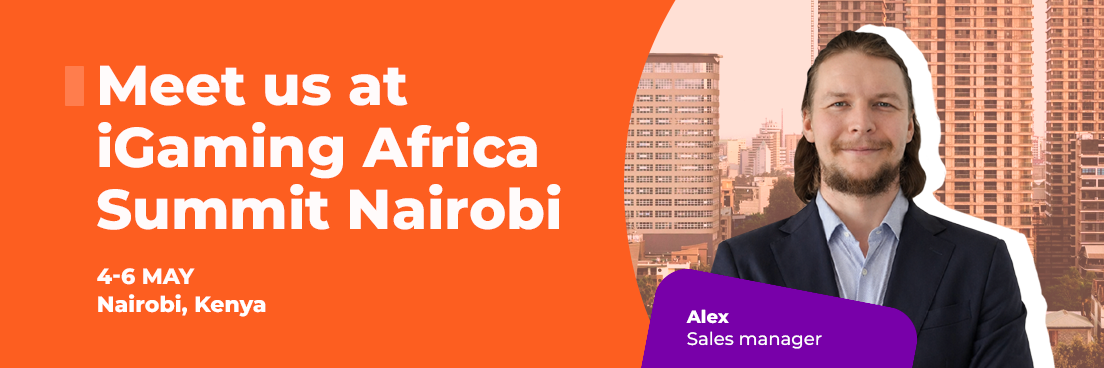
Nairobi, May 4–6. We’ll be there.
Uplatform is attending iGaming Africa Summit 2026, and we’re bringing Alex, from our Sales team, to connect with operators, catch up with existing partners, and talk about one of the most exciting emerging markets in iGaming right now.
Africa has been building momentum for the better part of a decade. The growth is real, it’s fast, and it’s drawing serious attention from operators who understand what it means to get into a market early. New operators are entering, new markets are opening up, and the conversations happening across the continent right now are the kind that shape the next few years. Nairobi feels like exactly the right place to be part of that.
“I’m really looking forward to this one. Africa is moving fast and there’s so much happening — new operators, new opportunities, markets that are just starting to open up. Whether it’s catching up with people we already know or meeting someone completely new, these are the trips that remind you why this industry is so exciting right now.”
— Aleksey, Sales

Uplatform has been building for markets like this for a long time. Localization isn’t a feature we bolt on, it’s central to how our platform is structured. For African operators specifically, that means local language support including Kiswahili, Amharic, and Lingala; 550+ payment methods including local and mobile money options; SMS and Telegram betting for markets where internet access isn’t universal; omni-channel infrastructure for operators bridging retail and online; and African league and championship coverage down to amateur level.
If you’re looking for a partner who already understands the complexity of operating in these markets, not one who’s figuring it out alongside you, that’s the conversation we’re here to have.
Explore our Africa offering
Alex will have time to meet properly, no rushing between sessions, no five-minute hallway conversations. If you’re an existing partner, come say hello. If we haven’t spoken yet, this is a great time to change that.
Spots fill up fast. Reach out soon to get something in the calendar.
See you in Nairobi.
UX & UI in Sports Betting – Is the Interface Holding Players Back?

TL;DR
UX UI in sports betting directly affects conversion, retention, and player behavior. Cluttered interfaces, slow performance, and poor mobile design lead to lost bets and early exits. Operators that focus on speed, clarity, and localized user experience create smoother journeys, increase engagement, and improve long-term player value.
Why is UX & UI important?
Imagine your player logs in right before a live match, prepared to place a bet. Instead of instantly placing a bet, they struggle and move slowly. Navigation is not intuitive, elements are hard to locate, and the flow breaks. By the time they figure it out, the moment has passed and the bet is not placed. Moments like this explain how players decide to stay on your site or disappear, and it all comes down to your UX, UI, and your interface.
What Really is UX and UI?
Lots of people talk about “UX” and “UI,” but for most, it is easy to gloss over what those terms actually mean and how much they shape the day-to-day side of their business. In simple terms, UX (user experience) is how easy and enjoyable your site feels to use, while UI (user interface) is how it looks and functions on screen.
The user interface (UI) covers everything you see and touch, from buttons to colors, symbols, and menus. The user experience (UX) is what you feel every time you try to use those things. The interface is the bridge between wanting something and actually getting it. When these parts work together, your betting site feels polished and easy to navigate.

Think of it like checking into a good hotel. The lobby (UI) welcomes you, the staff and layout (UX) keep it friendly, and the doors and hallways (interface) help you get to your room. If any step annoys you, whether it is confusing sign ups, slow service, or a room you can not find, it messes up the whole stay. Betting should be just as easy.
Where Players Get Stuck
Before a player ever places a bet, they face their first real test of your UX: the registration form. And it is where many operators quietly lose the players they worked hard to attract.
Overly long forms, unclear error messages, and no sense of progress are the most common culprits. Ask for too much upfront and players feel interrogated rather than welcomed. A phone number field with no format guidance, a password rule revealed only after submission, or a five-step form with no progress indicator — each of these sends the same message: this is going to be complicated.
The fix is not radical. It starts with asking only for what is essential at sign-up and leaving the rest for later. Real-time field validation that explains errors as they happen, rather than after the fact, removes the guesswork entirely. Social login options, via Google or Facebook, reduce the perceived effort even further, letting players get started in seconds.
As Dina, Head of B2B Projects at Uplatform, puts it:
“Onboarding effectiveness always lies at the intersection of content and interface. Ensure consistency across all devices and make every action as seamless as possible.”
A visual progress bar across multi-step flows keeps players motivated rather than anxious about how many screens remain. And showing value early — a welcome bonus, a highlighted feature, a piece of social proof — reminds the player why they signed up in the first place.
At Uplatform, registration flows are built and tested with real users, not assumptions. We track where drop-offs happen, identify the exact field or step causing hesitation, and refine until the path from visitor to active player is as short and friction-free as possible.
Other biggest turn-offs for players are cluttered designs and slow response times. It is hard to get excited about a wager when you are fighting through too many screens or the site freezes mid-bet. You tap “Place Bet,” and instead of instant confirmation, the website keeps on loading indefinitely. That tiny delay is all it takes for excitement to turn into doubt.
According to industry insights from PayNearMe, over half of online gaming players admit to abandoning a bet due to these headaches. That’s a lot of missed action, but it also shows how much better things can get when the friction is gone.
What Players Really Want
Ask players what matters most, and you will hear the same things:
- Clean design and fewer clicks.
- Speed that keeps up with their instincts.
- Personal touches like remembering favorites or suggesting timely bets.
- Localization – language, odds format, and sports that feel familiar.
Players do not see these as nice-to-haves anymore; they expect them by default. The easier and more intuitive a betting site feels, the longer players stay. For more on key sportsbook features and regional customization, check out Uplatform’s insights on must-have features for a successful betting experience.
Fixing the Friction
Here is the secret! Make everything feel easy. When logins are smooth, menus are simple, bet slips are clear, and results update instantly, betting stops feeling like a task and starts to feel natural.
That kind of experience does not happen by guessing. The best iGaming providers test, tweak, and test again. They use real users to try out every new feature, and quick prototypes help catch what feels off before launch.
That is exactly how we work at Uplatform. We watch how your players move through your site, where they pause, and how they react. Fresh feedback shows us what to fix and what to keep. And even after launch, we stay close, making sure your site keeps getting better with every update.
The result is an interface built around speed, clarity, and local fit. Every detail, from mobile menus to language options and payment methods, is refined to meet your players’ needs.
Designing for Modern Bettors
Modern bettors expect more because they get more from everything else they use online. They want mobile betting UX that fits any screen, bigger buttons, instant support, and features that feel personal, not generic. You can learn more about how to meet these needs in Uplatform’s article on mobile-first design.
Details like bright or dark mode, adjustable text, and responsive design show players that you’re thinking about their comfort.
And it’s not just about players. You also have to juggle local rules, age checks, privacy laws, and strict ad regulations. To strike a balance, operators must aim for peak player satisfaction while meeting their region’s iGaming regulations, such as those set by the Malta Gaming Authority and the UK Gambling Commission.

Where to Start
If you’re wondering how to begin, keep it simple:
- Run strict usability tests with real users, not just your tech team.
- Strip down menus to what’s essential.
- Build with mobile betting UX in mind.
- Use analytics to spot where players drop off or hesitate.
Each step you simplify brings players one thought closer to “done.”
The Real Edge
At the end of the day, nobody complains when placing a bet feels too simple. Stress-free experiences keep players coming back, replaying the fun, and telling friends about it.
Sometimes the edge isn’t in better odds. It’s in having a button that just works and makes everything easier.
How to Enter and Operate in Mexico’s iGaming Market: A Practical Guide for Operators
TL;DR
Mexico is one of Latin America’s most commercially significant online gambling markets. It offers scale, strong sports betting culture, and growing digital engagement. However, it is competitive and structurally complex. Operators must approach it as a long-term strategic market, focusing on local incorporation, payment depth, mobile optimization, and retention-led growth rather than bonus-driven acquisition.
Mexico on the Latin American iGaming Map
Mexico consistently ranks among the most significant betting and gambling markets in Latin America by revenue and player volume. Unlike Brazil, which is transitioning toward full regulatory clarity, or Colombia, which implemented a modern licensing system early, Mexico operates under a long-standing federal law structure that predates iGaming.
That sounds like a weakness. It is not necessarily one.
It means the market has evolved organically. Large land-based operators extended online. International brands partnered with existing license holders. Over time, a functioning digital betting region formed.
Today, Mexico represents:
- One of the largest Spanish-speaking betting audiences globally
- A deeply sports-oriented population
- A mobile-dominant user base
- A hybrid payment economy combining digital and cash
It is a structural opportunity with real competition.
Operator Regulation in Mexico
Online betting and gambling in Mexico operates under the Regulation to the Federal Gaming and Raffle Law of 2004, which amended the original 1947 Federal Gaming and Raffles Law. While the 1947 framework was designed primarily for raffles, games, and sporting activities, the 2004 regulation broadened the interpretation of permitted activities to include online gambling, bingo, and related formats under the legal definition of “raffles.” This regulatory evolution forms the basis for today’s online betting and gambling operations in the country.
A critical structural requirement is that any entity seeking to become a licensed operator in Mexico must be incorporated locally. Foreign companies cannot simply extend an offshore license into the market. Instead, participation requires the establishment of a Mexican legal entity and alignment with the existing regulatory framework. In practice, operators typically work in coordination with authorized permit holders, making proper due diligence and contractual clarity essential from the outset.
Many of the largest licensed operators in the country are members of the Asociación de Permisionarios de Juegos y Sorteos, an industry group that represents operator interests and participates in dialogue around regulatory and operational matters. While membership is not mandatory, it reflects the structured nature of the market and the presence of established stakeholders.
For operators evaluating entry, the main takeaway is practical rather than theoretical. Mexico is not a jurisdiction where a remote license model can simply be exported. It requires deliberate legal structuring, local incorporation, and early engagement with qualified advisors. Proper setup before launch significantly reduces operational friction and long-term risk.
Step 1: Structuring Your Market Entry
Entering Mexico typically involves three layers:
1. Legal Incorporation
You must establish a Mexican legal entity. This impacts:
- Corporate structure
- Tax exposure
- Banking relationships
- Payment integrations
Local incorporation is not optional.
2. Permit Alignment
Operators usually work through authorized permit holders. This requires:
- Due diligence on permit scope
- Clear contractual terms
- Defined operational responsibilities
- Transparent revenue arrangements
This stage determines your long-term operational stability.
3. Banking and Mexico iGaiming Payments Setup
Before marketing begins, you must secure reliable local payment processing. Without it, conversion collapses.
Mexico is unforgiving when payments fail.
Step 2: Building a Payment Strategy That Converts
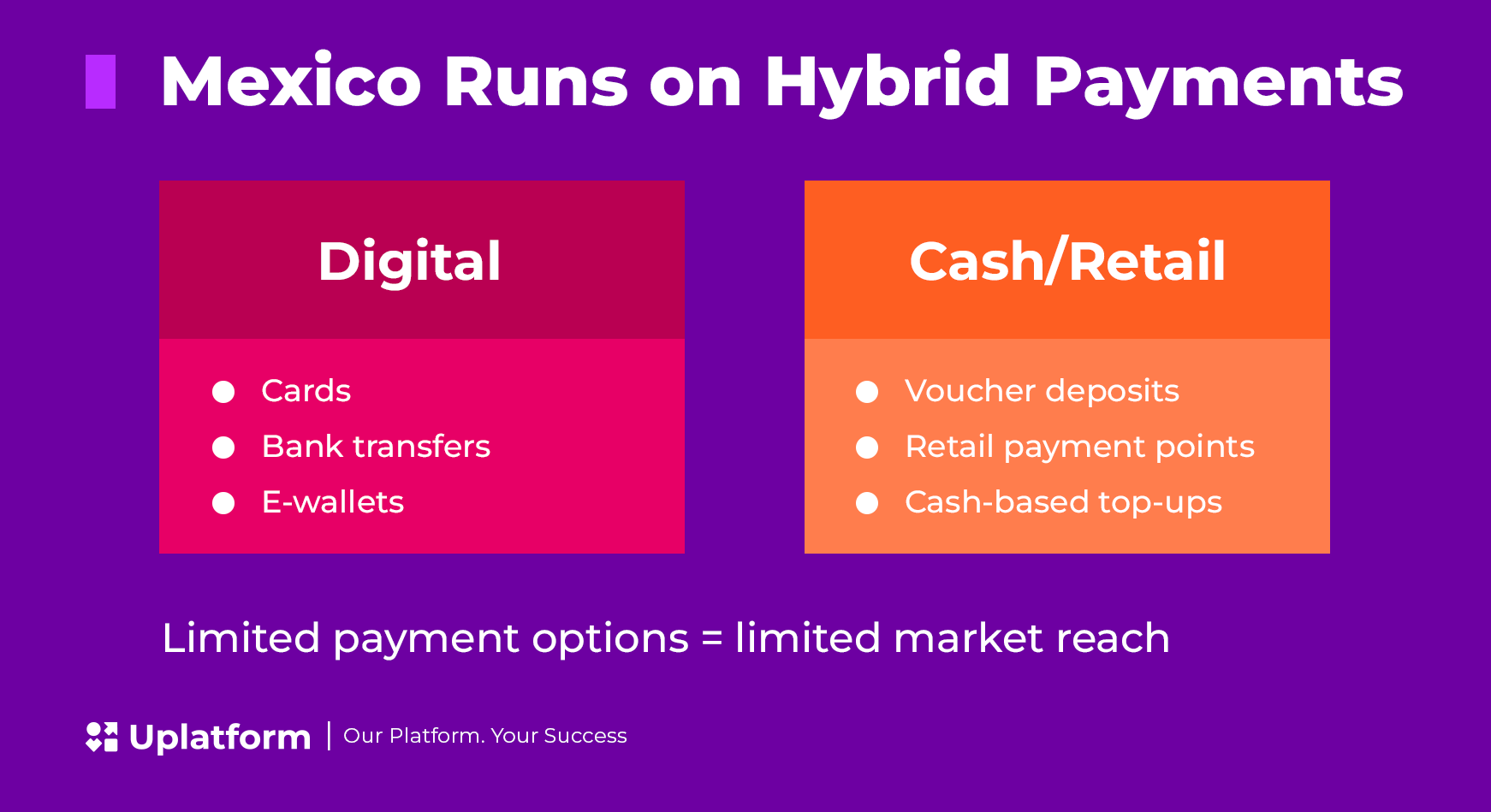
Mexico iGaiming Payments are arguably the most underestimated operational factor. Many operators focus heavily on acquisition, bonus mechanics, or product mix, but in practice, payment infrastructure often determines whether a player converts, stays, or leaves permanently.
Mexico operates within a hybrid financial model. Card penetration and digital banking adoption continue to expand, particularly in urban areas, yet cash-linked retail systems remain deeply embedded in everyday consumer behavior. For many players, especially outside major metropolitan centers, depositing funds through familiar retail channels feels more secure than purely digital transfers.
This dual structure means operators cannot rely on a single payment channel. A limited payment offering does not just reduce convenience. It reduces market reach.
Mexican players generally expect:
- Immediate deposit confirmation, without extended processing delays
- Familiar and recognizable local payment brands that feel trustworthy
- Clear, transparent confirmation flows that leave no ambiguity about transaction status
- Fast and predictable withdrawals
Withdrawal speed, in particular, has a direct impact on retention. Players may tolerate friction during onboarding, but they rarely forgive payout delays. Slow withdrawals quickly erode trust, and negative experiences tend to circulate rapidly across social channels and community forums. In a competitive market, reputation damage spreads faster than recovery.
For operators entering or scaling in Mexico, payment strategy should be treated as a core growth lever rather than a technical backend detail. That means:
- Integrating both digital methods and retail-linked deposit options to cover behavioral diversity
- Establishing reliable connections with local banking channels where possible
- Designing internal processes that prioritize withdrawal efficiency
- Communicating fees, limits, and timelines clearly to avoid perceived hidden costs
In Mexico, payment trust and brand trust are inseparable. A smooth, reliable transaction experience strengthens retention and increases lifetime value. A weak one undermines even the strongest marketing campaign.
Step 3: Sportsbook Localization Beyond Translation
Launching a sportsbook in Mexico is not simply about translating the interface into Spanish and uploading an odds feed. Engagement depends on whether the structure of the sportsbook reflects how players actually bet.
Football is the primary driver of betting activity, supported by strong domestic competitions and year-round engagement. International tournaments amplify traffic, but consistent volume comes from local matches and regional narratives. Mexican bettors are particularly active in live betting, with in-play wagers forming a significant share of activity during football and boxing events.
Because of this, sportsbook localization must go beyond language. It requires thoughtful event prioritization, deep live coverage, and broad market availability that supports accumulators and dynamic betting behavior.
Product scale directly influences this.
Uplatform’s sportsbook includes more than 200 sports in line, covering major global disciplines as well as niche competitions that attract loyal audiences. Across these sports, the platform delivers over 1.5 million pre-match and live events annually and provides 5,500+ betting markets. This depth ensures constant availability, detailed market structures, and the ability to configure offerings around local demand rather than relying on simplified templates.
Beyond traditional sports, Esports is becoming increasingly important in Mexico. A young, digitally native audience actively follows competitive gaming and streaming projects, creating strong alignment with esports betting.
Uplatform supports more than 60 esports titles and games, offering over 9,500 pre-match and live esports events and 300+ dedicated esports betting markets. This allows esports to function as a fully integrated vertical within the sportsbook, expanding reach and strengthening long-term audience growth.
In Mexico, sportsbook depth across both sports and esports is not an optional enhancement. It is part of operational credibility. When players consistently find relevant matches, stable live markets, and broad coverage, engagement remains strong and lifetime value increases. Localization, therefore, is about aligning product architecture with real betting behavior rather than simply adapting language.
Step 4: Casino as a Retention Engine, Not an Add-On
While sportsbook often drives initial acquisition in Mexico, casino typically determines long-term value.
Many players enter through sports betting in Mexico but gradually diversify their activity. When the casino vertical is properly integrated, it increases session frequency, smooths revenue volatility between sports cycles, and strengthens overall lifetime value.
In Mexico, mobile slot play is expanding steadily, particularly among users who prefer shorter, more frequent sessions. Live dealers are also gaining traction, especially when streaming quality is stable and payments are reliable. In a market where trust and withdrawal speed strongly influence brand perception, live casino performance is directly tied to operational credibility.
Uplatform’s casino offering includes more than 16,000 slot games and 120+ live tables, supported by over 300 global and local providers. This breadth allows operators to balance globally recognized titles with regionally relevant content, adapting the portfolio to local audience preferences rather than relying on a narrow game mix.
Casino growth, however, does not happen automatically. It requires structured planning from the beginning.
First, the product mix must reflect user behavior. A balanced slot portfolio that includes different volatility levels allows operators to serve both casual players and higher-risk profiles. With a large catalog available, operators can fine-tune content selection instead of oversaturating the lobby.
Second, user experience must remain consistent with sportsbook flow. Switching between sports and casino should feel seamless, particularly on mobile. Uplatform supports multi-device access through web versions and dedicated apps for iOS, Android, and Windows, ensuring continuity across platforms.
Third, bonus mechanics should be transparent and flexible. With more than 30 promo types available and a wide selection of bonus configurations, operators can design structured campaigns aligned with player segmentation rather than relying on generic offers.
Finally, CRM strategy is critical. In-depth statistics and player segmentation tools allow operators to trigger contextual cross-sell campaigns based on sportsbook behavior. A player active during major sporting events, for example, can receive targeted casino incentives during off-peak sports periods. Cross-sell should feel relevant and timed, not intrusive.
Casino should therefore be built into the market entry strategy from day one. Treating it as a secondary expansion months after launch often results in missed retention opportunities and uneven revenue distribution.
In Mexico, sportsbook drives traffic. Casino stabilizes and extends value. When both are structured together, supported by deep content, multi-device access, and strong promotional flexibility, operators create a more resilient and scalable operating model.

Step 5: Mobile Optimization Is Mandatory
Mexico is overwhelmingly mobile-driven. For many users, the smartphone is not a secondary access point. It is the primary and often only device used for betting.
However, mobile-first does not simply mean responsive design. It means building the entire user journey around speed, clarity, and low friction.
Load time is critical, particularly in regions where bandwidth quality may fluctuate. Heavy interfaces, excessive animations, and unnecessary redirects increase abandonment rates. Fast page rendering and stable live updates directly influence both conversion and session duration.
Interface design should remain clean and intuitive. Overcrowded dashboards and complex navigation structures reduce engagement, especially during live events when users expect immediacy. A streamlined layout that prioritizes active markets and clear calls to action performs better than feature-heavy screens.
Registration and verification processes must also be optimized. Lengthy onboarding flows discourage first-time deposits. Identity verification should be efficient and integrated seamlessly into the journey rather than presented as a disruptive barrier.
Language clarity matters as well. Clear Spanish UX copy, transparent instructions, and unambiguous transaction messaging strengthen trust and reduce support requests.
In Mexico, speed is not a convenience feature. It is a performance metric. The smoother and faster the mobile experience, the stronger the conversion, retention, and overall lifetime value.
Step 6: Customer Acquisition vs. Retention Economics
In Mexico, scaling profitably requires more than strong acquisition.
Customer acquisition remains necessary, particularly around major sporting events and seasonal peaks. However, acquisition costs are increasing, and bonus-driven onboarding strategies alone rarely produce sustainable profitability. Generous welcome offers can create short-term spikes in registrations and deposits, but without structured retention systems, those players often churn quickly.
The real economic shift in Mexico is from acquisition-led growth to retention-led economics. This means operators must look beyond first-time deposit metrics and focus on player lifetime value from day one.
Retention in Mexico is closely tied to trust, payment reliability, and product depth. But beyond operational foundations, structured CRM becomes the primary growth lever. Segmented CRM campaigns allow operators to differentiate between casual bettors, high-frequency sports players, casino-focused users, and emerging VIP segments. A single promotional strategy cannot serve all behavioral profiles effectively. Precision increases relevance, and relevance increases retention.
Loyalty layering also plays a critical role. Structured reward systems, tiered benefits, and clearly communicated progression mechanics encourage ongoing engagement without relying exclusively on high-cost bonuses. When players perceive long-term value, churn decreases naturally.
VIP management is particularly important in markets where a relatively small percentage of players generate a disproportionate share of revenue. Dedicated account oversight, faster withdrawals, and tailored incentives can significantly stabilize high-value segments.
Fraud control alignment is equally essential. As acquisition expands, so does exposure to bonus abuse and transactional risk. Strong internal controls protect margin and prevent acquisition spend from being diluted by exploitation.
Responsible gambling tools should not be viewed solely as compliance requirements. In Mexico, visible responsible gambling features contribute to brand credibility and long-term trust. Clear limits, transparent controls, and accessible support options reinforce a perception of professionalism.
Instead of chasing raw registration volume, disciplined operators optimize for sustainable player value. Acquisition creates traffic, but retention builds revenue.
Step 7: Building Trust in a Competitive Market
Trust plays a central role in Mexico’s iGaming market. Reputation spreads quickly, particularly through social media, community groups, and informal word-of-mouth channels. Positive experiences travel fast, but dissatisfaction travels even faster.
Players evaluate brands based on practical signals rather than advertising claims. Withdrawal reliability is often the first and most important benchmark. When payouts are processed consistently and within clearly communicated timeframes, confidence builds. When delays occur without explanation, skepticism grows rapidly.
Bonus transparency is another key factor. Clear terms, understandable wagering requirements, and straightforward mechanics tend to outperform aggressive but complex promotional structures. Mexican players respond well to clarity. If bonus conditions feel misleading or difficult to interpret, trust erodes.
Customer support responsiveness also influences brand perception. Questions about payments, verification, or promotions require timely and competent answers. Spanish-speaking support is not optional. It is an operational baseline. Communication that feels natural and culturally aligned reinforces professionalism and reliability. For high-value players, dedicated VIP support with faster response times and personalized handling further strengthens trust and long-term retention.
Payment familiarity further strengthens credibility. When players see trusted local payment options and experience seamless deposit and withdrawal flows, the website feels stable. Every smooth transaction reinforces the brand.
Over time, these elements combine into a perception of operational seriousness. Brands that consistently deliver reliable payments, transparent promotions, responsive support, and localized communication build durable retention. In a market where switching between different operators requires only a few taps, credibility becomes a measurable asset.
In Mexico, trust is not built through campaigns. It is built through consistent execution.
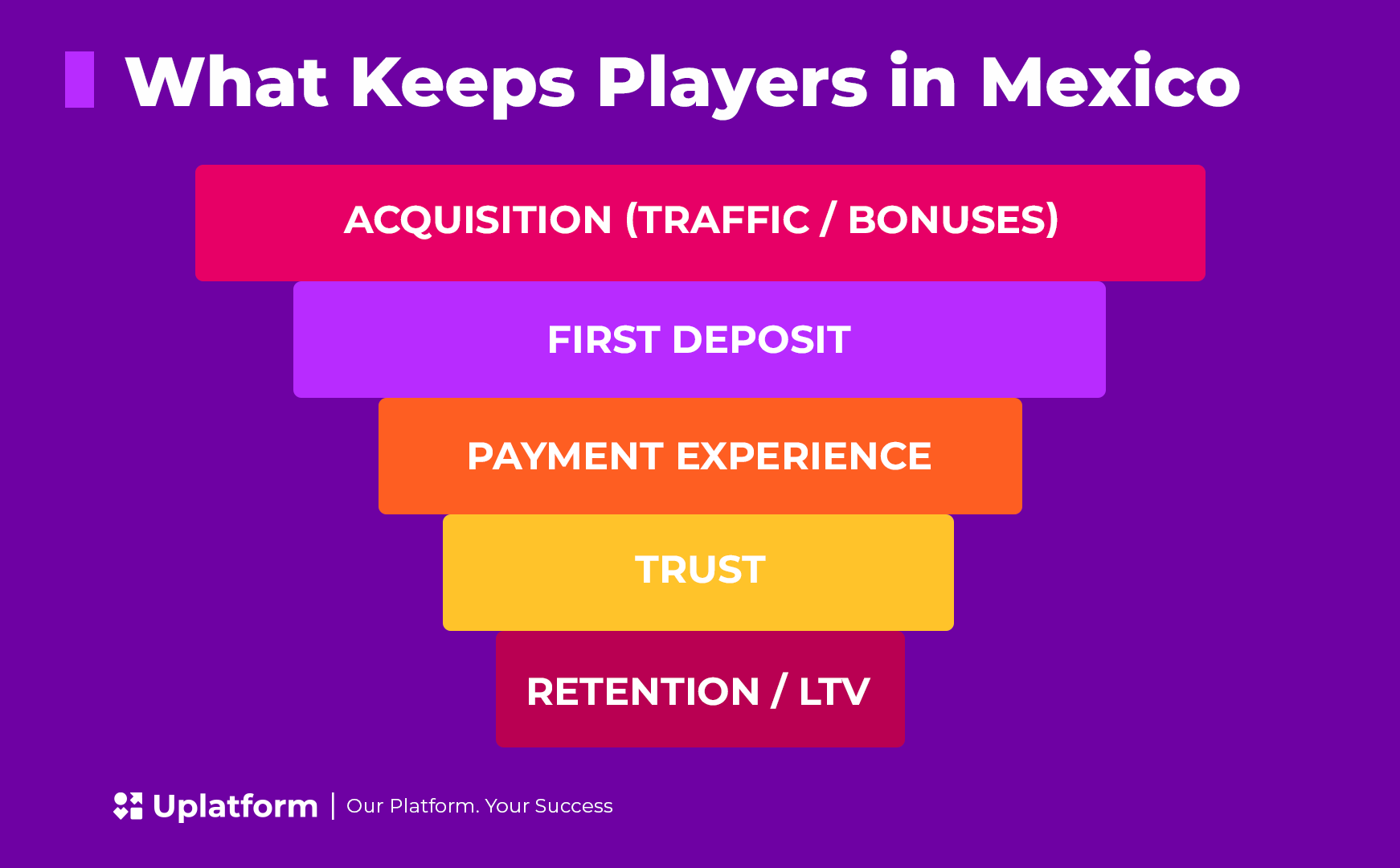
Common Entry Mistakes Operators Make
- Underestimating payment localization
- Launching marketing before legal structure is stable
- Using generic sportsbook configuration
- Over-relying on bonuses without CRM depth
- Ignoring mobile performance optimization
Mexico punishes rushed entry.
Is Mexico Still Worth Entering?
Yes, but only with preparation.
Mexico is mature in competition but still growing in digital depth and player value.
The opportunity lies in operational execution, not market novelty.
Operators who treat Mexico as a strategic long-term market can secure meaningful share.
Operators who treat it as a regional add-on often exit quietly.
No Stereotypes. Just U – Stories of Women Who Lead, Build, and Inspire

Stereotypes. They’re sneaky, persistent, and somehow always dare to show up at work. “Women are weak.” “Women want only family.” “Women belong in support roles.” Heard them before? Yeah, so have we. But here’s the thing: these clichés are getting a serious makeover.
This International Women’s Month, we’re not just celebrating women—we’re celebrating the way they shatter assumptions, rewrite the rules, and quietly prove that the only limits are the ones they choose. In industries like iGaming, fintech, and SAS, these women face labels, expectations, and a double-take or two, but they respond with skill, resilience, and results that speak louder than any stereotype ever could.
We at Uplatform asked them to share their stories. The answers? Honest, inspiring, and unapologetically themselves. Because when it comes to breaking the mold, no one does it better than women who simply refuse to fit into it.
“Women are agreeable” – Maria, Sales Team Lead, Uplatform

Women are often expected to be agreeable, supportive, and accommodating in professional settings. While collaboration is important, leadership also requires the confidence to question ideas, express clear positions, and challenge decisions when they don’t align with the goals of the team or the business. Maria tackles this expectation directly:
“Being opinionated doesn’t mean being confrontational; it means being prepared, clear, and respectful. I challenge when something doesn’t align with our goals or values.”
She also addresses the narrative that women need “help” to succeed:
“I separate emotion from execution. Disagreements are resolved by looking at data, priorities, and business impact. When discussions stay focused on results, disagreements become productive.”
“Women can’t handle pressure” – Maria Vartanians, Senior Sales Manager, 18Peaches
High-pressure roles are often seen as environments where only certain personalities can succeed. Sales targets, negotiations, and leadership decisions demand resilience, sharp judgment, and the ability to stay steady when outcomes are uncertain. Yet women in these roles are sometimes assumed to be less suited to that pressure. In reality, many build their careers precisely by navigating complexity, expectations, and responsibility across multiple fronts. For them, pressure isn’t an obstacle. It becomes the ground where resilience, clarity, and leadership are formed. Maria Vartanians puts it simply: women don’t just handle pressure, they build under it.
“In senior leadership, visibility isn’t neutral; it’s amplified. And for women, it usually comes with commentary. Success is still defined differently for women and men. For men, it’s usually measured by career progress only. For women, it’s expected to include career, marriage, family, and social approval all at the same time. That’s why the idea that women ‘can’t handle pressure’ has always sounded cliché. Women don’t discover pressure at work; we arrive there already trained. Most women carry pressure across multiple fronts: delivery at work, a second shift at home, children, household responsibilities, and the mental load of keeping everything running. Add the pressure of simply being a woman in society, where confidence is judged, standards are constant, and you’re expected to look calm while carrying weight. So the issue isn’t capacity. The reality is women carry more, more often, and are still expected to make it look effortless.”
Maria continues:
“In my career, sales is the purest form of pressure: targets, negotiations, client expectations, and the need to be sharp, communicative, friendly, and persuasive every day. And once the contract is signed, the pressure doesn’t end, it upgrades. It becomes ownership, accountability, and results with your name on them. Leadership also comes with scrutiny. Your decisions are challenged more, your mistakes last longer, and your successes are explained faster. That can drain you unless you operationalize it. I treat constant evaluation as information: anchor everything to measurable outcomes, communicate early so interpretation has less space to grow, document impact, set boundaries, and work with people who value execution over perception. But when scrutiny becomes predictable, it stops being pressure and becomes feedback. And feedback, used properly, builds resilience and over time, that resilience turns directly into performance. ”
Her final word? Women don’t just handle pressure—they build under it.
“Women get promoted for diversity” – Marie Reyjal, Head of Sales, Sigma Group

In roles where success is measured through revenue, growth, and delivered targets, career progression is usually expected to follow clear results. Yet when women reach senior positions, their promotion is sometimes attributed to diversity efforts rather than the work and outcomes behind it. In reality, leadership in these roles is built on consistent results and measurable impact. Marie reframes it with a simple metric: performance.
“I’ve always worked in roles where performance is measurable: revenue, growth, targets achieved. I know the results I’ve delivered. But stepping into leadership, I’ve noticed that some people assumed my promotion was linked to diversity rather than performance. No one says it directly, but you feel that you have to prove yourself a little more. You’re not just leading, you’re validating that you earned your seat at the table. That creates extra pressure. Because instead of simply focusing on driving results, you’re also managing perception. I think the way forward is transparency and consistency. When promotions are clearly tied to measurable impact and that impact is visible, assumptions lose power. And the more women we see successfully leading revenue roles, the less this question will even come up.”
“Women want only family” – Maria Bashkevich, Head of Marketing, Uplatform
Questions about family plans still appear in conversations about women’s careers more often than they should. Sometimes directly, sometimes between the lines, they suggest that personal life and professional ambition must eventually compete with each other. In reality, every career path is shaped by individual choices, not assumptions about what someone might want in the future. As if professional drive somehow disappears the moment personal life enters the picture. Maria knows this narrative all too well — and she’s not buying it.
“At 30, during interviews, I was repeatedly asked if I was married or planning to have children. Apparently, that mattered more than my portfolio or my ability to grow a brand and increase ROMI.”
The questions weren’t just awkward; they reflected a deeper assumption about what women’s career paths are supposed to look like.
“A recruiter friend later told me one company chose a ‘safer’ candidate — a man — assuming I might go on maternity leave soon. His offer, by the way, was 45% higher than what we had discussed. Assumptions are expensive 🙂 Five years later, that assumption still looks ironic. Interestingly, none of my male peers were ever asked similar questions. The issue isn’t family. The issue is the assumption that career paths can be predicted based on gender. That motherhood is automatically my priority. If I choose it, it will inevitably compromise my ambition or performance. And underlying all of this is another assumption: that parenting is primarily a woman’s responsibility.”
“Family is a personal decision. Performance is professional. They are not the same conversation. What I want is a choice, the freedom to be whatever I want and have whatever I want, without assumptions, questions, or judgment.”
Maria’s story is a reminder that ambition doesn’t come with a template and it certainly doesn’t need permission. Success looks different for everyone, and the strongest careers are the ones shaped by choice, not expectation.
“Women are weak” – Lucie Kadlecová, CMO, Aviatrix
Strength is often imagined as something loud, aggressive, or purely physical. In reality, leadership strength looks different: it shows up in difficult decisions, clear boundaries, responsibility, and the willingness to take risks. Let’s start with a classic stereotype that women are “weak.” Lucie Kadlecová would probably laugh at that idea if she weren’t busy proving the exact opposite. Having started her career in iGaming more than a decade ago, Lucie remembers a very different industry.
“Having started my career in the iGaming industry 10 years ago, I worked my first years as a Marketing Manager in a completely different environment than you can see now. It used to be a male-dominated industry back then, and women in iGaming were mostly just the sexy hostesses, and rarely had a managerial position.Mostly during events, it led to quite a few situations when I was viewed as ‘good-looking supporting staff’ and not as someone who is a company representative.”
Instead of letting those assumptions define her, Lucie relied on persistence, professionalism, and a steady belief in her expertise.
“It took a lot of resilience and consistency to prove my qualities as a marketing professional and have people realise that I am not just a pretty face. Step by step, alongside how the iGaming industry has been changing, I became a respected professional in this industry. Today it feels almost unreal that it used to be like that.
“I’ve always been professional, hardworking, and a leader who is both strong and empathetic and supportive to their team. I’m also a risk-taker and a strong decision maker, and I’m always ready to take full responsibility for my decisions. This industry is not for the weak. It is extremely dynamic and demanding. I think that having this long track record of 10 years in the industry, and still being alive and sane (most of the time, haha), I have proved to myself and everyone else that I am strong enough.”
Lucie’s story is proof that strength doesn’t always arrive with noise or spectacle. Sometimes it’s persistence, confidence, and the quiet determination to show up, deliver results, and let your work speak louder than stereotypes.
“Women are lucky to succeed” – Kristina Topal, Senior Sales Manager, 18Peaches

When someone succeeds quickly, people sometimes explain it with luck. It’s an easy way to understand results without looking at everything that happened behind them. Women in business often hear this more than men, especially in industries where leadership and sales have traditionally been male-dominated. Kristina Topal knows this one all too well.
“People sometimes say women in iGaming are ‘lucky’ to get where we are. Honestly, I’ve heard it more times than I can count. But success comes from curiosity, persistence, and showing up consistently—not luck. Every deal, every project, every launch is built on learning, hard work, and trusting your own judgment. And yes, beauty is often seen as an advantage… but sometimes it actually makes things harder. People don’t always take women seriously. In a male-oriented industry, when you’re dealing with guys, some assume you’re only skin-deep. Some treat you like a pretty doll, not someone who can challenge them, solve real problems, or say something nobody has said before. Sometimes conversations shift into something more personal, and the truth is: being a successful woman isn’t an easy milestone to reach. The bigger point is that women deserve recognition for skill, capability, and results. And… I won’t lie, looking cute and keeping a big smile is a bonus too!”
Kristina adds that assumptions about readiness for high-stakes decisions are equally common:
“Show up, do the work, lead with confidence—and yes, do it with a smile. Because in the end, results speak louder than assumptions. The more we show up and deliver, the harder we are to underestimate. 💪”
“Women belong in support roles” – Dina, Head of B2B Projects, Uplatform

For a long time, many industries quietly placed women in coordination or support positions, roles that kept things running but rarely carried visible authority. The assumption was simple: organization and assistance suited women better than decision-making or strategic leadership. Over time, that narrow view has steadily faded as more women have taken on roles that shape projects, teams, and business outcomes. Dina’s experience reflects that shift and challenges the idea that careers should follow a predetermined path. As she puts it:
“Any situation of success is almost always accompanied by assumptions from others about how it was achieved and why the circumstances unfolded the way they did. This is natural. People want to understand and sometimes repeat someone else’s path. But every development story is unique. Many factors influence the result: the decisions that were made, timing, circumstances, the people around you, and, of course, a certain amount of luck.”
For Dina, the real focus isn’t copying someone else’s formula; it’s recognizing opportunities and making the most of them.
“What matters much more is the ability to recognize your own opportunities, understand your goals, and make use of the chances that appear. At the same time, it’s important to remember that any achieved result is only one stage — after which the next stage can always begin.”
Her approach to work reflects that mindset: curiosity, adaptability, and a genuine love for tackling challenges.
“What probably helps me the most is flexibility and the ability to navigate changing circumstances quickly. I really enjoy learning and constantly look for new opportunities to develop and improve what I do. Difficult tasks don’t scare me; on the contrary, they create a healthy sense of excitement to find the optimal solution and do something genuinely interesting and new. Working with people is very important to me. It gives incredible energy; the chance to exchange experience, learn from one another, and see how many strong specialists and interesting ideas exist around us. This interaction often becomes a source of new solutions and inspiration for further growth.”
That perspective also shapes how she approaches disagreements and decision-making.
“I separate emotion from execution. Disagreements are resolved by looking at data, priorities, and business impact. When discussions stay focused on results, disagreements become productive.”
Dina proves that labels are only as strong as the people who let them stick. In her world, curiosity beats assumptions, collaboration fuels progress, and initiative speaks louder than tradition.
“Women are “too much” – Josmar Diaz, Regional manager Iberoamerica, Endorphina
Leadership often requires directness, clear opinions, and the confidence to challenge existing ideas. Yet when women demonstrate those qualities, they can sometimes be labeled as “too much,” while the same behavior is often interpreted as decisiveness or strong leadership in men. Josmar Diaz has encountered this dynamic throughout her career in male-dominated industries.
“Yes, definitely. I’ve experienced this many times as a woman working in male-dominated environments, especially in fields like commercials and now in iGaming. There is often an unspoken expectation that women should be agreeable, always smiling, and not challenge decisions too much. When you express a strong opinion or push for a different approach, it can sometimes be perceived as being ‘too much,’ while the same behavior from men is often seen as leadership.”
For Josmar, the real issue lies in the double standard around assertiveness, particularly in creative and strategic roles where strong ideas and clear direction are essential. Women in these positions can find themselves balancing decisiveness with the expectation of being constantly likable, something their male peers are rarely asked to manage.
“One of the main challenges is the double standard around assertiveness. In creative or strategic roles, strong ideas, clear direction, and confidence are essential, but when women demonstrate these qualities, they can be labeled as difficult or emotional instead of decisive or visionary. This can make women feel like they have to constantly balance being assertive with being likable. To move toward a more objective evaluation of leadership, the industry needs to focus more on outcomes, collaboration, and the quality of ideas rather than personality stereotypes. Encouraging diverse leadership styles and creating spaces where different perspectives are respected would help a lot. Leadership shouldn’t be measured by how closely someone fits a traditional mold, but by how effectively they guide teams, communicate ideas, and deliver results.”
At the same time, she has also encountered another common assumption: that women are less familiar with the gaming or technical side of the industry. In reality, she sees more and more women shaping strategy, products, and decisions across the sector.
“Sometimes there’s an expectation that women will focus more on communication or support roles rather than strategy, product, or decision-making. In reality, many women bring strong strategic thinking, creativity, and leadership to the table, and the industry benefits when those contributions are recognized and valued.”
“Women are “emotional” – Denise Abela, Chief Legal & Business Operations Officer, Yggdrasil
Women are emotional
Emotional → Perceptive
Emotional expression in women is often misinterpreted as instability rather than awareness, conviction, or control. In leadership, this stereotype is frequently used to undermine decision-making, even when it is grounded in logic, experience, and results.
Have you ever been labeled “too emotional” or sensitive? Has emotional intelligence helped you in leadership or decision-making?
“The stereotype that women are ‘too emotional’ has long been a convenient way to dismiss results. I grew up seeing confidence called ‘too assertive’ in women and ‘leadership’ in men. I call it accountability. Competence and ambition don’t have a gender.”
Thread Between Stories
Across these stories, a pattern quickly becomes clear: stereotypes may try to define the starting point, but they rarely define the outcome. In fact, for many of the women who shared their experiences, these labels become something else entirely motivation.
“Weak” turns into resilience. “Family priorities” becomes a personal choice, not a prediction. “Support roles” expand into leadership, strategy, innovation, or whatever role someone decides to pursue.
Each story reminds us that stereotypes only work if they remain unquestioned. And the moment real experiences enter the conversation, those assumptions start to fall apart. What replaces them is something far more interesting: individual paths shaped by ambition, curiosity, persistence, and sometimes a bit of stubborn determination.
The bigger lesson? Skill, determination, and consistency will always outshine assumptions. And a little humor along the way definitely helps.
If these voices resonated with you, there’s more to explore. Uplatform has collected additional stories, reflections, and perspectives from women across our industry. You can share your experiences and stories here and read others’ perspectives to discover even more voices shaping the conversation. The more openly we talk about it, the harder it becomes for anyone to ignore.

Conclusion
This International Women’s Month, let’s celebrate women who refuse to fit into outdated boxes. Let’s acknowledge their accomplishments, honor their choices, and challenge the labels that linger in workplaces worldwide.
Because here’s the truth: no stereotype can define these women—because they define themselves.
#beU #NoStereotypesJustU

What Drives iGaming Success Behind the Scenes

TL;DR
Sustainable success in iGaming depends less on products or traffic and more on how the operator’s team and processes are built from the start. Strong projects launch with clear ownership, stable payments, and aligned decision-making. As they scale, structured teams outperform chaotic ones by reacting faster to change, protecting player experience, and avoiding growth driven only by traffic. Long-term performance comes from coordination, analytics, and operational discipline, not from acquisition alone.
Behind the Scenes: How Strong Teams Determine Success in iGaming
The iGaming industry continues to grow, driven by new markets, evolving regulations, and constant technological development. On the surface, success in this space often appears to be a matter of product quality, licensing, or marketing scale. Yet behind many stalled or failed projects lies a much less visible factor: how the operator’s team and internal processes were built from the very beginning.
In practice, projects rarely collapse on their own. Products do not fail in isolation. What usually breaks first is the operational structure supporting them. Behind every sustainable iGaming project is a team capable of making decisions quickly, reacting to unexpected challenges, and scaling without losing control.
Launch Is Not a Testing Phase
For many operators, the launch stage is treated as a trial period. Features can be adjusted later. Processes can be improved after traction appears. Teams can be expanded once revenue starts flowing.
This assumption is often costly.
“At launch, there’s no time for a slow warm-up,” says Dina, Head of Projects at Uplatform . “Who stands at the helm determines how fast the project finds its course and whether it reaches its destination at all.”
Early-stage projects rarely have the luxury of learning through mistakes. User expectations are immediate. Payment friction is unforgiving. Competition is already established. This makes the initial team structure not just important, but decisive.
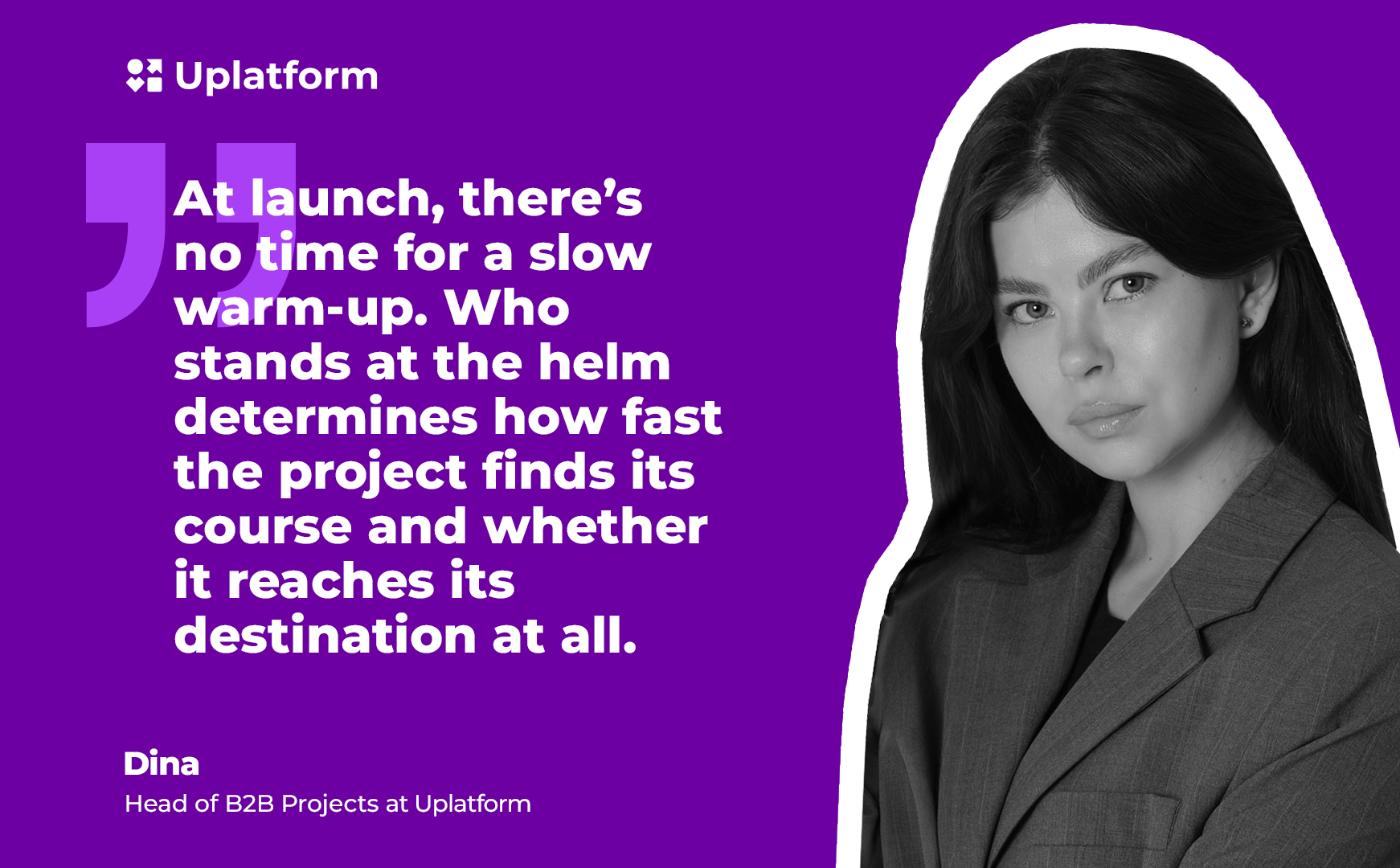
Successful launches tend to rely on a lean core team with clearly defined ownership rather than a broad but unfocused lineup. Strategic leadership is needed to set priorities and handle key negotiations. Product ownership ensures that the launch is driven by real player needs instead of assumptions or internal preferences. Payments expertise becomes critical immediately, as deposits and withdrawals form the backbone of user trust. Marketing completes the structure by attracting the right audience, not simply high volumes of traffic.
You should build the core team from the very beginning. Early-stage projects do not have time for long ramp-up periods. Results are needed immediately, which makes the initial team composition critical.
At a minimum, several key roles are essential:
- CEO – sets the direction of the project and drives execution. At the start, this role is often directly involved in key negotiations and complex decisions.
- Product Manager – a strategic role responsible for aligning the product with market and user needs. This person defines what should be launched, which features and promotions matter first, and how success is measured.
- Payments Specialist – ensures stable and flexible payment flows. Deposit and withdrawal reliability directly affects conversion and survival in the market, making this role non-optional.
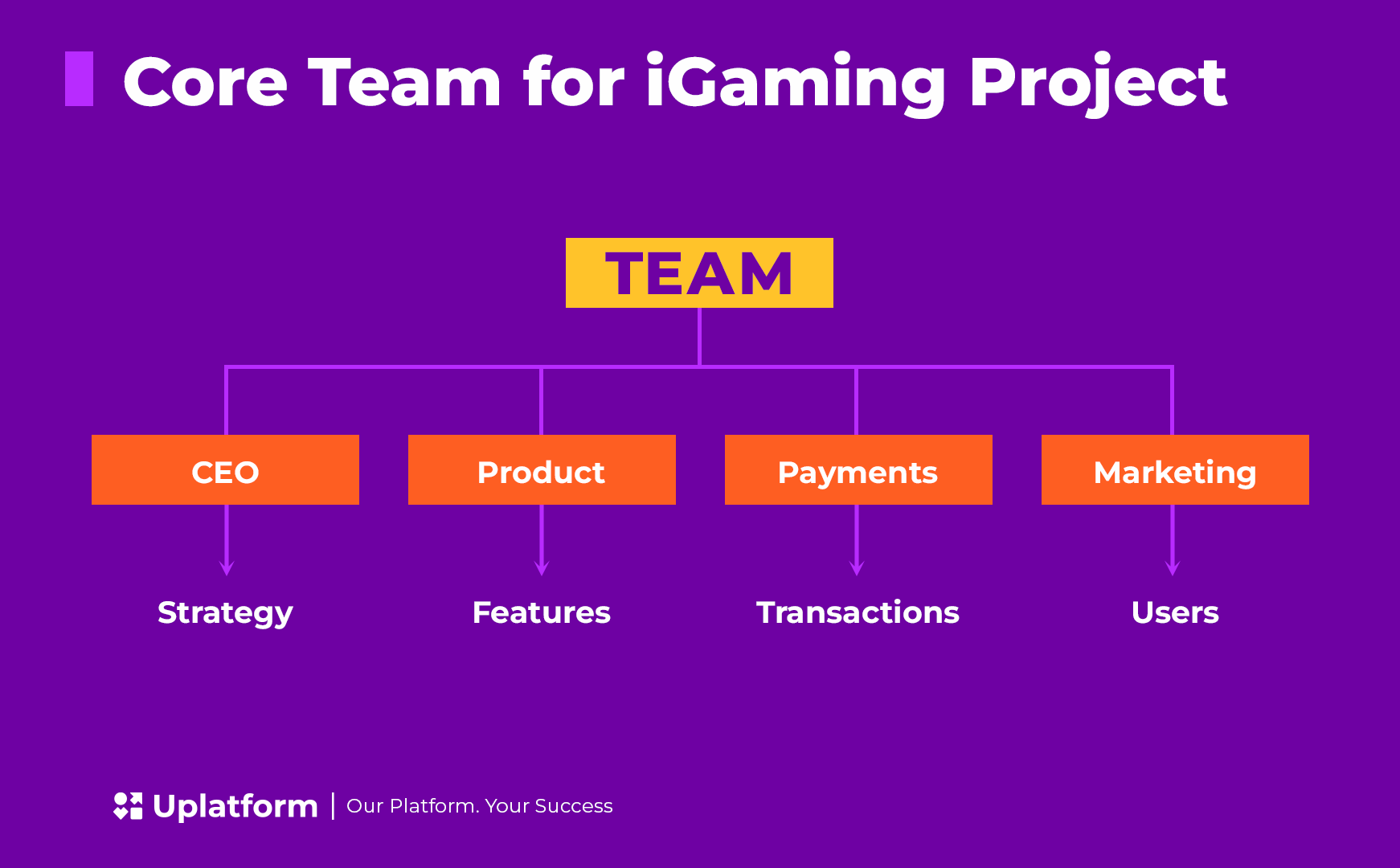
“Smooth payments are not a bonus feature. They’re a condition for survival,” Dina adds. “Conversion rates, flexibility for local markets, and the speed of reaction to new challenges directly affect whether players stay or leave.”
Traffic/Acquisition Specialist – responsible for bringing in the right audience and building visibility. Without users, even a strong product cannot grow.
This is a basic starting structure that allows a project to launch efficiently and avoid critical gaps.
However, there is no universal team model. The exact composition depends on business goals, budget, market specifics, and product type. The only constant is that the operator must clearly understand what they are building and why, and then assemble a team that fits that objective.
Growth Changes the Nature of Problems
As projects move beyond launch, operational pressure begins to shift. What worked at the early stage often stops working at scale. Payment methods that converted well initially may struggle under volume. Marketing channels lose efficiency. Compliance requirements evolve. Product complexity increases.
Importantly, these challenges rarely appear in a predictable order.
“Even experienced operators are often surprised by how fast the market can change,” Dina explains. “One day the challenge is payments, the next it’s marketing efficiency, and after that new requirements force changes in the product itself.”

Forecasting and planning remain important, but they do not eliminate uncertainty. The operators that scale successfully are not those who try to predict every issue in advance, but those who build teams capable of reacting quickly when forecasting stops working.
This is where process quality becomes more important than headcount. Simply adding people rarely solves structural problems. In many cases, it amplifies them.
Analytics is often the first pressure point. Teams that rely on intuition or competitor behavior tend to make reactive decisions, misallocate budgets, and chase short-term signals. Dedicated data ownership changes how fast teams can identify issues, test hypotheses, and adjust strategy.
As turnover grows further, financial control, technical ownership, and internal coordination become equally critical. Without documented processes and clearly defined responsibility zones, growth creates noise instead of momentum.
Structure Versus Chaos
Differences between well-organized and chaotic operators become visible very early.
“Well-organized operators work through documented processes, clear priorities, and measurable goals,”says Katerina, Team Lead, Key Account Management.
“Chaotic teams operate in last-minute mode, constantly firefighting instead of building.”
This distinction becomes especially apparent during market expansion. Entering a new region is rarely just a marketing exercise. Payment methods must be adapted to local preferences. Legal and regulatory risks need to be assessed. Product localization requires technical coordination. Affiliate traffic needs proper onboarding and tracking. Customer support must be operationally prepared to handle real player traffic from the first day of launch.
Structured operators plan these activities in parallel, treating market entry as a coordinated operation rather than a single event. Less organized teams tend to launch first and resolve operational gaps later, often at the cost of retention, reputation, and internal efficiency.
In chaotic setups, growth frequently happens not because of the system, but despite it. Manual control replaces structure. Urgency replaces prioritization. Over time, this leads to burnout, inconsistent performance, and stalled scaling.
The Myth of Marketing-Only Growth
One of the most persistent misconceptions in iGaming is the belief that aggressive acquisition alone drives success. Marketing spend increases. Traffic flows in. Numbers look promising in the short term.
But without operational alignment, growth quickly plateaus.
“Many teams believe business grows purely through marketing,” says Katerina, Team Lead, Key Account Management. “Without analytics, stable payments, and coordination with the platform, scaling quickly starts to stall.”
In practice, acquisition performance is deeply dependent on what happens after the click. Payment conversion, onboarding flows, support response times, and retention mechanics all influence whether acquisition spend translates into sustainable revenue.
Teams that neglect these areas often experience high churn, blocked transactions, and escalating support issues. Over time, acquisition costs rise while lifetime value stagnates.
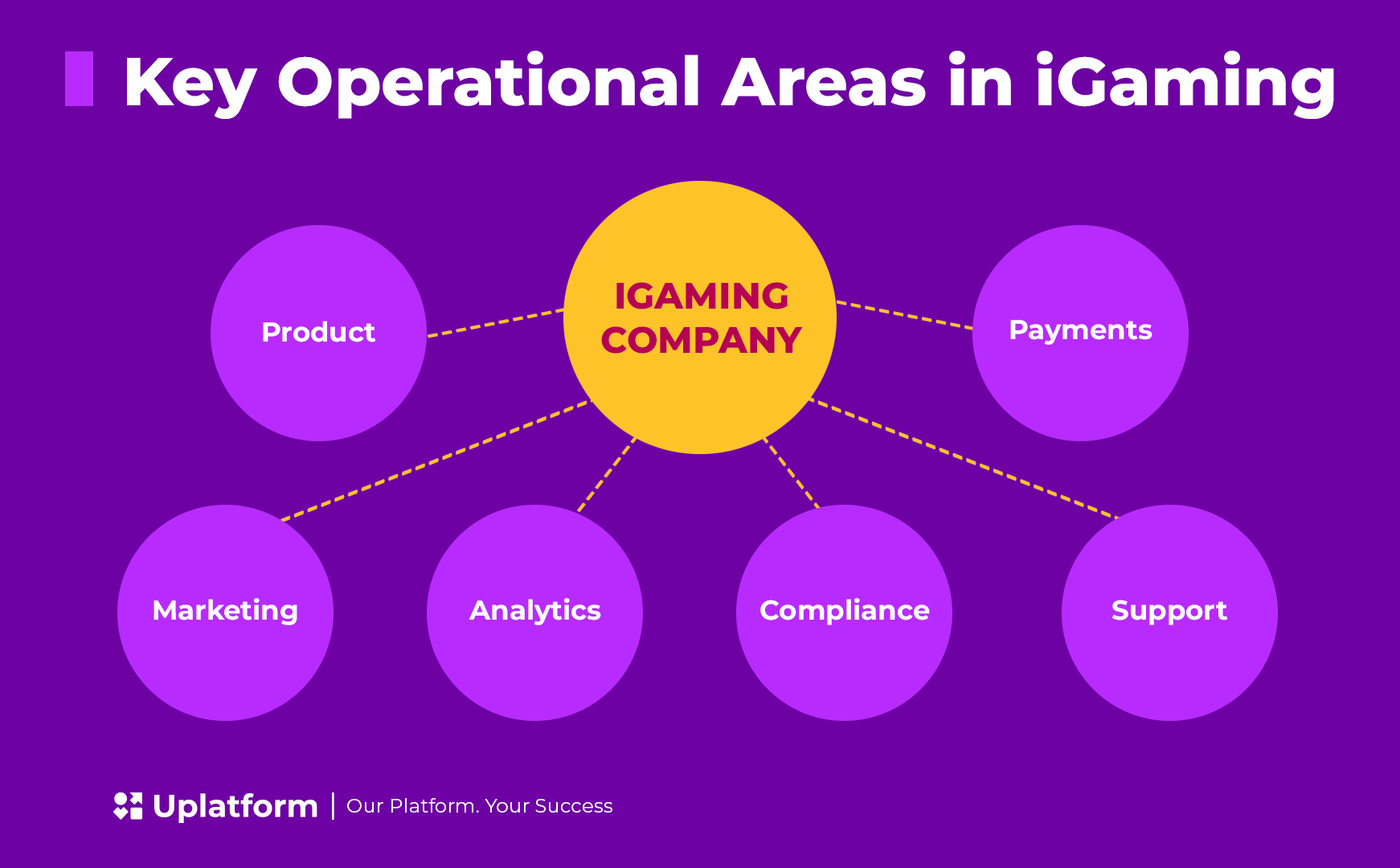
Player Experience as a Structural Decision
As operators mature, player experience becomes a defining factor. This is especially true for high-value segments.
In most iGaming projects, a relatively small share of players generates the majority of turnover, illustrating the Pareto principle in practice. Mature operators reflect this reality not only in strategy, but in team structure.
“In iGaming, 10–15% of players generate up to 80% of turnover,”
Katerina explains.
“That’s why successful operators always build dedicated VIP programs and separate fraud control. It protects margin and allows the business to grow predictably.”
VIP management is not simply about bonuses or personal communication. It requires trained staff, clear escalation processes, fast payouts, and coordination across departments. Predictive analytics helps identify valuable players early, while tailored retention strategies reduce churn before it becomes visible in headline metrics.
Fraud prevention follows a similar logic. Treating risk management as an afterthought often leads to uncontrolled losses, payment issues, and strained relationships with providers. Operators that integrate fraud specialists early build systems that scale safely rather than reactively.
Scaling Through Alignment, Not Pressure
As teams grow, internal alignment becomes just as important as external performance. Operators that succeed in scaling, do not treat their platform provider as a passive service layer. They work through coordination, shared priorities, and transparent communication.
One of the most common management mistakes observed by KAM teams is unilateral decision-making. Launching promotions without risk assessment. Changing payment flows without coordination. Applying pressure to support teams instead of addressing root causes.
These actions rarely accelerate growth. Instead, they introduce friction that must be resolved later, often under greater pressure.
Operators that invest in alignment tend to move faster over time. Clear points of contact, documented processes, and shared metrics reduce noise and improve decision quality across the board.
What Happens Behind the Scenes
Behind the scenes, sustainable iGaming success is rarely the result of a single decision or feature. It is built through dozens of structural choices made over time.
Strong teams launch faster, react better to change, and scale with control. Weak structures burn resources, lose players, and struggle to recover from operational shocks.
In an industry where markets evolve quickly and competition is relentless, team structure is not a background concern. It is one of the primary drivers of long-term performance.
Ultimately, the difference between struggling and thriving iGaming projects is not what happens on the surface, but how well the team behind it is built to handle complexity, uncertainty, and growth.
The Data Science Behind The Casino Content Portfolio Mix
TL;DR
A casino content portfolio mix is a data-driven approach to selecting and sequencing games across player cohorts. By balancing volatility, session length, and familiarity, and tailoring exposure by region and maturity, operators increase retention, stabilize revenue, and reduce churn.
Introduction
In today’s competitive and regulated online casino markets, acquiring new players is not enough to keep a business growing. Long-term success depends on how well players are kept engaged over time. One of the most important factors in this is the mix of games an operator offers.
Choosing games to offer is not just about creativity, branding, or keeping suppliers happy. It is a practical decision that directly affects how long players stay, how often they return, and how predictable revenue becomes. Most operators offer thousands of slots, live casino games, and other games from many different studios, all designed in various ways. Without a clear plan, this variety quickly becomes a burden instead of a benefit.
What Does A ‘Content Portfolio Mix’ Really Mean For An Operator?
A content portfolio mix is the deliberate balance of game types. This includes how risky the games feel (volatility), how often players see results, how long a particular session lasts, and the split between familiar formats and new mechanics.
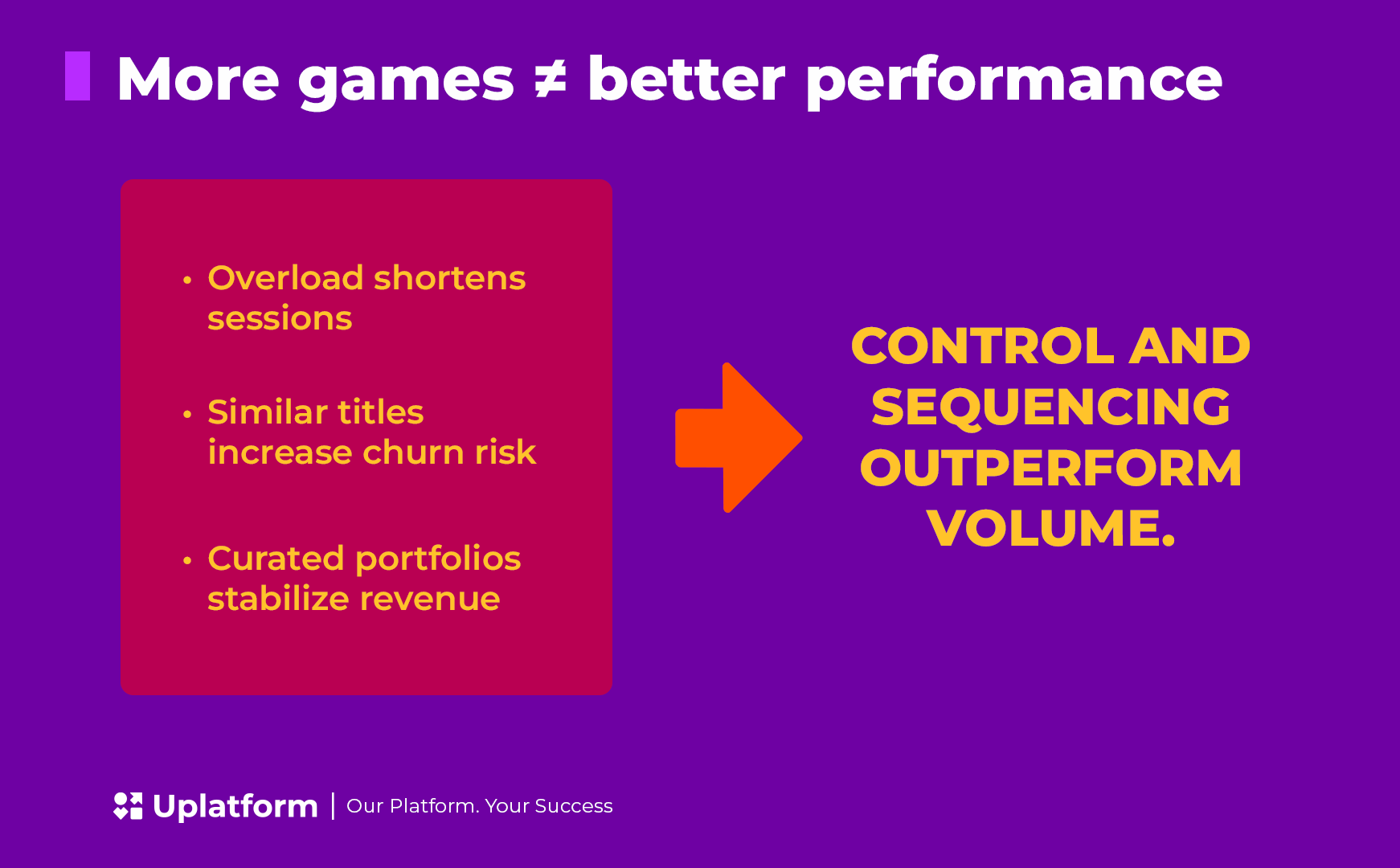
The aim is not to give players unlimited choice. Too many similar options can actually push players away. The real goal is to support different play styles and different stages of the player lifecycle.
Each game plays a different role in player behaviour. Some games are good at convincing first-timers to try real-money play. Others keep players engaged for longer sessions. Some help reactivate players after a break. When an operator relies too heavily on a single type of game or a dominant style, performance may spike early. Still, it usually becomes fragile and declines as novelty fades or player preferences shift.
In practice, you judge the mix by tracking how many players return after 1, 7, and 30 days. A balanced portfolio keeps those return rates steadier over time while also making revenue less vulnerable to sudden shifts in taste, competition, or regulation.
Using Player Groups To Shape Content Portfolio Structure
Players are often grouped by age, region, or spending level, but those labels rarely explain how they actually behave on a casino site. A more useful approach is to segment players by how they interact with games over time.
Some players leave soon after signing up. Others play frequently but stake small amounts. Some stay for months but get bored when nothing new comes up, while others are consistently active players who contribute significantly to predictable revenue.
Each group of players responds to different content. Newer players typically prefer simple, familiar games with clear mechanics and frequent outcomes that build confidence. As players gain experience, many start exploring higher-volatility titles, deeper features, and new formats, if the operator makes that progression feel natural.
If an operator shows the wrong content at the wrong stage, players lose trust, shorten sessions, or stop returning. Aligning the game mix with player maturity helps retention grow and increases value over time without relying on pressure tactics.
Why Variety Helps Reduce Churn
Many operators assume variety means adding more games or partnering with more providers. In reality, variety only matters when it changes player behaviour or helps different cohorts find something that fits their preferred pace, risk level, and session style.
A strong game mix typically includes:
- Games with different levels of risk and reward (volatility range)
- Options for short sessions and longer play
- Familiar formats alongside more unusual mechanics
- Reliable favourites combined with carefully tested new releases
Problems arise when too much play or revenue depends on a small set of similar game types. If preferences shift, a competitor launches a stronger alternative, or regulations affect a category, performance can drop quickly.
A balanced mix spreads this risk. It smooths player behaviour over time, reduces churn triggers, and helps revenue stay more stable through market changes.
Building Trust In The Early Stages
Many operators lose most of their potential value in the first weeks after a player signs up. This does not usually happen because bonuses are too small. It happens because the experience feels confusing, unpredictable, or uncomfortable.

Early-stage players respond best to games that feel familiar, move at a steady pace, and provide frequent outcomes. These games reduce early uncertainty and help your new audience understand the experience faster and stay engaged longer.
When new players are pushed too quickly toward complex or highly risky games, excitement may increase briefly, but trust suffers. Losses feel sharper, learning feels harder, and players leave sooner.
A well-planned portfolio introduces stability first, then gradually expands into richer and higher-volatility experiences as players mature. Done well, this improves early-cohort retention (Day 1/Day 7) and increases the share of players who progress to longer-term engagement (Day 30+).
Adjusting The Casino Content Mix By Region
Player behaviour differs by region, but smart operators do not rely on stereotypes. Instead, they look at how players in the region actually engage their product.
In parts of Latin America, players tend to return regularly and stay loyal when games feel consistent. Over-rotating content too frequently can reduce long-term engagement. Familiar formats often perform better here.
Across many mobile-first African markets, players prefer quick games with fast outcomes. Sessions are short, but return visits are frequent. In these markets, fast time-to-outcome and frictionless re-entry matter more than visual themes or complex features.
Asian markets are more mixed. Some players enjoy games that reward long-term progress and deeper interaction. Others prefer fast, repeatable play. Operators need flexibility rather than a single default mix.
European players are often open to a wide range of risk levels but lose interest quickly if the experience feels repetitive. Here, balance matters more than volume.
The key point is that regional differences are about usage patterns, not culture. Data from real behaviour leads to better decisions than assumptions.
How Player Risk Preferences Change Over Time?
One overlooked aspect of game planning is how a player’s appetite for risk changes as they gain experience.
Most players start with games that pay out safely, offer smaller wins, and incur fewer losses, allowing them to learn without incurring heavy losses. This stage is critical for building confidence.
As players become more familiar with the brand, many start looking for greater excitement, and their tolerance for results increases. If the game mix does not evolve with them, boredom sets in.
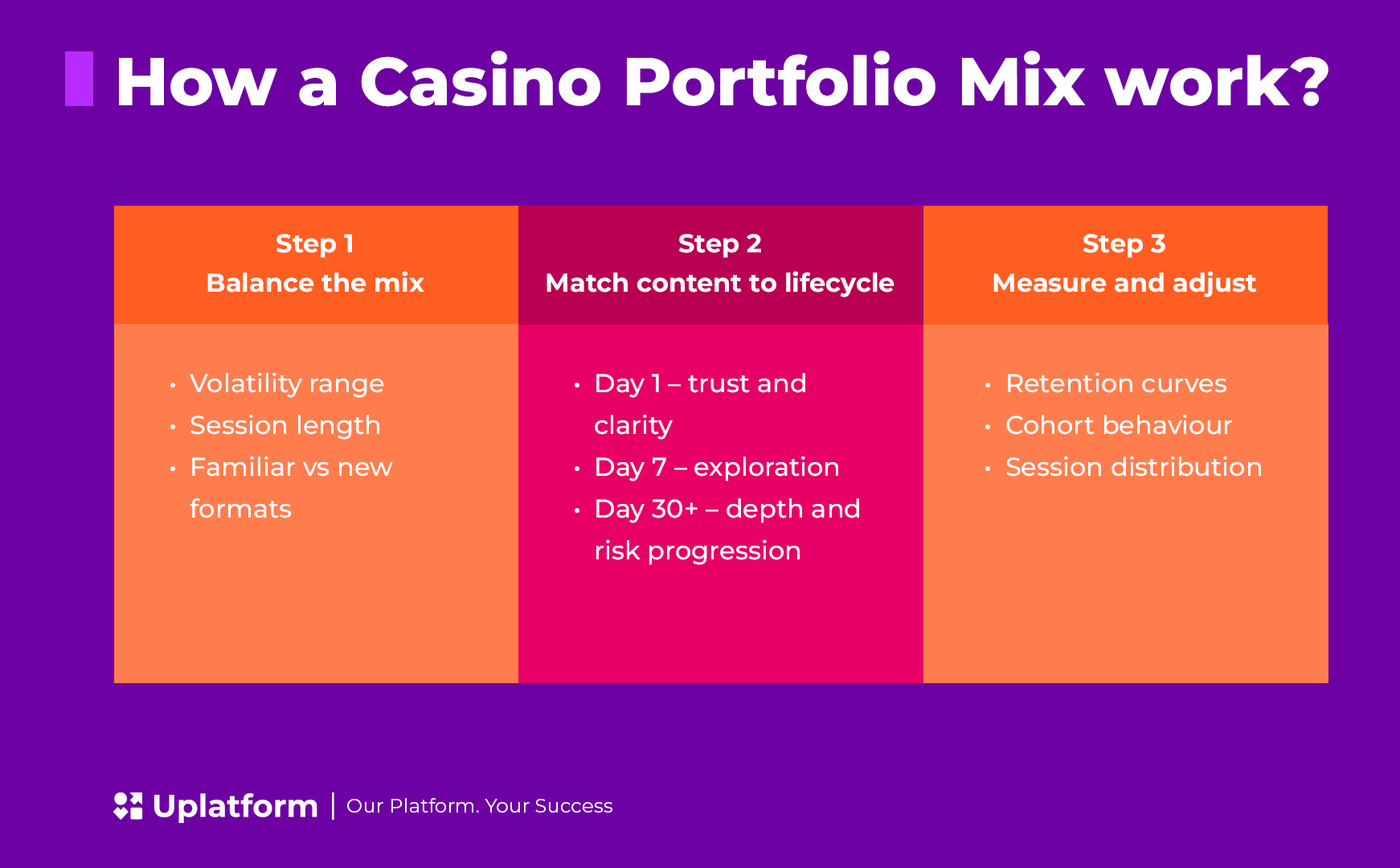
Operators who track these changes can introduce slightly riskier or more feature-rich games at the right moment. This keeps players engaged without pushing them too far, too fast.
Guiding players through this natural progression helps prevent sudden drop-offs and reduces the chance they will look elsewhere for variety.
The Problem With Too Many Games
A common belief is that adding more games always increases engagement. In practice, this stops being true very quickly.
Once a catalogue becomes too large, players struggle to find something new that feels meaningful. Recommendations become weaker, choices feel overwhelming, and sessions become shorter.
This issue is usually seen on mobile, where players want quick access and minimal effort. Too many similar options create frustration instead of value.
The solution is not to add more games. But identifying which games truly add value and which repeat the same experience, and then diversifying to reduce clutter.
Curated libraries help players focus, improve discovery, and strengthen retention. Removing underperforming or redundant titles often improves overall engagement rather than harming it.
Using Providers To Reduce Business Risk
Working with multiple game developers is important, but not simply for adding variety. When too much engagement or revenue depends on a small number of games, operators face the risk of content concentration. If a key developer encounters regulatory issues, slows its release cycle, or changes commercial terms, player behavior and performance can be affected quickly.
Casino aggregators matter because they remove integration friction. Instead of connecting to providers one by one, you integrate once and get access to a wide range of studios. From there, you decide what players see, when they see it, and how it performs across segments.
At Uplatform, our casino aggregator gives you access to 10,000+ games from 100+ providers through a single connection. That cuts down technical work and speeds up launch. As you grow, you don’t need to rebuild or re-integrate. You simply expand the portfolio and adjust your strategy inside the same setup.
Everything is managed from one admin panel. You control positioning, categories, exposure, and recommendations. Our game recommendation service helps surface titles based on player behavior, so content placement is not random. You can push new releases, highlight proven performers, or tailor visibility by market without involving developers each time.
On the player side, the experience stays consistent. They get access to both the latest releases and established global providers. Games load quickly, run smoothly across devices, and support multiple currencies. Whether traffic is low or scaling, performance remains stable and predictable.
The goal is simple: give you content at scale and the tools to manage it properly, without adding operational complexity.
Measuring The Real Impact Of the Game Mix
Looking only at performance revenue hides many problems. To understand the real impact of a game mix, operators need to observe how different player cohorts behave over time.
From a data science perspective, operators evaluate the game mix using cohort analysis, retention curves, session distributions, and reactivation rates rather than relying solely on revenue.
With these signals, operators can make small, continuous adjustments instead of large, disruptive reshuffles. This keeps the portfolio aligned with player needs as they evolve.
Why Careful Game Selection Guarantees Competitive Advantage?
An extensive library helps, but only when it’s usable. The real advantage goes to operators who curate, diversify, and personalize, offering the right games at the right time for each cohort.
Careful selection turns a static catalogue into a living system. Variety is controlled, not chaotic. Players feel supported rather than overwhelmed.
A balanced game mix improves retention, reduces revenue swings, and builds long-term confidence in the project.
Retention has long been recognized as one of the most powerful drivers of long-term revenue growth. Research discussed in Harvard Business Review shows that small improvements in retention can significantly increase profitability.
Conclusion
Online casino strategy is never just for new players. Keeping your audience engaged over time now matters more than ever. Balancing risk levels, offering effective variety, and adjusting the game mix based on behavioural patterns are essential for sustainable growth.
No Stereotypes. Just U
March 8 isn’t about flowers, chocolates, or applause. It’s a reminder: the world still labels women in ways that make no sense – both in professional and personal life.
At Uplatform, we’re calling it out. Our campaign, #beU, highlights the stereotypes women face in leadership, negotiations, hiring, and day-to-day business life — the ones that quietly shape decisions, opportunities, and confidence. Because let’s face it: labels are limiting.
“What I want is the freedom to choose my path — without assumptions, questions, or judgment. By bringing these experiences into the open, we can challenge stereotypes that still shape our industry and create a future where women won’t need to prove they deserve opportunities — they will simply have them. Without unnecessary fight”stated Maria B, Head of Marketing at Uplatform.
The Stereotypes We’re Kicking to the Curb
Even today, women are told they are:
- “Too emotional” – as if empathy is a flaw.
- “Too weak” – as if strength has to be loud to be real.
- “Not assertive enough” – as if leadership came in only one style.
These outdated assumptions are contradictory, confusing, and completely unnecessary. They show up everywhere: meetings, interviews, strategy sessions, and even casual conversations.
Stereotypes don’t define skills. They don’t define potential. They only limit perspective.
One Woman. One Stereotype. One Truth.
We spoke with our colleagues and partners to explore how stereotypes show up in real life — and how they challenge them every day. Each story contrasts an imposed label with a woman’s authentic identity, exposing the absurdity of assumptions and the distance between outdated thinking and real talent.
#beU gives women the floor. Each participant shares one stereotype she has faced, how it impacted her journey, and what she actually believes about herself.
The result? A powerful, living archive of voices proving that ambition, skill, and leadership aren’t determined by stereotypes — individuals determine them.
Share Your Story
We’re opening the platform to women everywhere:
- Have you been labeled unfairly in your career?
- Did it shape your opportunities or confidence?
- How did you overcome it — or are you still challenging it?
Submit your experience on our dedicated landing page, and selected stories will be published as part of the #beU collection. Each story adds to a growing archive of voices dismantling stereotypes in real time.
Why #beU Matters
#beU is not a contest. It is a reminder that professional potential should not be filtered through stereotypes. It’s about clarity:
- Stereotypes do not empower.
- Awareness does.
- Sharing experiences builds collective insight and inspires change.
Through #beU, we aim to spark conversations, challenge assumptions, and shift the professional culture one story at a time.
Because progress isn’t just about amplifying women’s voices. It’s about removing the labels placed on them.
No stereotypes. Just U.
#beU
Choosing an iGaming Platform Provider in Africa: Why Localization Matters
TL;DR
Africa is one of the most promising emerging regions for iGaming, but it demands a localized, market-specific approach and a right iGaming Platform Provider in Africa. To succeed, operators need:
- Mobile-first performance
- Local languages and cultural relevance
- Trusted payment methods
- Market-specific regulatory alignment
- Scalability that is built for diverse regions
A Practical Guide for Operators Expanding Across the Continent

Africa has become one of the biggest opportunities for iGaming brands aiming to scale in emerging markets. With more than 1.4 billion people, a rapidly growing young population, and a mobile-first digital landscape, Africa offers enormous long-term potential. But success here depends on one thing: smart localization. This market isn’t one country; it’s a mosaic of languages, cultures, payment habits, and regulatory frameworks.
To operate in Africa, you need to approach it strategically. Follow these steps to build a successful iGaming operation.
1. Learn the Realities of the African iGaming Market
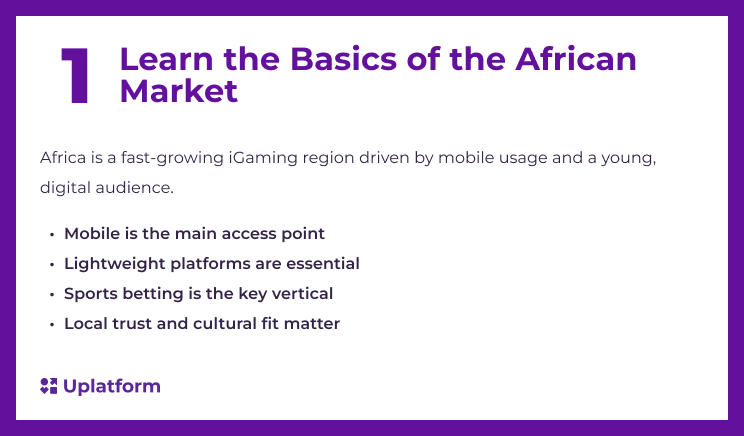
Africa is one of the fastest-growing online gaming regions, with the market expected to reach US$13.86 billion this year. Growth is fueled by rising smartphone adoption, cheaper data plans, and a strong sports betting culture, especially in Nigeria, Kenya, Ghana, and South Africa. And in order to succeed you need a right sportsbook platform provider that is tailored to an African market.
Before you expand, you need to understand the essentials:
- Mobile is the primary gateway to the internet
- Users expect lightweight apps and fast loading
- Trust, local culture, and familiar payment methods determine retention
- Markets differ dramatically country to country
Africa isn’t “one market,” so your localization plan must reflect regional realities.
2. Adapt Your Website for Mobile-First Performance
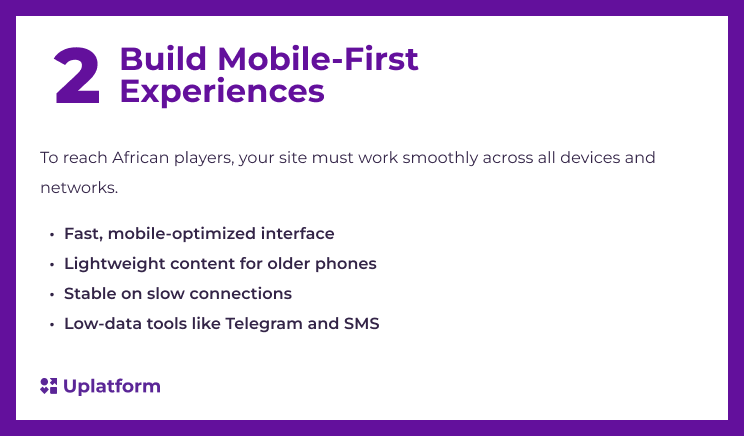
Most African players access betting sites on entry-level smartphones and unstable mobile networks. If your website isn’t optimized for that environment, you’ll lose players instantly.
Your iGaming project should deliver:
- Fast loading even on slower connections
- Efficient mobile UX across devices
- Lightweight casino content that runs smoothly
- Options for low-data betting
Tools that work extremely well in Africa include Telegram Betting and SMS Betting for players with limited mobile data.
3. Speak the Language and the Culture
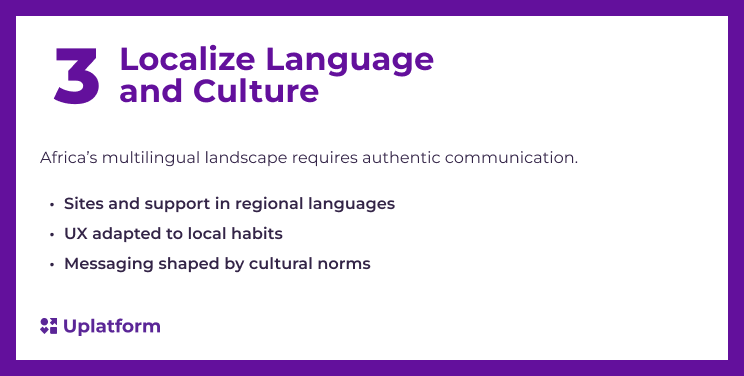
Africa is the most linguistically diverse region in the world with nearly 2,000 languages. While English, French, Arabic, and Portuguese are widely used, many players engage most comfortably through regional languages such as Swahili, Hausa, Yoruba, Amharic, and Zulu.
Effective localization means:
- Offering website, app, and support in local languages
- Using familiar cultural references for bonuses and promotions
- Localized UX design that feels native, not foreign
- Messaging that reflects regional values and habits
Localization builds trust and increases long-term retention.
4. Integrate Local Payment Methods That Players Actually Use
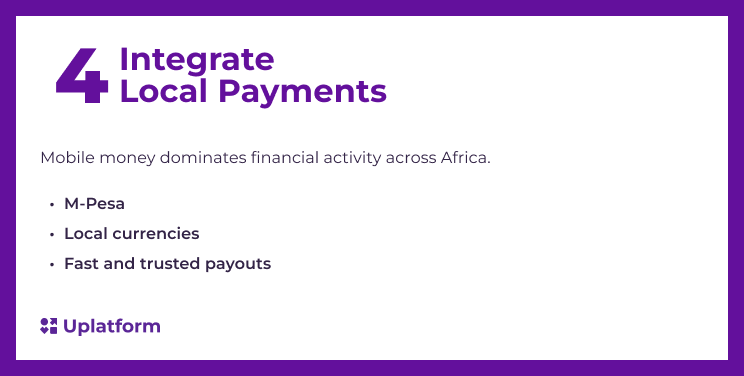
Traditional banking is not dominant in Africa. Mobile money is king.
To operate successfully, your cashier must support:
- Mobile wallets like M-Pesa
- Local bank transfers where available
- Flexible multi-currency support
- Fast deposits with transparent withdrawal flows
Local payment integration directly impacts conversion, brand trust, and long-term loyalty.
5. Understand Regional Licensing and Regulatory Requirements
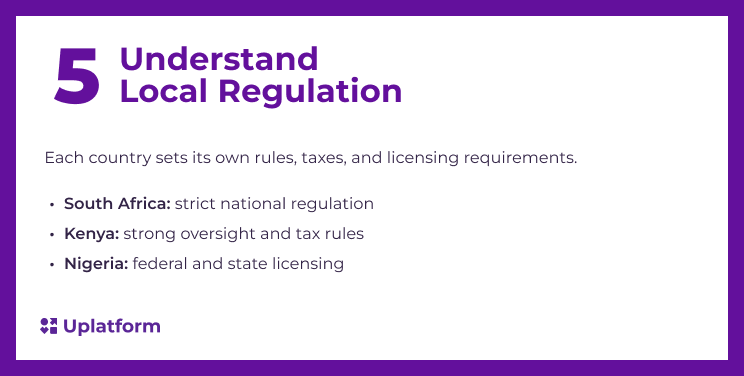
Regulation varies significantly across Africa. Each market has its own rules, taxes, and licensing conditions.
Examples:
- South Africa – tightly controlled by the National Gambling Board
- Kenya – regulated by the Betting Control and Licensing Board
- Nigeria – governed by the National Lottery Regulatory Commission, with state and federal frameworks
To enter these markets legally, operators must:
- Review each jurisdiction’s licensing requirements
- Follow advertising restrictions and tax rules
- Monitor regulatory changes in real time
- Work with local partners where required by law
Non-compliance results in bans, heavy fines, or blacklisting.
6. Localize Your Offer and Marketing Strategy

African markets reward brands that take the time to understand player behavior, not those who copy-paste global campaigns.
To succeed, focus on:
- Fully localized websites and customer support
- Promotions tied to local holidays, leagues, and events
- Region-specific bonus handling
- Ad campaigns that follow local cultural norms and regulatory rules
What doesn’t work:
Untargeted global offers, irrelevant bonuses, or ignoring local cultural nuances.
7. Optimize Your Tax and Financial Planning
Each African market applies its own taxes, license fees, and reporting obligations. These can include:
- Betting turnover taxes
- GGR taxes
- Licensing and renewal fees
- Withholding tax on player winnings in some countries
- Advertising and compliance levies
Understanding these costs early helps operators:
- Avoid legal issues
- Forecast accurately
- Prevent unnecessary financial risk
Local accounting partners are essential for accurate reporting and long-term compliance.
8. Maintain Strong Post-Launch Compliance
Launching in Africa is only the beginning. The region moves fast, and regulators are increasingly proactive.
You must:
- Update RNG certifications and content as required
- Maintain strict KYC and AML standards
- Monitor payment flows for transparency
- Keep responsible gambling tools active and visible
- Track affiliate activities and ad content
- Report data according to each regulator’s schedule
Strong compliance is the foundation of long-term survival in African markets.
With strong localization, compliance, and with the right igaming platform provider partner, Africa becomes a powerful long-term growth opportunity for operators.
Uplatform delivers localized casino and sportsbook content with 16,500+ games and 260+ sports and esports titles, tailored for regional player preferences. The platform supports 68+ languages including Swahili, Hausa, and Arabic, along with 550+ payment methods such as M-Pesa and MTN MoMo and 200+ currencies. Mobile-first tools like Telegram and SMS betting ensure strong performance even on low-bandwidth connections. Beyond launch, Uplatform continues to support operators with market insights, operational guidance, and ongoing optimization, helping brands localize effectively and scale with confidence across Africa.
When Life Gave Uplatform Lemons at SiGMA Central Europe 2025

ICE Barcelona 2026 is almost here, and yes we know everyone’s already packing, planning, and counting the days.
Before we jump ahead, here’s a quick #ThrowbackThursday to a moment when a simple idea unexpectedly turned into something big. SiGMA Central Europe landed in Rome for the first time this year! While the venue was brand new and the expo completely unfamiliar, no one anticipated the first and unlikeliest of the event’s many highlights to stem from a simple, brush-off wish: ‘I really want to try Italian lemon gelato.’
That one comment sparked a direction that changed everything.
What started as a casual idea quickly evolved into one of Uplatform’s most memorable expo concepts: a stand built entirely around freshness, energy, and the sunny spirit of Rome. Not just decoration, but a full creative narrative that reflects who we are as a brand.
And yes — there were lemons. A lot of lemons!
The Creative Spark: Why Lemons?
It was the first time the Uplatform team had to come up with a new stand concept in just eight weeks, but the tight time frame and the event’s scale created exactly the kind of real-world pressure that pushes creativity forward.
When exploring visual ideas, the team was drawn to something bright, fresh, and instantly uplifting — and lemons fit that naturally. Their vibrant color, clean simplicity, and clear associations with freshness and summer aligned perfectly with the message the team wanted to deliver. Lemons also carry a subtle hint of flair, evoking craftsmanship, warmth, and that effortless Mediterranean brightness — all without a complicated backstory. Most importantly, they make people smile and leave a memorable impression, both sharp and light at the same time.
So the stand concept became a mix of Italian summer energy and Uplatform’s own message: Fresh Solutions for Juicy Profits — a lighthearted metaphor with real strategic meaning. In iGaming, opportunities are everywhere, but only the brands that know how to “squeeze” them correctly turn them into results. That’s exactly what we help operators

From Idea to Reality: A Fast, Intense Build
The timeline was tight. Very tight.
Lemon trees needed to be custom-made from another part of the world, and that included having the branches sliced to the weight specifications. The team needed to have the two-tone freight to avoid any complications.
During the same period, the team also had to meet the legal requirements tied to Italy’s catering standards. The logistics stretched across six countries, and every detail had to be carefully coordinated to avoid overlaps in menus, staffing, and marketing. All materials needed to be perfectly aligned and delivered on time to the destination in Rome.
“It went smoothly in the end — though it certainly tested our nerves and probably added a couple of gray hairs along the way,”
Ana, Uplatform’s event manager, joked.
“But it was absolutely worth it!”

Stepping Inside: A Stand No One Could Walk Past
The result was managed and organized so well, it absolutely looked as if the team had a custom Italy-integrated stand prepared to be shipped to Rome.
Lemon-shed branches were designed overhead the booths to make guests feel as if they had stepped in an Italian courtyard. Throughout, guests saw large, yellow cedro-inspired showpieces accompanied by colored menus that complemented attired members of the serving team. From start to finish, the Uplatform team transported guests into the Italy of their dreams.
A few of the stand’s best attributes:

Lemon Gelato Served Inside Real Lemons
These lemons ended up being very popular, and the team even admitted being slightly surprised at the amount of soft, fragrant lemons they would need.
Aperol Spritz Fountain
A real Italian fountain pouring a cold and refreshing Aperol Spritz. Guests serving themselves, created more than a few videos from the wall, which became a popular moment from the expo.
The Lemon Mirror Selfie Spot
A giant mirror framed with lemons. Naturally, it became a magnet for photos, stories, and tags.
A Skill-Based Mini-Game of lemon throwing with an instant $100 Prize
Only the most determined players won — a neat reflection of how opportunity and skill play together in iGaming.
All of these elements worked together to create something fun, energetic, and unforgettable.
Reactions: “This Is Your Best Stand so Far!”
Visitors didn’t just see the stand — they felt the concept.
People walked in and smiled. They stayed, took pictures and brought their coworkers, and made return visits for more gelato. And the team kept hearing the same thing over and over:
“This is the best stand”
..and for good reason.
Attendance at the SiGMA expo in Rome was very high for a first-year expo, and as the team arrived, they could only wonder how high the attendance would be.
The buzz was social. Photos, reels, and stories; the lemon identity was everywhere.
Brand Impact: Fresh Visuals, Strong Message
The stand was a breath of fresh visual air.
It made the Uplatform message even more prominent and pulled messages together, which, beyond the aesthetics, made the message more memorable.
- Fresh solutions, smart tools, real profitability.
- A brand that brings energy instead of complexity.
The stand let the team build connections with new potential clients, strengthen partnerships, and enhance visibility in one of the biggest European markets. Additionally, they were able to creatively remind the industry that standing out from the competition is simply about differentiating the experiences, the core of every brand, and the packaging of the products.
Looking Back: Lessons, Wins, and a Bit of Laughter
The team pridefully noted that people arrived, and before even speaking, they understood the essence of the brand and walked right up to the most “Instagrammable” stand.
Proposals for the next event included: “More gelato. Always more gelato.”
The takeaway:
Quite a lot of ideas and excellent concepts in the team were present. Culture and consideration for the details were also important. When the team goes fully in on a theme and sticks to it on every level. When it comes to printed materials, even the smallest details, and gigantic neglected time indeed, the result is usually a hit.
Final Note
When you get lemons, don’t just display them. Create an entire experience that people remember for a long time. Uplatform used a simple fruit to symbolize the difficulty of any situation operators might be in, and to show that they will always find a way to succeed. SiGMA Central Europe 2025 was more than an exhibition for the team. It was an experience and a statement. A proud, colorful, and energetic one.
The Uplatform team joked that if they could do it over again and the universe gave them more lemons, they’d show up with even larger freezers.
However, it’s clear to everyone that when life gives you lemons, you don’t just make lemonade. You make one hell of a stand.
If SiGMA was about turning pressure into momentum, ICE Barcelona 2026 is about what comes next. With the Bloom Beyond Expectations theme, Uplatform is taking everything we cultivated this year and pushing it further, helping businesses move past survival mode and into real, sustainable growth. From fresh ideas to fully matured solutions, Barcelona is where challenges start to bloom into opportunities.
So if you missed the lemons, don’t worry. The stand may come down, but the energy stays. And Uplatform is already preparing the next experience building on everything we’ve learned and taking it one step further.

Casino platform provider: Payments and Integration

Payments have always shaped the player experience in iGaming, even when many casino platform providers treated them as a technical afterthought. Every failed deposit, slow withdrawal, or missing local method creates friction players immediately notice.
Today, that friction has real commercial consequences. Payment performance influences conversion, retention, regulatory compliance, and the ability to operate efficiently across multiple markets. For operators, payments are not a technical checkbox but a core operational decision.
A strong casino platform provider gives operators the foundation to run payments securely, reliably, and in line with regional expectations. Knowing how payment systems work is essential for anyone building or expanding an online gambling operation. At Uplatform, we see these challenges daily when supporting operators entering new and highly regulated markets.
1. Understanding the Payment Landscape
Every hour, operators handle thousands of deposits, withdrawals, verification actions, and compliance checks. These interactions must be quick, transparent, and secure, because they touch the most sensitive part of the user journey.
Players expect convenience above everything. Deposits should clear within seconds. Withdrawals should not be delayed without explanation. If a player encounters friction more than once, the likelihood of churn increases dramatically.
Regulators, on the other hand, require accuracy and traceability. Licensing frameworks often mandate identity verification, income checks, anti-money-laundering screening, responsible gambling controls, and detailed transaction audits. An operator that lacks the technical infrastructure to support these processes risks fines or license suspension.
Payment Service Providers require consistency. They expect operators to follow standards for transaction routing, settlement, and security. If an operator’s website sends unstable or incomplete data, PSPs may impose higher fees, block certain methods, or terminate service.
This three-way pressure shapes the entire architecture of iGaming payments.
A major factor is regional variation. Payment behaviors differ not only by continent but by country. A method that converts exceptionally well in Europe may be irrelevant in Africa. A trusted solution in Asia may not exist in Latin America. Here are the general patterns:
- Europe prefers card payments, SEPA transfers, and digital wallets.
- Africa operates largely on mobile money infrastructure.
- Asia leans toward e-wallets, bank transfers, and prepaid systems.
Operators that enter new markets without adapting their payment stack face higher decline rates, slower conversions, and reduced player trust. A provider with broad payment coverage allows operators to expand without rebuilding systems for every region.
Modern payment workflows must combine speed, compliance, and flexibility. The diversity of methods players use today makes a one-size-fits-all approach ineffective. Operators need infrastructure that can grow and adjust as the market evolves.
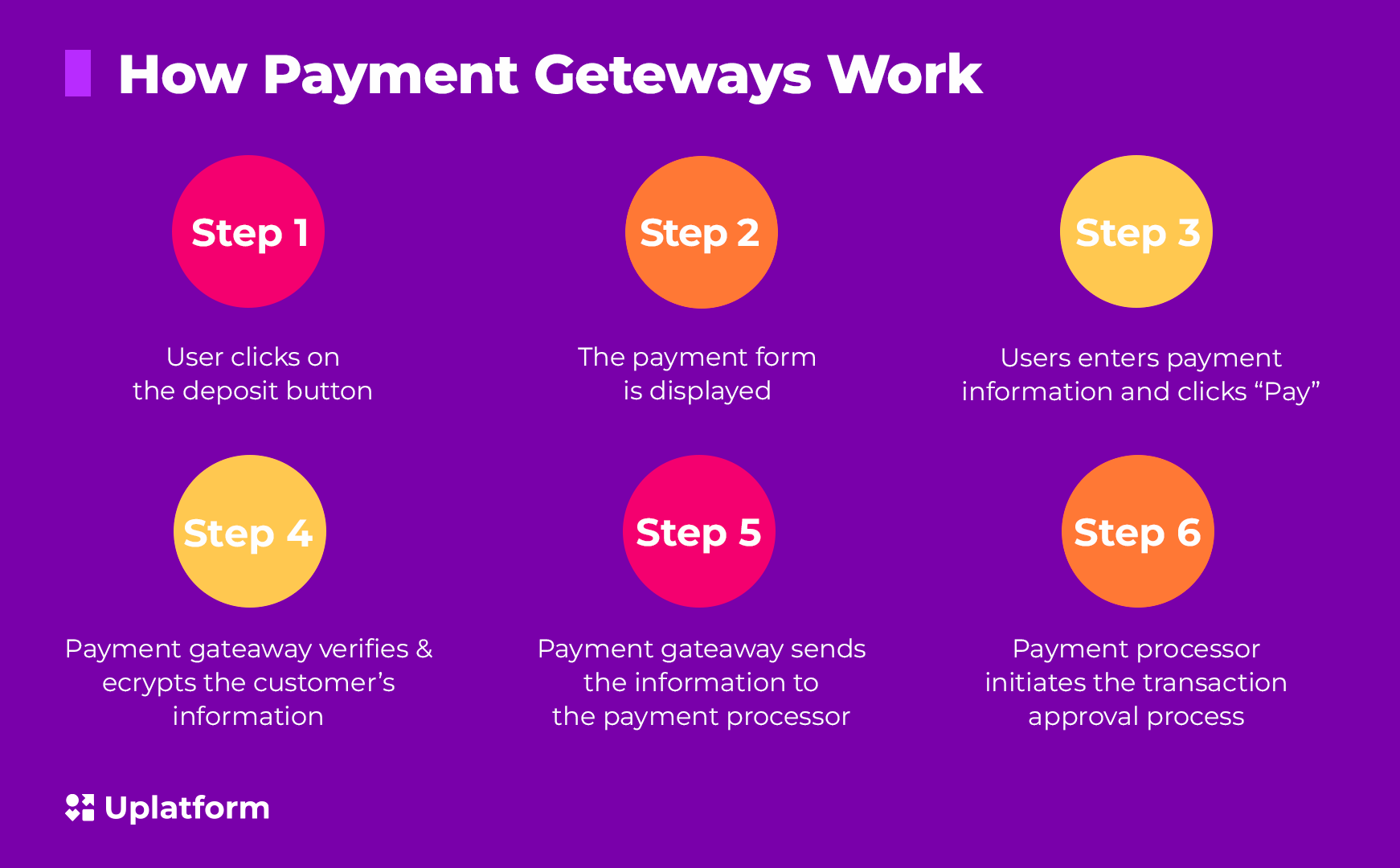
2. Payment Methods Overview
A successful iGaming operation must offer a wide range of familiar and reliable payment methods. Players often deposit impulsively, and if their preferred method is missing or inconvenient, they leave the website without completing the process. Payment variety directly affects retention, lifetime value, and overall satisfaction.
Below is an expanded look at the most important payment categories.
Card Payments
Visa, Mastercard, and Maestro continue to dominate many regions. Their global presence, ease of use, and instant authorization make them essential. For operators, card payments require integration through PSPs that route transactions through acquiring banks. Proper routing improves approval rates, especially in markets where issuing banks frequently decline gambling transactions.
Card payments are also subject to strict compliance rules. Operators must handle secure tokenization, PCI DSS requirements, and transaction monitoring. When done correctly, cards remain one of the most stable pillars of iGaming payment flows.

E-Wallets
Digital wallets such as Skrill, Neteller, PayPal, and ecoPayz offer faster payments, higher privacy, and often better approval rates than cards. Players appreciate the separation of their gambling funds from their main bank accounts. Operators like them for reduced chargebacks and smoother cross-border processing.
E-wallets also support instant withdrawals, which is a major competitive advantage. When players can withdraw quickly, trust grows, and retention improves. Some markets even treat e-wallets as the primary deposit method.
Bank Transfers
Bank transfers suit players who prefer traditional financial channels. They are widely used for larger deposits and withdrawals. In some regions, transfers are considered safer or more legitimate than cards.
Instant bank transfer systems have changed the landscape significantly. In Europe, solutions built around open banking allow players to authenticate with their bank and complete a transfer within seconds. This bridges the gap between traditional banking and instant digital payments.
Prepaid Vouchers
Prepaid solutions like Paysafecard cater to users who want to control their spending, maintain privacy, or avoid using their bank details online. These vouchers are popular among younger audiences and in regions with lower financial inclusion.
Prepaid systems generally support only deposits, not withdrawals. Operators need additional methods to handle cashouts, usually via bank transfer or e-wallet. Despite this limitation, prepaid vouchers remain a valuable part of the payment mix.
Mobile Payments
Mobile carriers and mobile wallets play a defining role in regions with limited card penetration. In parts of Africa, mobile money is the primary financial infrastructure. Players deposit using only their phone number, and funds move instantly between accounts.
Mobile payments reduce friction and bring gambling accessibility to markets where banking services are limited. Their simplicity and reliability make them indispensable for operators focusing on emerging regions.
Offering all these methods gives players flexibility and helps operators meet the expectations of various demographics and regions. A strong payment portfolio improves conversion rates and minimizes abandonment during the deposit flow.
3. PSP Integration
Payment Service Providers sit between the operator’s website and the financial networks that process transactions. A good PSP reduces complexity, consolidates payment methods, and ensures compliance with global standards.
Instead of building separate connections to each card scheme, e-wallet, or bank, operators integrate a single API that handles multiple routes. This simplifies development and maintenance. PSPs also provide essential infrastructure such as encryption, fraud screening, currency conversion, and reporting tools.
When evaluating a PSP, operators must consider several factors:
- Transaction fees and pricing transparency
- Settlement times for deposits and withdrawals
- Supported currencies and local payment methods
- Geographic coverage and regional licensing
- Stability of the API and historical uptime
- Fraud and risk management tools
A PSP that performs well in one region may not necessarily excel in another. That is why many operators use multiple PSPs. This ensures redundancy, better routing, and optimized approval rates.
For iGaming, reliable PSPs also handle the industry-specific challenges of chargebacks, high-volume withdrawals, and compliance audits. Their infrastructure must support large spikes in traffic during peak hours or major sport events.
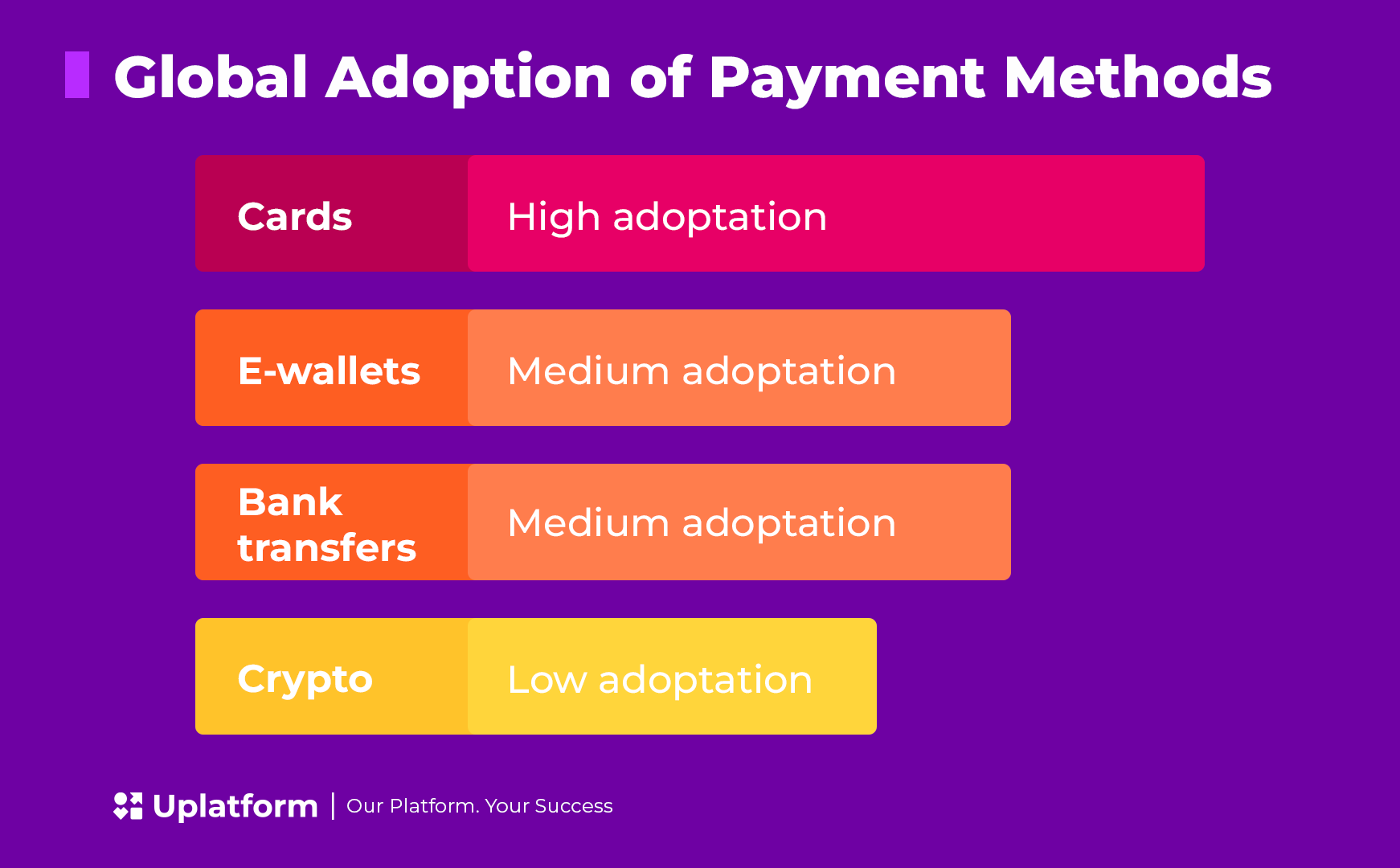
4. Fraud Prevention
Fraud is one of the most critical concerns in iGaming, driven by the high speed of transactions and the presence of bonuses that attract bad actors. The most common threats include identity fraud, payment fraud, chargebacks, multi-accounting, and bonus abuse.
Effective fraud prevention requires several layers of protection:
KYC and AML verification
Identity checks confirm that a player is who they claim to be. These procedures include document verification, database checks, and proof of address. AML screening looks for suspicious behavior such as rapid deposits and withdrawals, mismatched identities, or transactions linked to high-risk jurisdictions.
Real-time transaction monitoring
Platforms must flag unusual activity such as repeated failed deposits, sudden spikes in bet sizes, or rapid deposit-withdrawal cycles. Automated alerts help operators intervene before significant damage occurs.
Multi-factor authentication
Requiring an additional verification step strengthens account security and reduces unauthorized access. This protects both the player and the operator.
Behavioral analytics
Advanced platforms use behavior-based detection to identify irregular betting patterns or deposit habits. This is particularly effective against bonus abuse and multi-accounting.
Chargeback management
Chargebacks cost operators money and can damage relationships with PSPs. Proactive management includes proper documentation, dispute handling, and clearer payment descriptors to reduce misunderstandings.
A strong fraud management system builds trust and reduces financial losses. It also helps operators remain compliant in jurisdictions where responsible gambling and AML requirements are becoming stricter each year.
5. Regional Payment Preferences
One of the biggest challenges for iGaming businesses is adapting to regional differences. Payment culture varies widely across the world.
Europe
Players rely on cards, SEPA transfers, and e-wallets. Instant payments are becoming the standard. Operators must support multiple currencies and offer fast withdrawals to stay competitive. Compliance is strict, so transparency and documentation are essential.
Africa
Mobile money dominates the region. Services like M-Pesa and Airtel Money give millions of users access to financial tools without needing bank accounts. Operators that do not offer mobile money often fail to capture the majority of potential players.
Asia
Asia’s payment environment is diverse. E-wallets, mobile banking, and domestic bank transfers are common. Prepaid vouchers are also widely used in countries where players prefer controlled spending.
Mobile optimization is mandatory, as many players access gambling services primarily through smartphones.
Americas
Payment habits vary between North America and Latin America. Cards, PayPal, and domestic bank transfers are common in the United States and parts of Canada. Latin America relies heavily on local banking tools, cash-based vouchers, and region-specific wallets.
Adapting payment methods to local preferences is essential for conversion. A mismatch between user expectations and available options results in lower approval rates and weaker player retention.
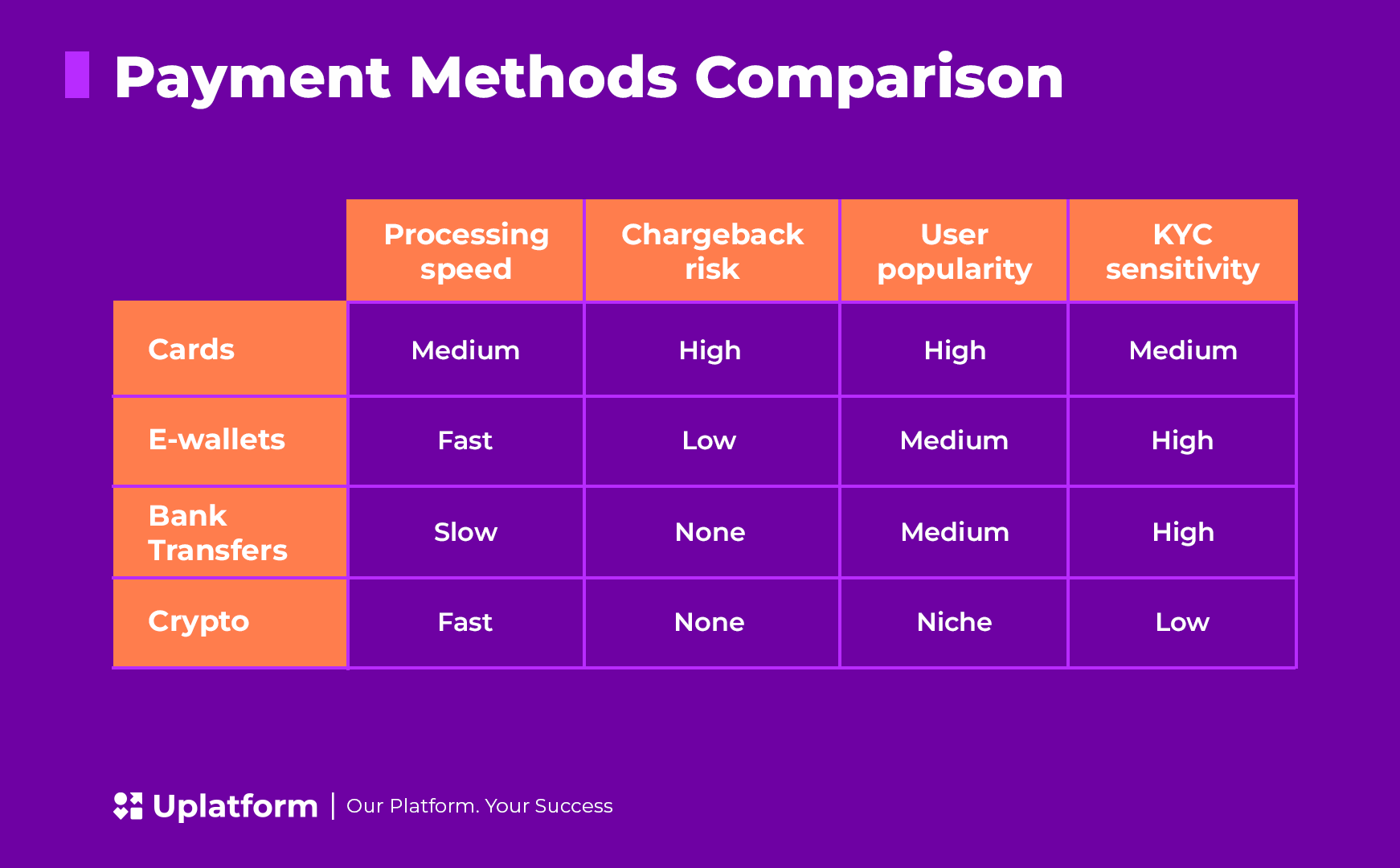
6. Crypto Payments
Cryptocurrency has become an increasingly relevant payment method in the iGaming sector. Crypto appeals to players who value speed, privacy, and independence from traditional banks.
Key advantages of crypto in iGaming include:
- Faster settlement times compared to traditional banking
- Higher privacy, as users do not need to share banking details
- Lower transaction fees in many cases
- Global accessibility, especially in regions with limited financial infrastructure
- Flexibility during periods of local banking restrictions
Operators must handle wallet management, conversion processes, and compliance standards adapted to crypto transactions. In some markets, crypto payments operate under specific regulatory requirements, while in others they remain unregulated or restricted.
The volatility of cryptocurrencies can be a challenge, although stablecoins reduce this risk by maintaining a fixed value relative to major currencies. When implemented correctly, crypto payments help operators reach broader audiences and offer an additional layer of convenience.
7. Optimization Strategies
Payment optimization directly affects revenue. If a player struggles to deposit or withdraw, they rarely return. Creating efficient workflows reduces drop-offs and increases the lifetime value of users.
Key optimization strategies include:
Multi-currency support
Allowing players to transact in their local currency prevents unnecessary conversion fees and improves trust. It also simplifies accounting for the operator.Clean user interface
Deposit and withdrawal flows must be intuitive. Unnecessary steps increase abandonment. Players should clearly understand fees, processing times, and verification requirements.
Fast withdrawals
Speed is one of the strongest differentiators in iGaming. Operators that offer near-instant withdrawals consistently outperform those with longer processing times.
Real-time analytics
Continuous monitoring of payment performance helps operators identify issues such as declining approval rates, regional outages, or method-specific problems.
Multiple PSPs
Relying on several PSPs allows for dynamic routing, which improves approval rates and provides redundancy if one provider experiences downtime.
Localized promotions
Some operators use targeted bonuses or incentives tied to specific payment methods. This encourages players to adopt more reliable or cost-efficient options.
A platform provider that offers these optimization tools gives operators the ability to scale efficiently in competitive markets.
AI in iGaming: How Players Use Artificial Intelligence to Gain the Edge

TL;DR:
AI is reshaping player behavior in iGaming. Bettors use predictive models for sportsbetting, casino players run slot simulations, and poker grinders rely on real-time solvers. But no matter how advanced the tools get, AI still can’t erase the house edge. This article explores how players use AI today, its real limits, and what this shift means for operators.
Introduction
Artificial Intelligence (AI) is no longer a tool used only by operators to manage odds, automate risk, or analyze player segments. It has now moved to the other side of the table: into the hands of the players themselves. From casual bettors running open-source models to experienced poker pros using real-time assistants, AI is changing how decisions are made in every vertical of iGaming.
This isn’t a doomsday scenario for operators—but it is a fundamental shift in player expectations and behavior. Understanding how AI is used on the player side has become not just a security concern, but a strategic necessity for anyone building or running an iGaming business.
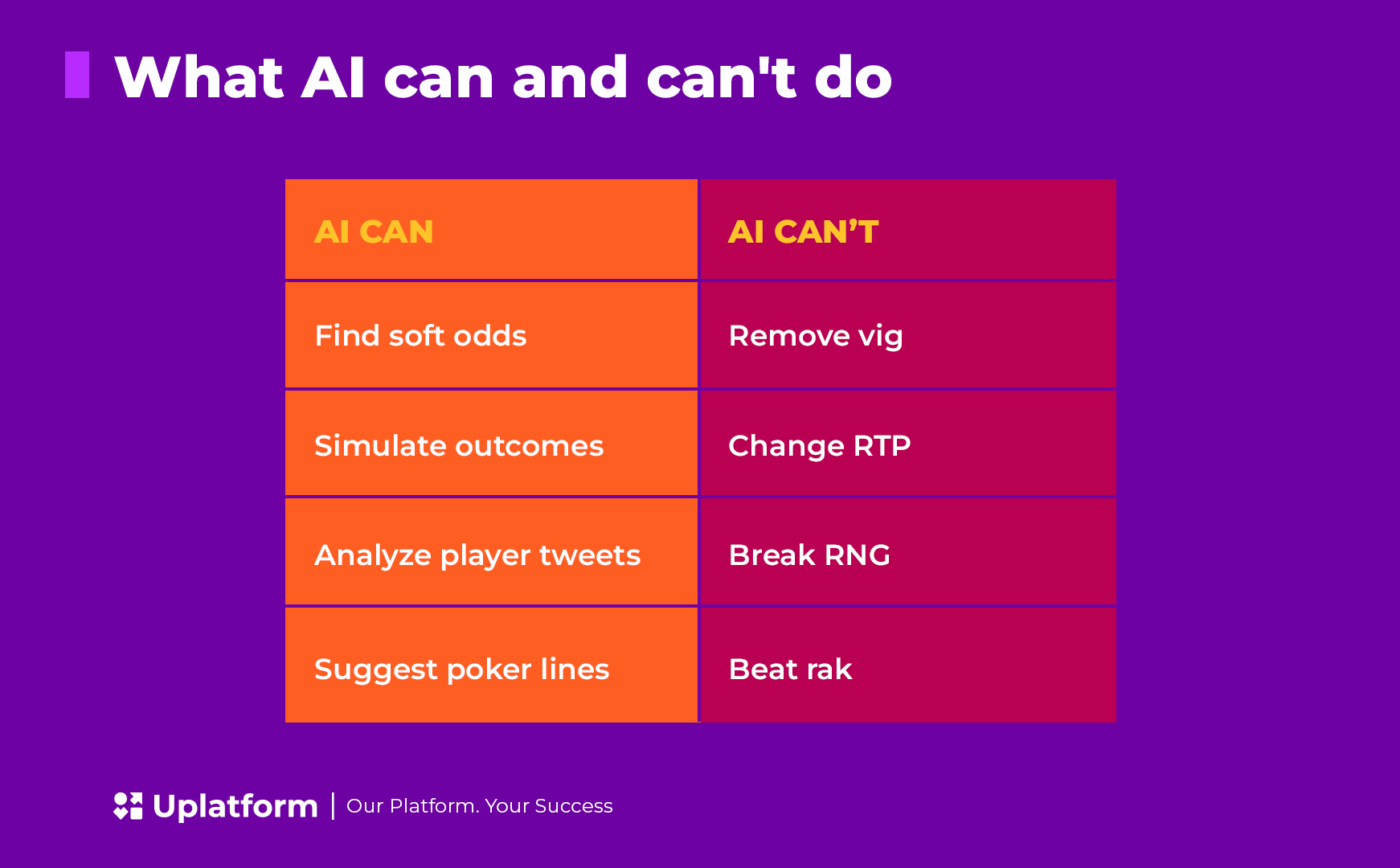
AI in Sportsbetting: A Numbers Game Evolving
Sportsbetting has always been driven by data, but AI has changed the scale and speed at which players can act on it.
Predictive Modeling and Simulation-Based Betting
Modern bettors can now run thousands of simulated outcomes for a single event using lightweight AI models. These models process:
- historical match statistics
- player fitness, injuries, or travel fatigue
- offensive and defensive efficiency ratios
- weather and venue data
- live odds movement across sportsbooks
A bettor with no coding skills can now plug CSV files into public AI tools, request ROI projections, and get instant recommended bets.

Real-Time Odds Sniping
Where humans used to rely on manual line-shopping, AI bots now scan odds across hundreds of sportsbooks in milliseconds, highlighting:
- arbitrage spreads
- soft lines before correction
- price drops due to slow-moving books
- middle opportunities in live games
This makes the “find value before the market adjusts” window much smaller.
NLP and “Hidden Signal” Analysis
Some players use Natural Language Processing (NLP) to scan coach interviews, player tweets, press leaks, or fan-forums to detect signals before they reach public feeds.
Sportsbooks aren’t competing only with intuition anymore—they’re competing with sentiment scraping, data mining, and automated decision engines.
Compliance Note: AI ≠ Always Allowed
Most sportsbooks classify automated betting bots, live-odds scrapers, or auto-executed wagers as a violation of Terms & Conditions. Even if the tool performs analysis only, not placing the bet, accounts can still be flagged for abnormal betting behavior.
AI gives players more information—but it doesn’t grant immunity from operator policy.
AI in Casino Games: Smarter Players, Same Math
Unlike sportsbetting, casino games are built on fixed house edge and Random Number Generators (RNG). AI doesn’t change the math—but it is changing how players think about the math.
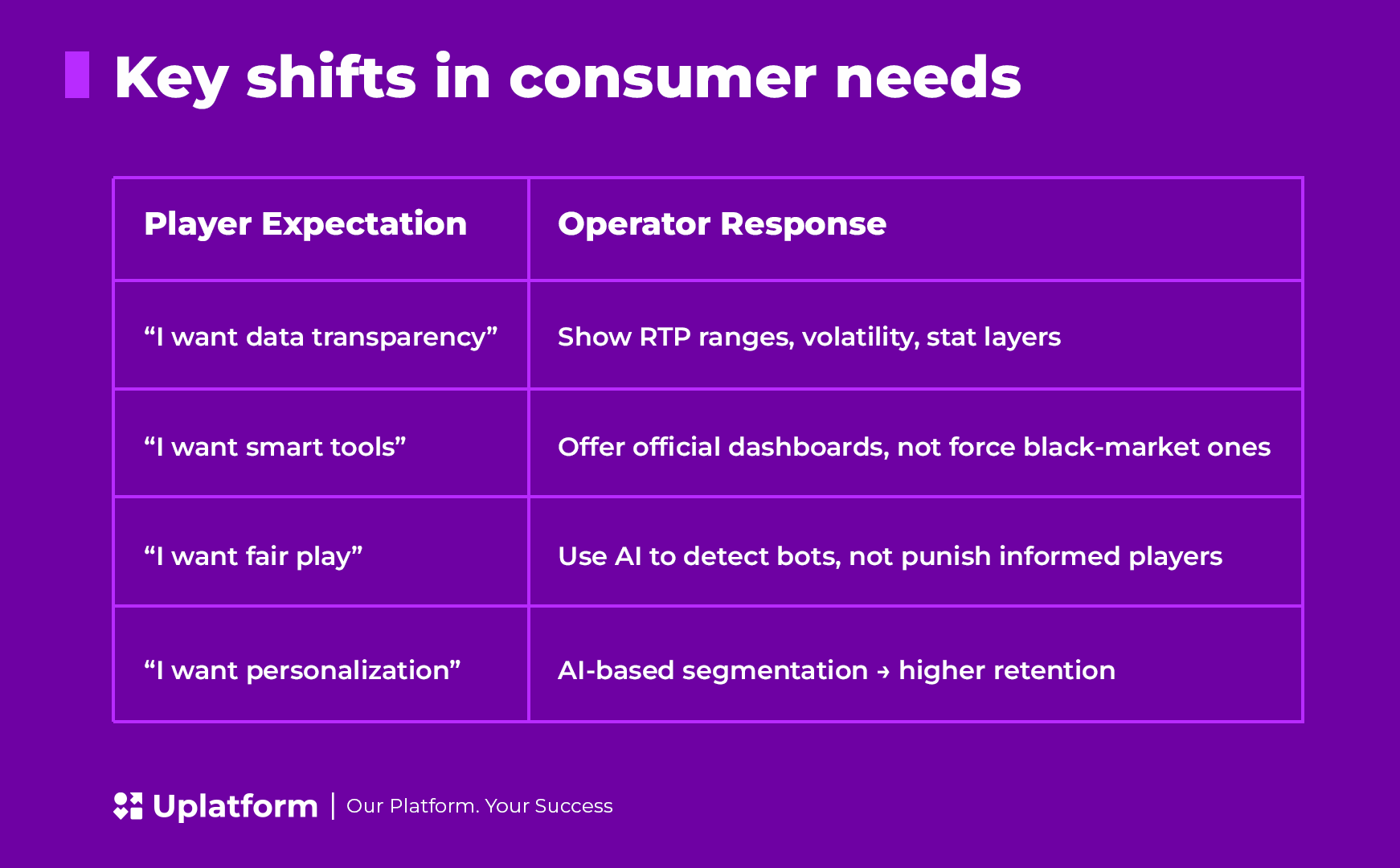
Slot Simulations and Volatility Mapping
Players can now record thousands of demo spins and feed them into AI models to chart:
- RTP deviation over time
- bonus round frequency
- volatility curve behavior
- streak clusters
Some communities even generate “slot heatmaps” to decide when a title feels “cold” or “worth entering.”
The issue? Every spin is still independent, and the long-term EV never turns positive.
Strategy Bots and Bonus Pattern Tools
Even basic AI models now advise casino players when to switch machines, how to run bonus hunts, or when to stop a session before variance burns the bankroll.
Again: strategy improves control, not odds.
Knowledge-Sharing Networks
Telegram, Discord, and forum groups now exchange AI-generated volatility logs like trading signals. That creates something new: collective pattern-based casino play.
But it still doesn’t beat the house. It just changes the psychology of losing.
AI in Poker & Skill Games: The Most Advanced Battlefield
If sportsbetting is data-driven and casino is probability-driven, poker is logic-driven—and AI has deeply influenced it.
GTO Solvers and Real-Time Assist
Poker solvers can now:
- identify the correct play for any board texture
- calculate mixed betting frequencies
- show exact EV differences between move options
- run full hand-tree analysis while a live hand is in progress
Some players even pipe solver suggestions into hidden overlays or side monitors. This is where most platform bans now happen.
Computer Vision and Dealer Pattern Reading
In live or camera-based formats, some users use computer-vision AI to:
- detect dealer hand rhythm
- track shuffled deck patterns
- log repeated motion behavior
These methods are rare—but they exist.
Botting in Social or Unregulated Poker Apps
Where regulation is weak, entire tables can be made of bots farming daily rewards or converting bonus chips into crypto.
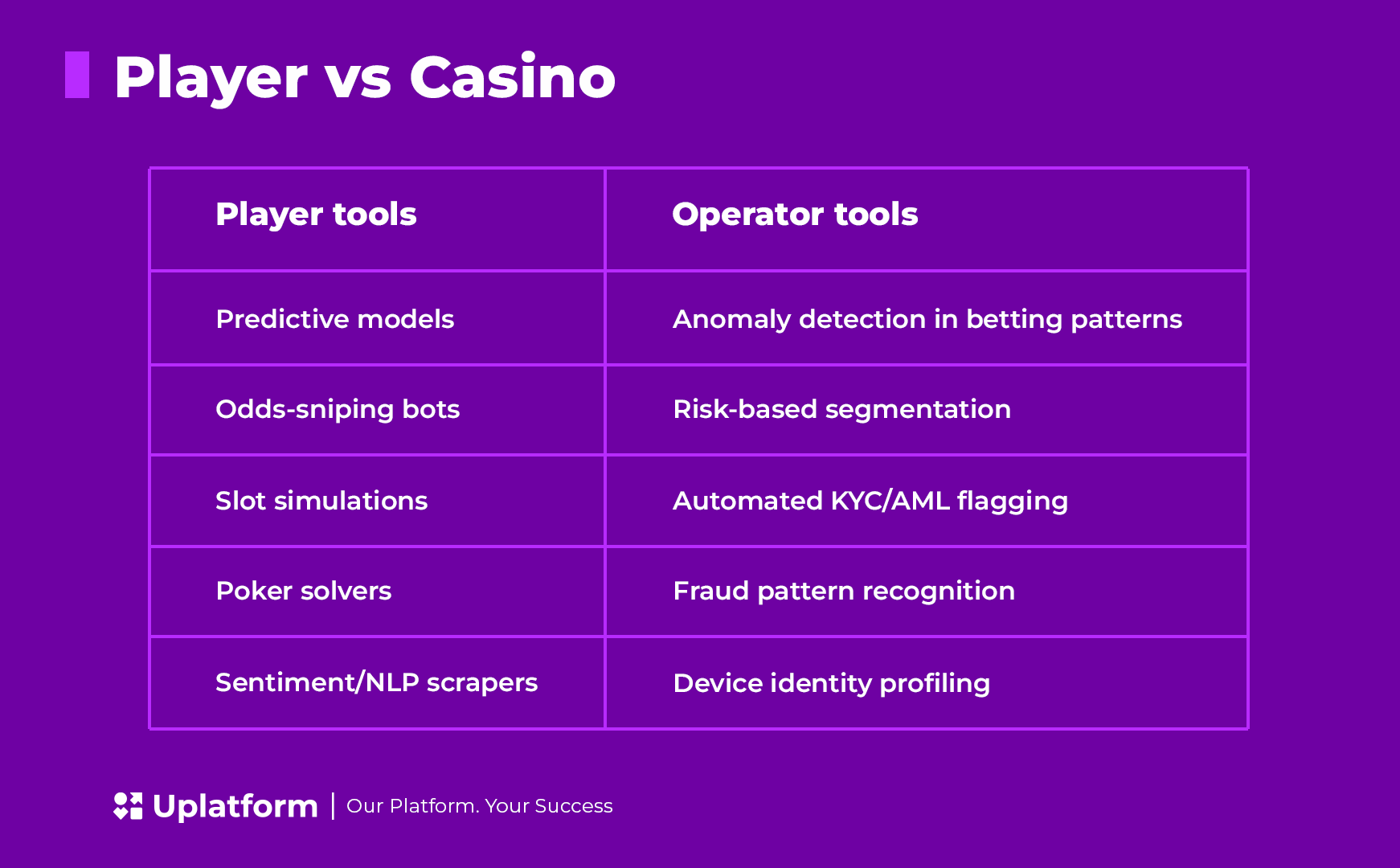
Where AI Stops: The Limits That Still Protect the House
Even the best AI cannot neutralize core factors in gambling:
1. The House Edge Is Permanent
- Casino games: fixed EV
- Sportsbetting: vig built into the line
- Poker: rake over time
AI can optimize input—but can’t adjust the math.
2. AI Needs Clean Data, and Players Rarely Have It
No real-time official feed = educated guess, not guaranteed edge.
3. Human Bias Still Leaks In
People override AI because of emotion, tilt, ego, or “gut feeling.” The weakness is rarely the model—it’s the operator of the model.
4. Operators Also Use AI
Modern platforms now run:
- bet pattern anomaly detection
- bot-traffic fingerprinting
- solver-like move consistency tracking
- device and latency identity checks
The race is no longer manual vs manual—it’s AI vs AI.
What This Means for Operators
AI-assisted players aren’t going away. The real question is: will operators adapt passively or strategically?
Some key shifts:
| Player Expectation | Operator Response |
|---|---|
| “I want data transparency” | Show RTP ranges, volatility, stat layers |
| “I want smart tools” | Offer official dashboards, not force black-market ones |
| “I want fair play” | Use AI to detect bots, not punish informed players |
| “I want personalization” | AI-based segmentation → higher retention |
Final Thoughts
AI is not destroying iGaming—it is raising the intelligence level of the average player. Where “sharp bettors” were once a minority, AI is now making data-driven behavior mainstream. This forces operators to move beyond the old model of “the house knows everything and the player guesses.”
The winners in this shift won’t be those who fight AI, but those who study it, regulate it, and build with it in mind. The industry is moving toward a future where fairness, transparency, and control are no longer features—they’re expectations.
The question for operators isn’t “How do we stop players from using AI?”
The real question is: How do we remain relevant in a world where they already do?
Pocket-Sized Play: Brazil’s Mobile Revolution in iGaming
TL;DR:
Brazil’s iGaming market is being reshaped by the rise of mobile use. With affordable smartphones, better internet, and a tech-savvy generation, online betting has moved entirely to the palm of the hand. From social habits to infrastructure, this mobile-first shift is defining how Brazilians play, pay, and engage with iGaming. Here’s how mobile became Brazil’s main arena for digital entertainment — and what that means for operators.
A Nation That Went Mobile-First
Few markets illustrate mobile dominance like Brazil. For many Brazilians, the smartphone isn’t just a device — it’s their main connection to the internet, entertainment, and even work. Over 250 million mobile connections and high 4G/5G coverage have made it the fifth-largest smartphone market globally.
This is a country that skipped the desktop era almost entirely. For millions, the first and only screen for betting and gambling is mobile. That cultural leap has defined the way Brazilians approach iGaming — fast, social, and always within reach.
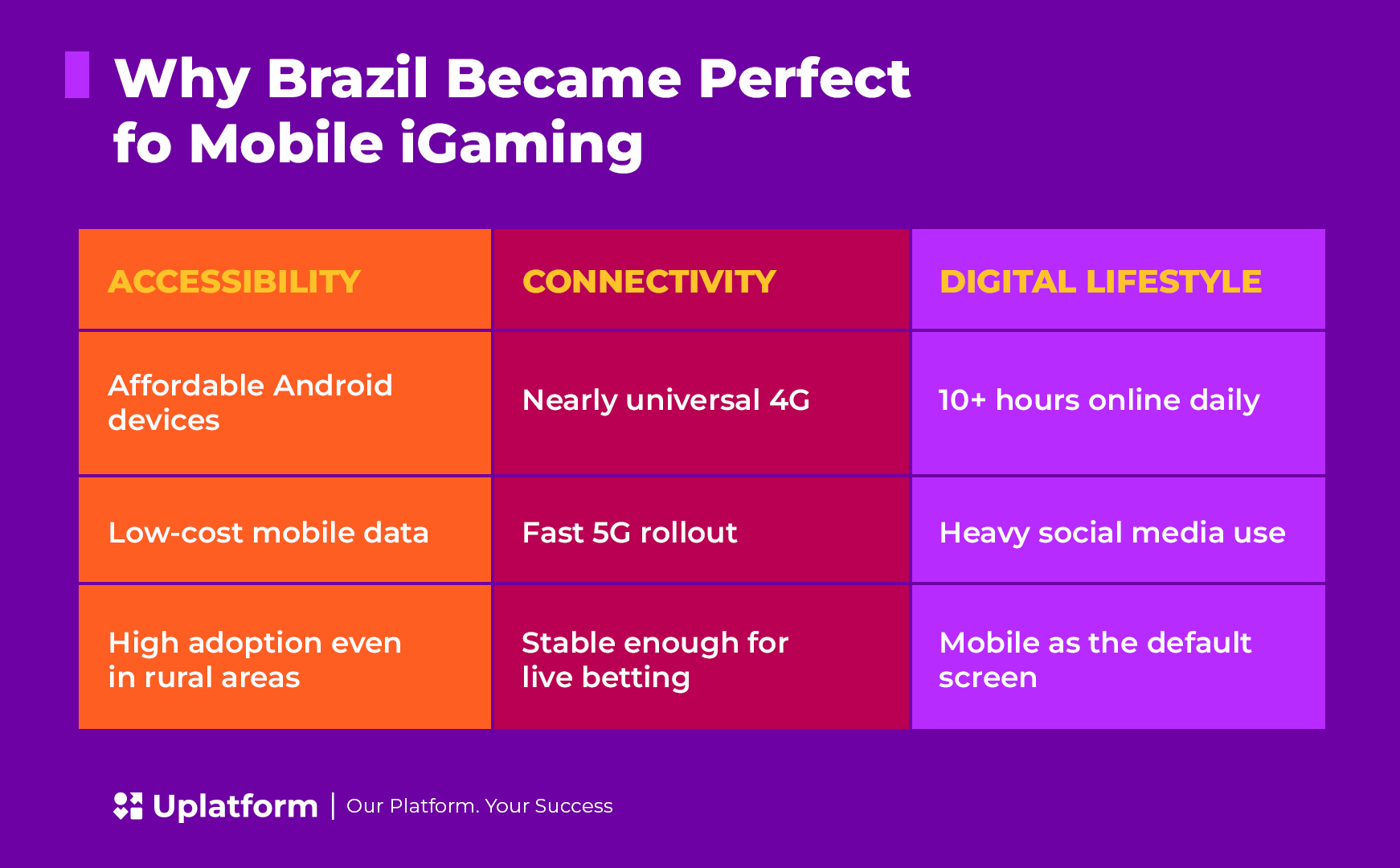
Why Brazil Became a Perfect Ground for Mobile iGaming
Three forces fuel this mobile revolution:
- Accessibility: A flood of budget Android devices and data-friendly plans made smartphones nearly universal, even in rural areas.
- Connectivity: Investment in broadband and mobile networks made live betting viable from virtually anywhere.
- Digital lifestyle: Brazilians spend over 10 hours a day online, and most of that is through their phones — social media, streaming, and increasingly, betting.
This combination turned iGaming into a pocket-sized experience where players place bets or spin slots instantly — anytime, anywhere.
The New Habits of the Brazilian Player
Mobile use in Brazil isn’t just about convenience, it’s woven into everyday culture. For younger audiences, mobile gaming works almost like social currency. They share results the moment they happen, follow creators they trust, and jump into group chats during live matches. Betting naturally blends into this behaviour, becoming another layer of digital entertainment that sits right alongside sports fandom and social media.
These players expect everything to happen now. Live odds that update instantly, betting UI that feel intuitive, cashouts that arrive instantly. And because most of them rely on mid-range phones and unstable connections, the apps that succeed are the ones that stay fast, lightweight, and reliable even under pressure. In this reality, the overall experience isn’t just a nice addition, it’s as important as the betting product itself.
Infrastructure That Powers Mobile Play
Mobile iGaming’s rise is tied to Brazil’s infrastructure boom. The country’s 5G rollout began in 2022 and now covers major cities like São Paulo, Rio de Janeiro, and Brasília. Meanwhile, 4G networks reach nearly 99% of the population.
This coverage allows operators to deliver high-quality streaming, live stats, and immersive casino content without lag. Combined with widespread smartphone penetration, it’s no surprise that over 80% of iGaming traffic in Brazil now comes from mobile devices.
Local Payment Methods
Payments are an important part of the story, but not the whole story. Yes, Pix revolutionized digital transactions — offering instant, 24/7, zero-fee transfers used by more than 160 million people — but it’s part of a broader financial evolution.
Brazil’s players use e-wallets, mobile banking apps, and prepaid vouchers just as actively. The trend isn’t about one method; it’s about frictionless transactions that match mobile habits. Players expect instant deposits, smooth withdrawals, and transparent verification — without having to deal with support.
For operators, that means adapting payment flows to local behavior, not just plugging in Pix. Supporting multiple trusted options and offering clear, localized onboarding builds the credibility that drives long-term retention.
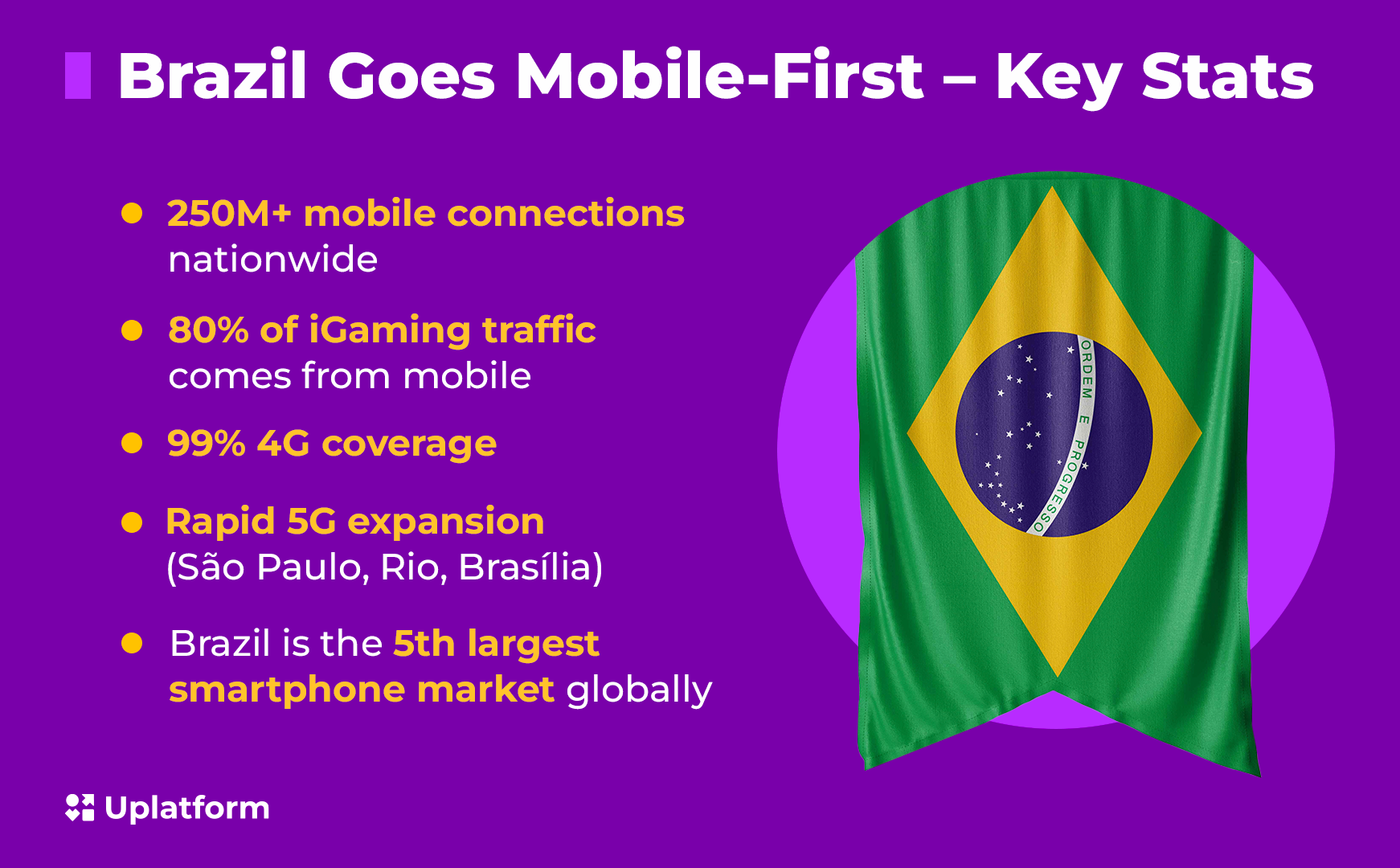
How Operators Can Win in Brazil’s Mobile Market
Success in Brazil’s mobile iGaming environment depends on localization and optimization, not just technology.
To connect with Brazilian players, operators need to:
- Build mobile-first: lightweight apps and responsive sites that run smoothly on varied devices and networks.
- Localize content: Portuguese language, culturally relevant visuals, and sports like football, basketball, and MMA.
- Prioritize UX: fast navigation, visible odds, quick withdrawals, and clear limits.
- Adapt payments: integrate instant local options (Pix, wallets, vouchers) and support transparent KYC.
- Emphasize responsibility: deposit caps, reminders, and local responsible-gaming resources.
The brands that succeed aren’t necessarily the biggest — they’re the ones that feel Brazilian.

Regulation and Market Outlook
Brazil’s regulated betting market entered a new phase in 2025, opening a structured licensing system. Enforcement is still ramping up, but the direction is clear: tighter oversight, consumer protection, and accountability.
Operators must now navigate new advertising rules, payment verification standards, and social-responsibility obligations. While these bring added complexity, they also push unlicensed competition out and increase player trust — key ingredients for sustainable growth.
In a country with 200+ million potential users and unmatched mobile adoption, regulation isn’t a barrier; it’s the foundation for long-term confidence.
What Brazil Teaches the Global iGaming Industry
Brazil’s mobile revolution is more than a regional success story — it’s a preview of where global iGaming is heading. In markets where mobile has already replaced desktop, players expect immediacy, flexibility, and culturally aligned experiences.
For operators expanding into Brazil or similar regions, the takeaway is clear: mobility isn’t a feature; it’s the default.
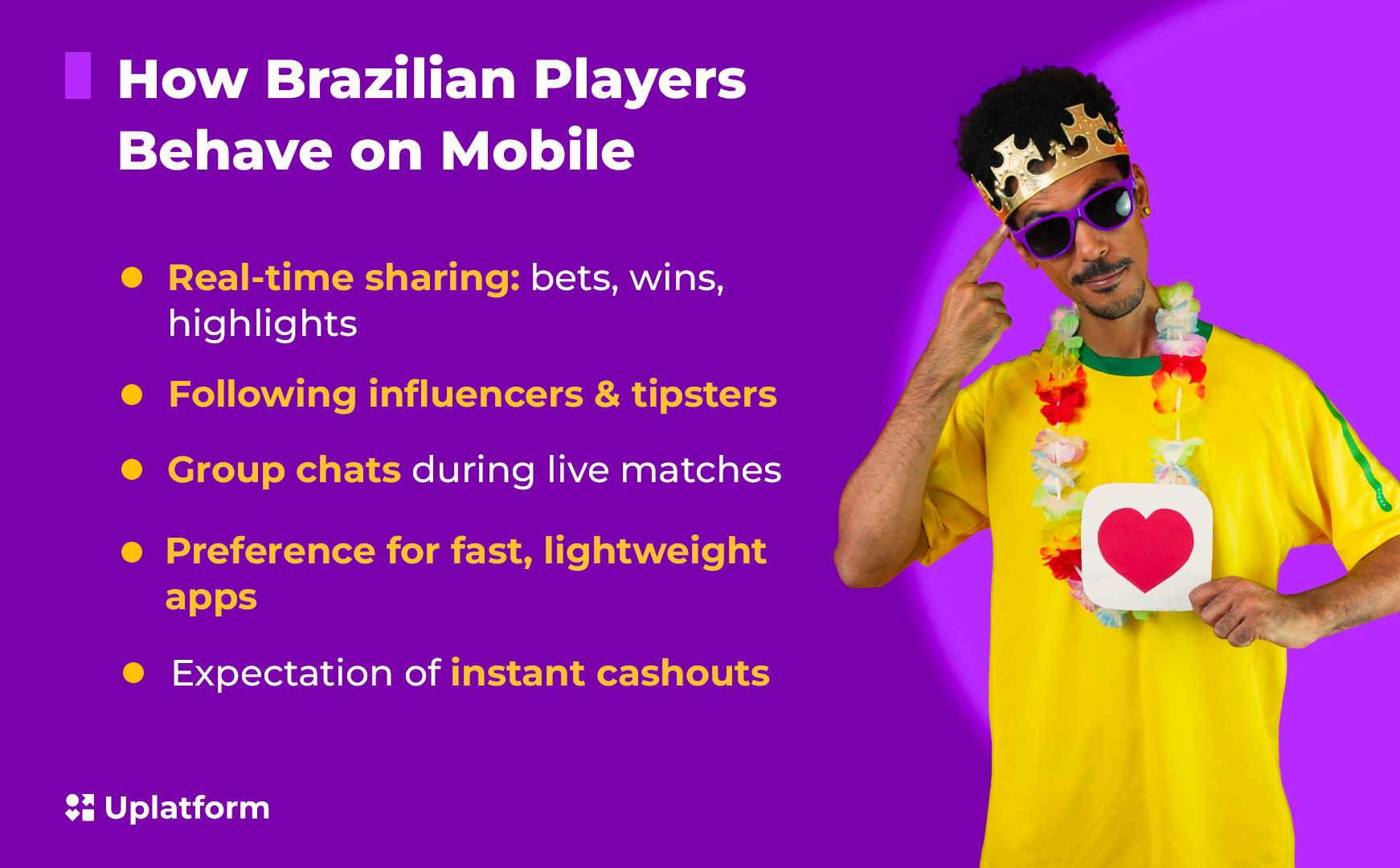
Where Uplatform Fits In
To thrive in a fast-moving market like Brazil, operators need a partner who understands mobile performance, localization, and compliance.
Uplatform provides a turnkey solution that helps brands go mobile-first from day one — optimized interfaces, scalable sportsbook and casino modules, and full support for Brazilian Portuguese and local payment systems.
It’s everything an operator needs to meet the expectations of Brazil’s mobile players — and to keep up as the market evolves.