Content Localization in iGaming: What Operators Need to Know
TL;DR:
Operators who enter new markets with translated content and broad payment menus consistently miss revenue targets. The ones who outperform do two things differently: they build around the two or three payment methods that drive 80% of market deposits, and they deploy content that reflects genuine local operational knowledge. After the Google March 2026 update, that specificity is now a ranking variable. Uplatform’s localization and managing tools give operators the infrastructure to act on that specificity without rebuilding the website for each new market.
This article is for iGaming operators and product directors managing launches or active operations in LatAm or African markets, specifically those who have encountered FTD (first time deposit) conversion gaps they cannot explain through standard funnel analysis.
What is content localization in iGaming?
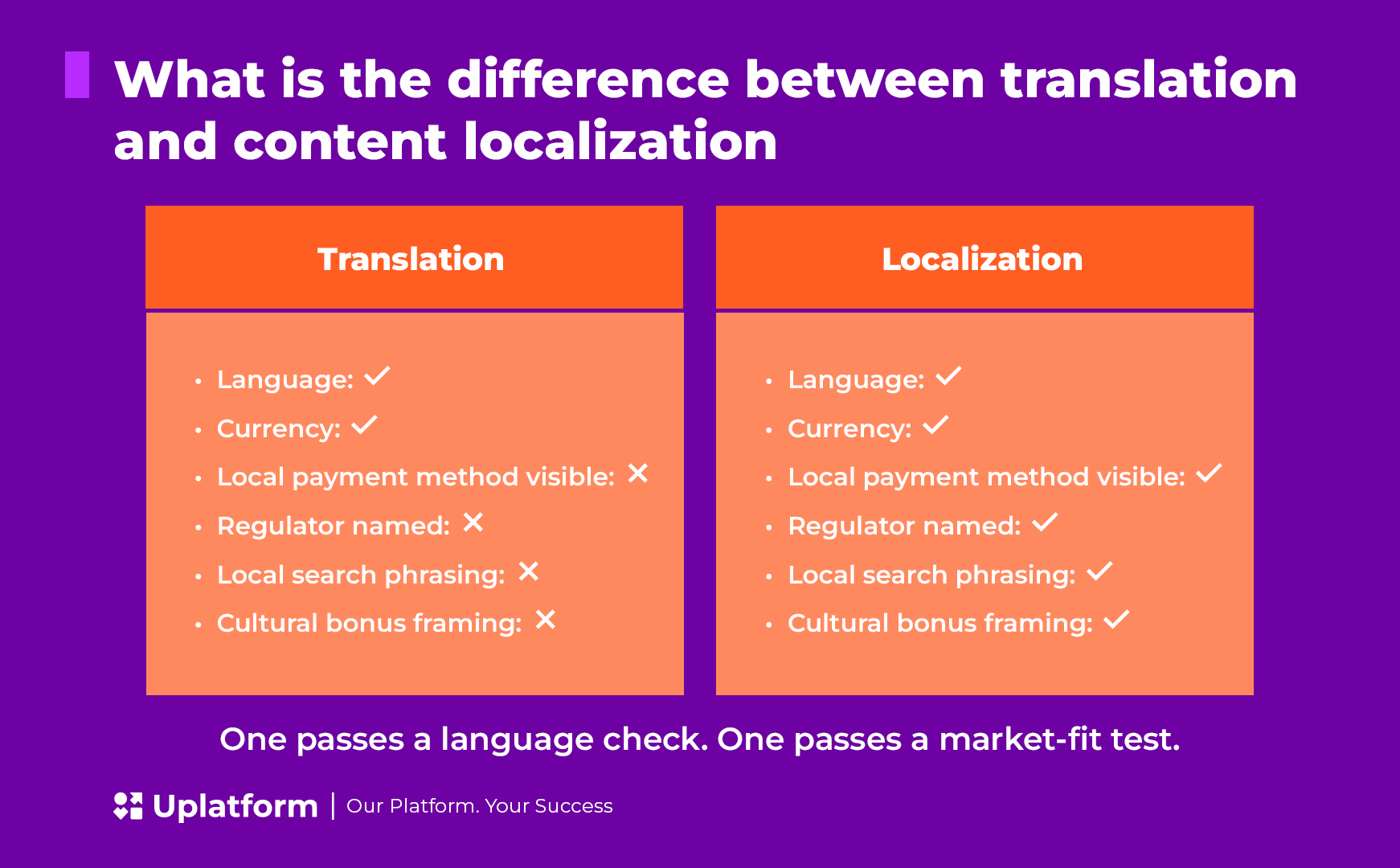
Content localization in iGaming adapts digital materials, payment pages, promotions, help content, SEO copy, to the regulatory, cultural, and behavioural expectations of a specific market. Operators who limit localization to translation produce content that passes a language check but fails a market-fit test. The distinction is not semantic. It shows up directly in deposit completion rates and first-month churn.
Why operators consistently fail at market entry, and what localization actually has to do with it
Most operators who underperform in new markets attribute the failure to the wrong cause. They point to licensing delays, marketing budget, or product fit. In the majority of cases, the actual failure point is content and payment localization, and specifically, the decision to treat both as secondary priorities that can be resolved after launch.
That sequencing error is expensive and consistent. Operators launching in LatAm with market-specific content consistently outperform those using adapted European content, particularly at the FTD (first time deposit) stage. The gap is not driven by brand or ad spend. It is driven by alignment. Whether the player, at every step of the registration funnel, encounters flows that match how they actually use financial services in that market.
Operators who treat localization as translation consistently underperform in new markets. Localization is one of the few variables that can improve both conversion and retention simultaneously. Most growth levers trade one against the other.
What operators get wrong about payment localization
Adding more payment options does not improve conversion. Identifying the two or three methods that drive 80% of market deposits and making them frictionless does. This is the payment Pareto reality that most operators only discover after launch, and it is the single most correctable mistake in a market entry strategy.
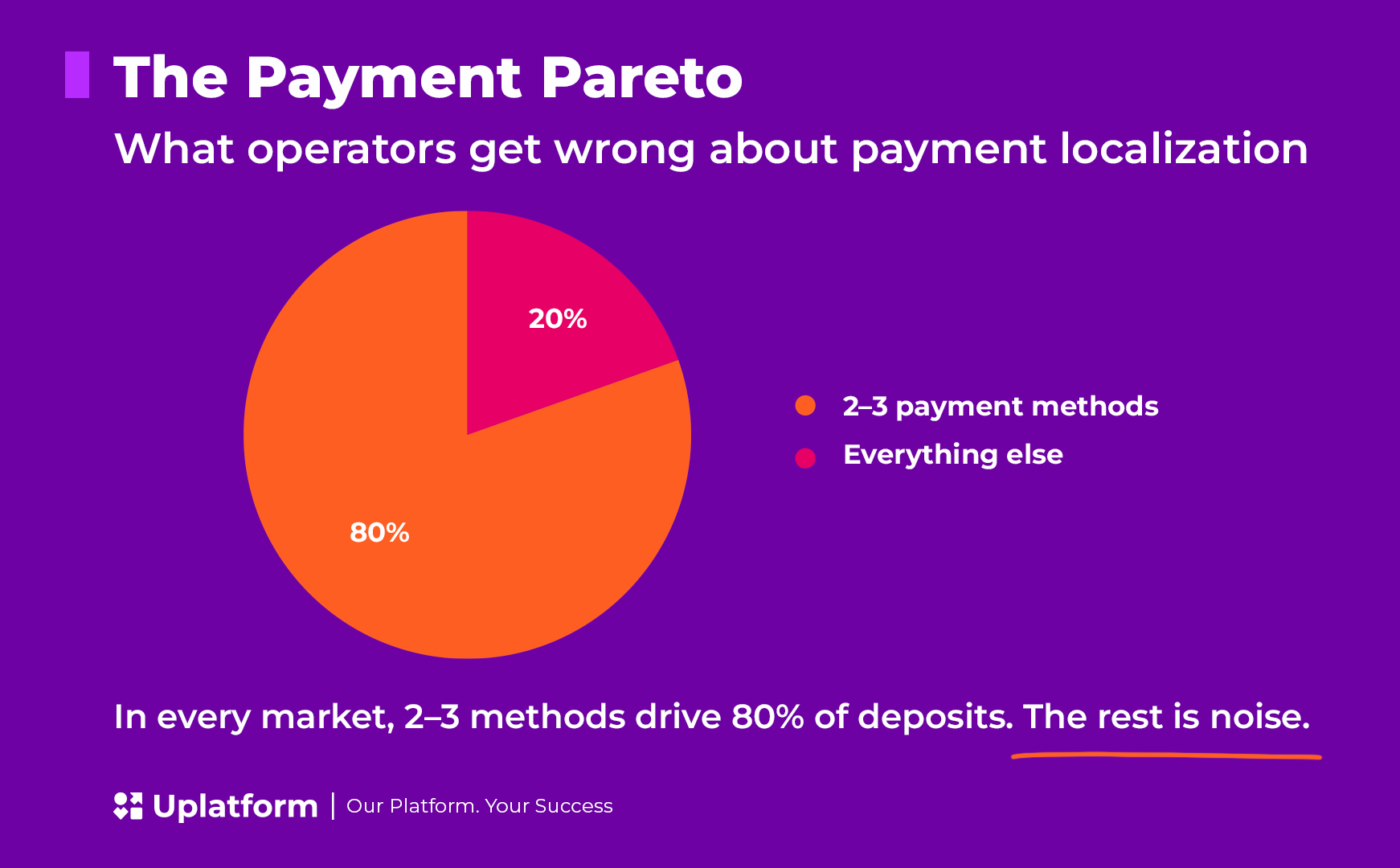
In Brazil, PIX is not a preferred payment method. It is the deposit infrastructure. Operators who configure PIX as the default path, immediately visible, zero additional steps, report deposit completion rates well above those who list PIX as one item in a ten-option payment menu. The extra options do not add choice. They add friction at the moment when a player is most likely to abandon.
In Kenya, M-Pesa holds an equivalent position. It processes the majority of mobile financial transactions in the country. An operator who treats M-Pesa as one of several mobile wallet options is reading market data about a different country. The correct approach is to build the payment experience around the dominant method and treat everything else as secondary.
The SEO implication follows directly. A player searching for online casino deposits in Brazil who lands on a page that makes PIX visually prominent converts at a higher rate than a player who has to scroll to find it. Payment visibility is a player trust signal and a conversion variable at the same time.
What the Google March 2026 update actually changed for localized iGaming contentRather than rewarding localization, the update focused on penalizing its absence, which is a different problem with a different solution.
Before March 2026, a well-structured page with correct geo-targeting signals, hreflang tags, regional subdomains, localised keyword placement, could rank adequately in a target market regardless of content depth. That approach stopped working. The update increased the weight given to market-specific entity references: named regulators, named local payment providers, specific regulatory frameworks. Pages that contain those references rank; pages that contain generic localized language do not.
In Colombia, a page that names Coljuegos, explains what a Coljuegos licence requires from an operator, and references the payment methods Colombian players actually use will outrank a technically superior page that mentions none of those specifics. In the UK, a page for a UKGC-licensed operator that treats regulatory compliance language as a formality, correct but thin, performs worse than a page that explains the UKGC’s requirements in a way that demonstrates genuine familiarity with the framework.
The practical result: operators who built multi-market SEO on translation plus technical optimisation saw measurable ranking losses in Q1 2026. Recovering those rankings requires genuine local knowledge, not better keyword placement. The March 2026 update effectively made local team capability an SEO variable.

Why a local team is not optional, it is a failure point
Most operators overbuild the website and understaff the market. This is the most consistent pattern in iGaming international expansion, and it is the one that causes the most damage because it is invisible until the data arrives.
A central team can launch a localised page with translation tools and a payments API but it cannot replace local presence. First, it cannot catch regulatory changes before they become compliance events, Coljuegos, the BCLB in Kenya, and Brazil’s Secretaria de Prêmios e Apostas all issue operational guidance that does not reach international trade press for weeks. Second, it cannot identify the cultural conventions that affect player trust in ways that do not translate from other markets, bonuses are different from one region to another and might confuse players, unless they are somewhat familiar with the mechanism, and the difference is not visible in keyword data. Third, it cannot generate the operational specificity, actual player behaviour, actual support patterns, actual payment failure points, that makes localized content accurate rather than plausible.
Operators who enter markets without local representation underestimate this dependency until it appears in churn data. By that point, the cost of correcting it is substantially higher than building it in from the start. Local team is not an operational luxury. It is a prerequisite for the content quality the post-March 2026 environment requires.
Why AI-generated content fails specifically in localized iGaming markets
The failure stems from operational gaps rather than grammatical errors.
AI tools produce content that is accurate about what is generally known and wrong, or silent, about what is specifically true in a given market at a given point in time. That gap between general accuracy and operational specificity is exactly where regional iGaming rankings are decided after the March 2026 update.
A page about online gambling licensing in Brazil generated from public sources will correctly describe the existence of a regulatory framework. It will not reflect that the Secretaria de Prêmios e Apostas issued updated guidance on bonus promotion language in late 2025, or that a specific payment processor integration created compliance friction that operators had to resolve before launch. That kind of operational detail, the kind that comes from running a business in the market, is what the current ranking environment rewards and what AI tools cannot produce.
The result is a content quality ceiling. AI-generated localized content can be grammatically correct, structurally sound, and keyword-complete. It will still underperform against content produced with genuine local operational input, because it lacks the entity specificity that both ranking algorithms and players now use to assess whether an operator actually knows the market.
The correct use of AI in a localization workflow is structural: outline generation, FAQ skeletons from keyword research data, sentence-level editing, entity gap identification in existing drafts. The claims that carry E-E-A-T weight, regulator-specific language, payment behaviour specifics, market-condition accuracy, require a human who is actually operating in the market.
What a localization workflow that produces results actually looks like
Four roles are required, and none of them is optional. A market specialist provides current regulatory and cultural input. A native-language writer produces the draft from that input, not from translated material. An SEO manager checks entity coverage, keyword distribution, and structural compliance. A legal or compliance reviewer confirms regulatory disclosures are accurate and formatted to the current requirements of the target jurisdiction.
The refresh cycle matters as much as the production process. Regulatory frameworks in active growth markets change at a pace that makes 18-month-old content a compliance risk. Brazil, Colombia, and Kenya have all issued significant regulatory updates in the past 24 months. Every localized page needs a six-month audit trigger and an immediate review protocol for any regulatory event in its target market. An article that was accurate in 2024 may create liability in 2026 if the licensing requirements it describes have since changed.
Uplatform’s solutions are built to run multiple regions at the same time, with each one configured independently inside the same website. Payment methods, bonus logic, and page content can be updated for one market without affecting any other. For operators managing several active markets, this removes one of the main risks in localisation at scale. Changes stay contained. Updating content, payments, or promotions in one region does not create unintended issues elsewhere. In practice, that means teams can move faster without adding layers of checks or duplicating setups for every market.
The broader lesson from operators who have built this well: localization is an ongoing operational function, not a launch task. The operators who treat it as something to solve once, then manage, are the ones who lose rankings when regulators update requirements and lose conversions when payment behaviour shifts.
Other news
-
 From Operator Wish List to Everyday Reality
28.09.2026
-
- Player Engagement in iGaming: Operator Guide
01.09.2026
- SEO & AEO Strategies for iGaming in 2026
18.08.2026
-