How Player Behavior Changes Casino Aggregator Selection
TL;DR:
Player behavior now directly shapes how operators evaluate a casino aggregator. Speed, content relevance, localization, and retention tools are no longer optional. This guide explains what players expect in 2026 and how those expectations translate into specific aggregator requirements that affect engagement, conversion, and long-term growth.
Throughout the years, player expectations and gambling patterns have changed by a lot. Just a couple of years ago people used to be more passive at choosing which website to use but in today’s world it has become an active comparison of everything the website has to offer. Now players move across projects, weigh up speed, content variety, and personalization, and they do it fast. If something feels subpar or irrelevant, then you have just lost a client.
That shift changes what it means to choose a casino aggregator. It’s no longer just a backend decision made by a dev team. It directly shapes how your casino performs, how long players stay, and whether they come back. At Uplatform, we see this play out every day and it’s why we’ve built our aggregator around real player behavior, not just provider counts and API specs.
Here’s what’s driving that change, and what it means for operators evaluating their options in 2026.
How is player behavior changing in online casinos?
Our world is much faster than before. The attention span is much shorter than before. Players are moving faster, expecting more, and it’s not about loyalty, it is about picking the best project. In the abundant world of iGaming only the best projects thrive, while there are thousands that you have never even heard about. Sessions are shorter but more frequent. Content cycles turn over quicker. And personalization, something players barely noticed five years ago, is now a necessity, not a nice-to-have.
If you want your project to be recognised, then you should focus on what the player expects. Which is instant loading, localized content, and relevant recommendations. They’re less loyal to brands and more responsive to experience quality. That puts real pressure on operators to deliver consistency across every touchpoint, every session, every device.
Why does player behavior affect casino aggregator choice?
Because the aggregator controls the experience. Content delivery, performance, availability, all of it flows through the aggregator layer. If it can’t match what players expect, operators feel it immediately: lower engagement, shorter sessions, higher churn rate.
Aggregators cannot be just a bridge between content and the player. It has to define how the casino experience performs under real users. That’s a big responsibility, and it’s one that’s easy to underestimate when you’re focused on provider counts and integration speed.
1. The Shift from Content Quantity to Content Relevance
“10,000+ games” used to be a headline feature. It’s not anymore. Players don’t scroll through thousands of titles, they want the right game to surface quickly. Discovery has become more important than volume.
Short session patterns amplify this. If a player opens your lobby and doesn’t find something worth clicking within a few seconds, they’ll close it.
What should operators evaluate?:
- Content performance analysis by region and player segment
- Game tagging, categorization, and catalog structure
- Data-backed recommendations on sorting and lobby configuration
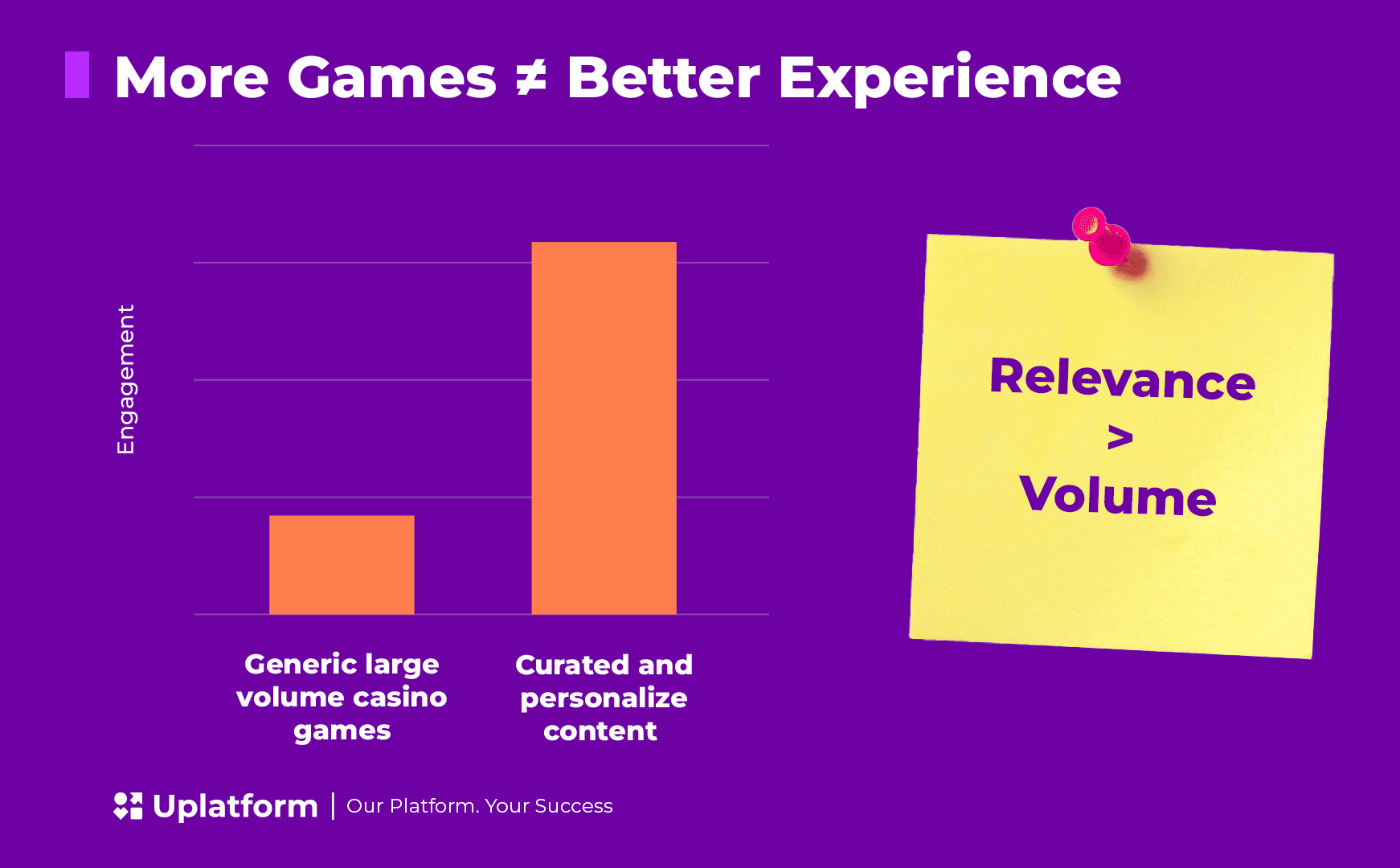
At Uplatform, our Game Recommendation Service does this in practice: we analyze player behavior across the platform and deliver concrete recommendations on sorting logic, content surfacing, and lobby configuration. The insight is data-driven. The decision stays with the operator.
2. Speed Is a Retention Factor, Not a Technical Detail
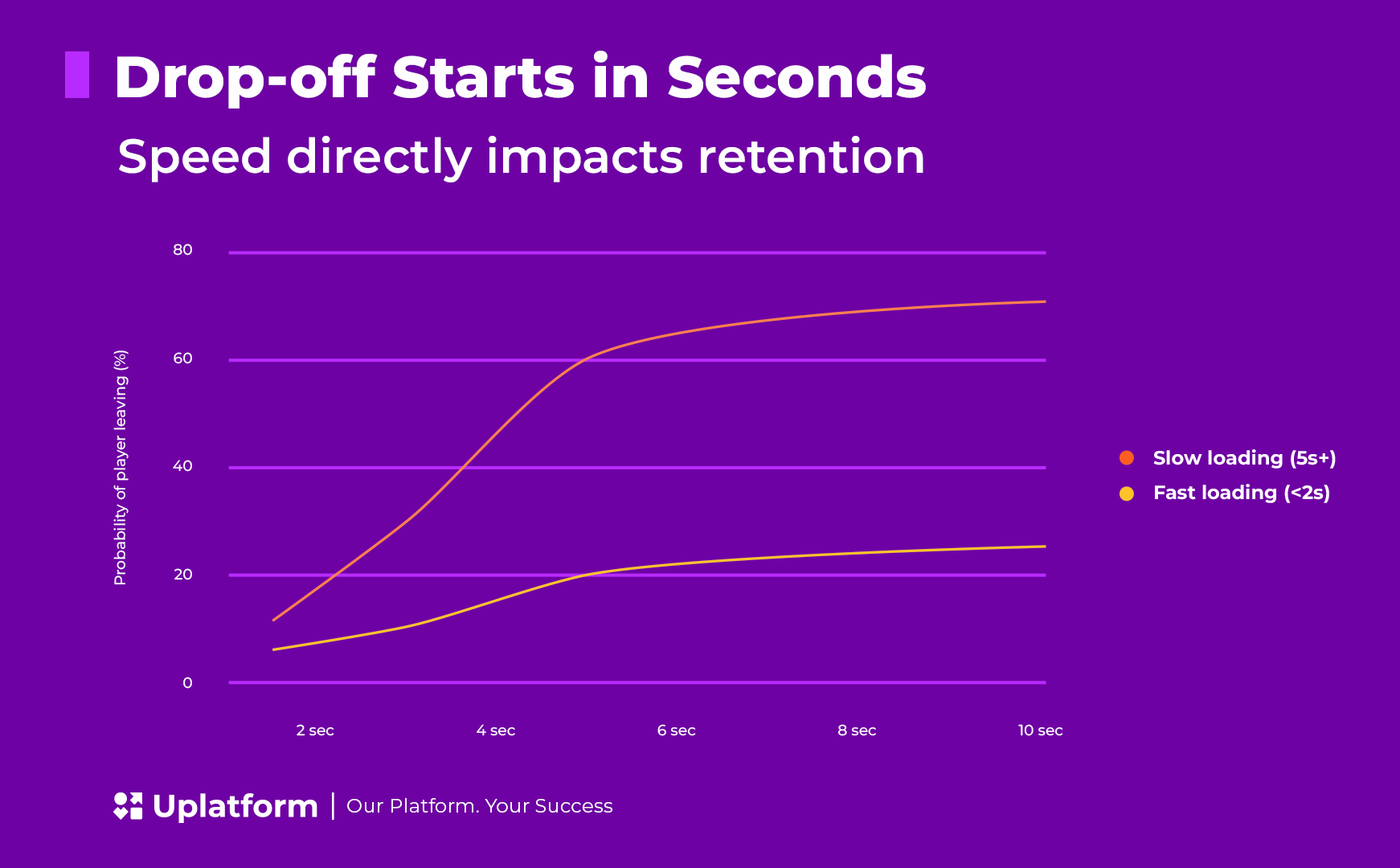
Players don’t give slow casinos a second chance. If a game takes too long to load, they’re already thinking about another website. This isn’t a niche concern, mobile-first usage dominates in most regions, and mobile players are especially unforgiving of lag.
The benchmark isn’t other online casinos. Every app player uses daily streaming services, e-commerce, social media. Those apps have trained players to expect instant response times. Your casino is competing with that standard whether you like it or not.
What to evaluate:
- Game launch speed across devices
- API response time under load
- Stability during traffic spikes
Aggregator performance directly affects session length and bounce rate. Uplatform’s aggregator is built for this, optimized delivery, stable uptime, and consistent performance across both peak and off-peak traffic. It’s not a bonus feature; it’s a baseline requirement.
3. Player Retention Depends on Content Flow
Players cycle through content faster than ever. A game that was trending last month might feel stale today. New releases and trending titles drive return visits, they give players a reason to come back. Static lobbies, on the other hand, signal to players that nothing’s changed and there’s no reason to check in.
This makes content refresh a retention strategy, not just a content management task.
What to evaluate:
- Frequency of new game releases via the aggregator
- Access to top-tier and up-and-coming providers
- Ability to surface trending or high-performing content dynamically
Through our Aggregator, operators get continuous content refresh from a broad provider network, with tools to highlight what’s trending and what’s performing. Aggregators should support continuous content refresh and prioritization, not just provide a static library.

4. Player Expectations Are Shaped by Other Industries
Your players aren’t just comparing you to other casinos. They’re comparing you to Netflix, Amazon, Instagram. Streaming websites set the standard for recommendations. E-commerce defines what personalization looks like. Social media shapes how engagement patterns work.
iGaming operators are competing in that broader context whether they acknowledge it or not. An aggregator that operates like it’s 2018, flat catalogs, no behavioral logic, generic sorting, creates friction against that backdrop.
What to evaluate:
- Personalization capabilities and data-driven content sorting
- Ability to integrate behavioral insights into lobby logic
- Modern UX patterns that match player expectations from other apps
These decisions ultimately sit with the operator. But the right aggregator gives you the backend infrastructure to make them well – behavioral signals, flexible lobby logic, and sorting capabilities that turn operator intent into player experience. Uplatform’s aggregator is built with that in mind.
5. The Risk of Choosing the Wrong Aggregator
This is where it gets concrete. A poor aggregator choice doesn’t just create technical headaches, it costs real revenue.
Poor performance means players abandon sessions within seconds. Limited content reduces your competitiveness with players who are comparing options. And weak personalization means players never feel like the website understands them, so they go somewhere that does.
The real-world impact:
- Lower session duration and engagement
- Reduced retention and repeat visits
- Increased acquisition costs as churn forces you to replace players constantly
These aren’t abstract risks. They’re outcomes operators deal with when their aggregator doesn’t keep pace with player expectations. The good news is that they’re avoidable, if you evaluate the right things upfront.
6. What a Modern Casino Aggregator Must Deliver
Use this as your evaluation checklist. A modern casino integration solution should cover all of these, not most of them.
- Single API integration that connects to a broad provider network without complexity
- High-performance delivery with fast game loading and stable uptime across traffic levels
- Broad provider network with frequent updates and access to top titles
- Cross-device consistency across mobile, tablet, and desktop
- Scalable architecture that grows with your operator ambitions without forced re-integrations
The Bottom Line
Player behavior is now the primary driver behind aggregator selection. It’s not a secondary consideration, it’s the framework through which every technical decision should be evaluated.
Operators that align their website with real user expectations improve retention, engagement, and scalability. Those that treat the aggregator as just a backend tool risk losing players at every stage of the journey, from first load to long-term loyalty.
At Uplatform, we’ve built our casino content aggregator around this reality. Fast delivery, smart content surfacing, deep localization, and a provider network that keeps refreshing, all through a single integration. Because that’s what your players expect, and it’s what your business needs to grow.
Other news
-
 From Operator Wish List to Everyday Reality
28.09.2026
-
- Player Engagement in iGaming: Operator Guide
01.09.2026
- SEO & AEO Strategies for iGaming in 2026
18.08.2026
-