The Future of iGaming Search and What it Means for iGaming

TL;DR: The future of iGaming search does not mean search is disappearing or SEO is being replaced overnight. What is changing is how users reach information: search engines increasingly generate answers, compare sources and support conversational follow-up queries before users click through to a website.
For small and mid-sized iGaming operators looking to scale, rankings alone no longer tell the whole story. Growth also depends on whether search and AI systems can accurately understand their brand, trust its content and reference it when potential players ask relevant questions.
Search Is Changing, But SEO Is Not Dead
For most of the web’s history, search followed a relatively predictable model: a user entered a query, received a page of links and selected one of them.
That model still exists, but it now shares the search results page with generated answers.
Google has integrated AI Overviews and AI Mode into Search, while Microsoft combines conventional Bing results with generative answers and Copilot. In May 2026, Google reported that AI Mode had surpassed one billion monthly users, illustrating how quickly conversational search has moved from experiment to mainstream product.
This does not mean conventional search results are being removed. Google explicitly states that the same fundamental SEO practices used for conventional Search remain relevant for AI Overviews and AI Mode. A page still needs to be crawlable, indexed and eligible to appear in Search before it can be used as a supporting source in these experiences. Google also says there is no special technical requirement or separate piece of markup needed to appear in its AI features.
The more accurate conclusion, therefore, is not that AI is replacing SEO. It is that SEO is operating inside a broader discovery environment.
The Biggest Change May Be What Happens After a Search
Generated answers can satisfy some queries without requiring a visit to another website.
There is already evidence of this effect.
Pew Research Center analysed 68,879 Google searches made by U.S. participants in March 2025. When an AI summary appeared, users clicked a conventional search result during 8% of visits. When there was no AI summary, they clicked a result during 15% of visits. Links cited directly inside AI summaries received clicks in only 1% of visits containing a summary.
That research covered Google users generally rather than iGaming specifically, so it should not be treated as an iGaming traffic forecast. But it demonstrates an important change in search behavior: visibility and website traffic are no longer necessarily the same thing.
A brand could potentially be used as a source in an answer without receiving the click that would previously have accompanied that visibility.
For publishers and affiliates whose commercial model depends heavily on organic traffic, this distinction matters.
From Ranking to Being Referenced
The search industry’s own analytics tools are beginning to reflect the change.
In February 2026, Microsoft introduced an AI Performance section in Bing Webmaster Tools. It shows publishers how frequently their pages are cited by AI-generated answers, which pages are referenced and which retrieval queries led to those citations.
Google followed in June 2026 by beginning to test dedicated Search Console reporting for visibility within generative Search features, including AI Overviews and AI Mode.
That development is significant because it changes what search performance can mean.
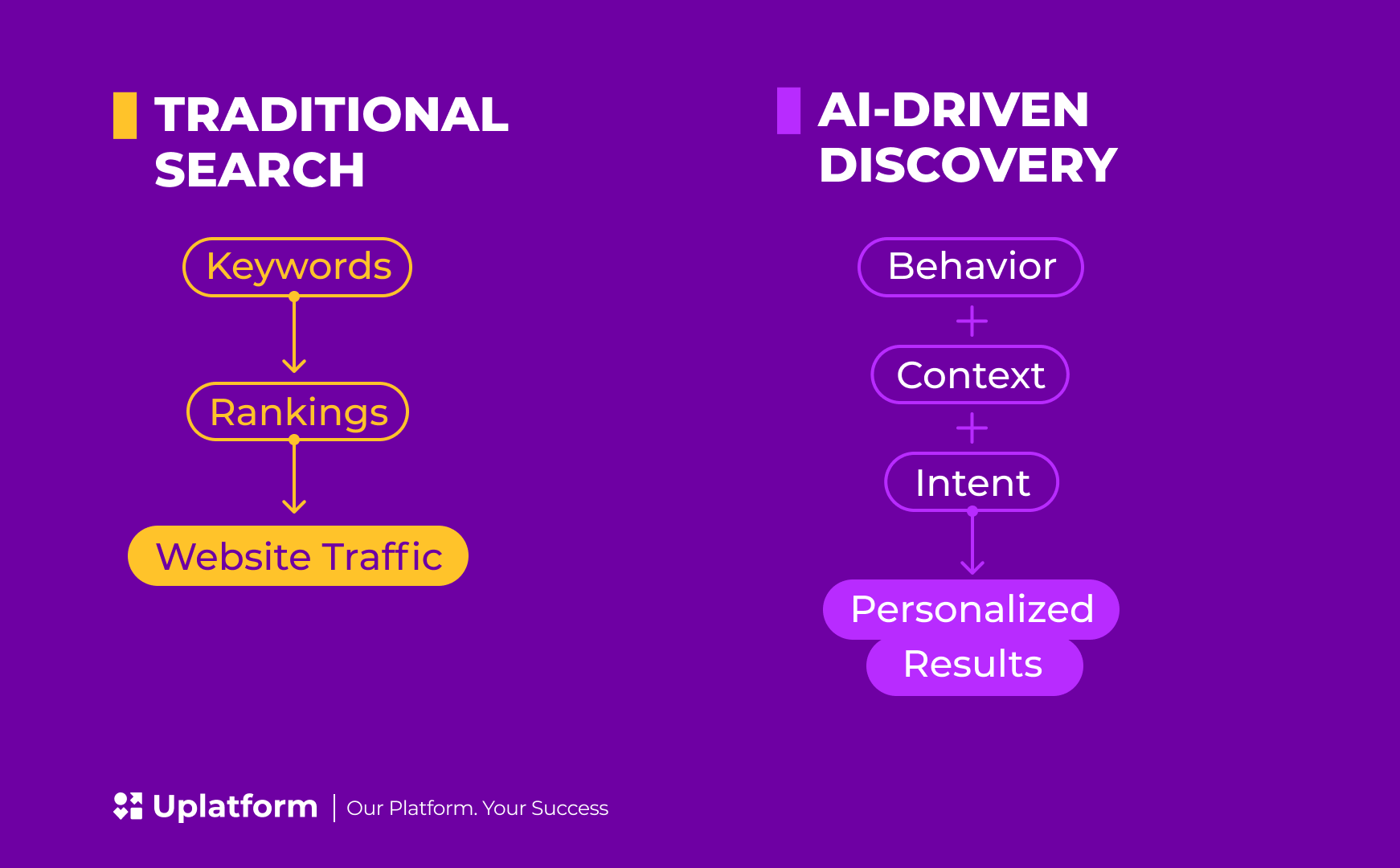
Traditional SEO asks: Where does this page rank?
AI-mediated discovery adds another question: Is this page being used as a source when an answer is generated?
Rankings, impressions and clicks will remain important. But citations, mentions and visibility inside generated answers are becoming additional signals worth monitoring.
AI Search Does Not Require an Entirely New Type of SEO
The rise of terms such as AEO — Answer Engine Optimization — and GEO — Generative Engine Optimization — can make AI search sound like a completely separate discipline.
The reality appears less dramatic.
Google’s current guidance says the fundamentals remain largely the same: create useful original information, maintain technically accessible pages, keep information accurate and make it easy for users and systems to understand what the page is about.
Microsoft’s recommendations for AI citations follow a similar pattern. It advises publishers to provide clear structure, supporting evidence, current information and sufficient subject depth.
This is important for iGaming content because much of the industry publishes very similar material.
Hundreds of websites can explain what a sportsbook is, describe the same casino mechanics or rewrite the same market statistics. Content that simply combines information already available elsewhere has relatively little unique information for either a human reader or an AI system to retrieve.
Original material has a stronger reason to exist.
That could include proprietary market data, original surveys, product statistics, expert commentary, regulatory analysis, payment research, player-behaviour studies or transparent comparisons based on a defined methodology.
Google’s latest guidance for generative search makes the same distinction, recommending unique, non-commodity content rather than simply producing more pages targeting variations of possible queries.
What the Future of iGaming Search Means for Affiliates
Affiliates are unlikely to disappear because of AI search. However, some types of affiliate content are more exposed than others.
A generic informational query can often be answered directly. Definitions, basic comparisons and simple explanations are exactly the kinds of queries that generated answers handle well.
Pages offering information that requires deeper verification are harder to replace.
A detailed comparison of operators, for example, may involve licensing information, payment availability, withdrawal conditions, regional restrictions, bonus terms, product testing and changes over time. An AI system can summarise those findings, but it still requires reliable sources from which to retrieve them.
The competitive advantage therefore moves further away from producing the largest possible volume of SEO content and toward producing information worth referencing in the first place.
The consequences may also differ by search intent. Informational queries are particularly suitable for direct AI answers. Commercial or transactional journeys may still require users to visit websites to verify conditions, evaluate a brand or complete an action.
The balance between these behaviours is still developing, which is why declaring the “death of affiliate SEO” would be premature.
Search Is Also Becoming More Conversational
Another important change is the structure of the query itself.
Traditional keyword research often assumes a relatively short search followed by several additional searches as the user refines what they want.
AI search can compress that process.
Google says AI Mode and AI Overviews can use “query fan-out”: the system performs multiple related searches across subtopics and sources when constructing its response. Users can then ask follow-up questions instead of restarting the process with another keyword.

For content teams, that weakens the logic behind creating dozens of near-identical pages purely to target slightly different keyword combinations.
A comprehensive page that properly answers the underlying subject may be more useful than a collection of pages created around every variation of the same phrase.
That does not eliminate keyword research. Search language still helps businesses understand demand. But keywords increasingly describe what the audience wants rather than functioning as instructions that must be repeated mechanically throughout a page.
Bots Create a Second Challenge: Crawling Without Traffic
There is another side to AI discovery that matters particularly to publishers.
Search crawlers historically created a relatively clear exchange. A search engine indexed a website and, in return, could send users back to it.
AI systems complicate that relationship because content can also be crawled for retrieval or model-related purposes without producing comparable referral traffic.
Cloudflare has documented a large gap between the amount of content accessed by some AI crawlers and the amount of referral traffic subsequently generated by AI services. Its research covers the wider web rather than iGaming specifically, but it demonstrates why publishers are increasingly examining which bots can access their content and for what purpose.
This means crawler management is likely to become a more deliberate part of publishing strategy.
Companies will need to decide where they want maximum discoverability, where they want AI systems to use their material and where restrictions make commercial sense.
The correct choice will depend on the site. Blocking every AI crawler may reduce potential visibility, while unrestricted access may provide little value if content is repeatedly consumed without attribution or referrals.
Trust Becomes More Important When Search Generates the Answer
Generated search results introduce another problem: the user does not necessarily know which source supplied each statement or how reliable that source is.
Public attitudes remain mixed.
A 2025 Pew survey found that only 20% of U.S. adults considered AI summaries in search results extremely or very useful. Another 52% considered them somewhat useful, while 28% said they were not too useful or not useful at all.
For iGaming, accuracy can be particularly important because information changes frequently.
Bonus conditions expire. Payment methods differ between jurisdictions. Operators enter and leave markets. Licensing conditions change. Sportsbook products are updated.
Content therefore needs more than the appearance of authority. Dates, named sources, authorship, methodology and clearly supported claims make information easier for both humans and automated systems to evaluate.
Google’s people-first content guidance specifically recommends original research, clear sourcing, demonstrable expertise and transparent authorship as indicators of useful and trustworthy content.
Do Not Confuse Search AI With On-Site Personalization
AI search, recommendation engines and chatbots will increasingly exist alongside one another, but they solve different problems.
- Search AI helps someone find or understand information across the web.
- A recommendation engine uses available customer or behavioural data to decide what content, products or games to present inside a particular service.
- A chatbot provides a conversational interface for support, navigation or other tasks.
All three may use AI, but they should not be treated as one technology.
For an operator, this distinction is also relevant to trust and compliance. In the EU, transparency requirements under Article 50 of the AI Act became applicable on 2 August 2026. Among other requirements, certain interactive AI systems must make users aware that they are interacting with AI rather than a human.
As AI becomes more visible throughout the player journey, clearly communicating what a system does — and what data influences it — will become increasingly important.
How to Prepare for the Future of iGaming Search
The future of iGaming search is still developing, so building a strategy around speculative technologies would make little sense. There are, however, several actions supported by what search platforms are already doing:
- Keep the SEO fundamentals strong. Crawlability, indexing, internal linking, site performance and clear page structure remain the foundation of both classic and AI-assisted search.
- Create information that competitors cannot easily reproduce. Original statistics, internal data, expert analysis, market research and first-hand knowledge provide more value than another rewritten summary of existing results.
- Make claims easy to verify. Use named sources, dates, methodology and clear distinctions between facts, estimates and opinions.
- Structure information clearly. Descriptive headings, concise explanations, useful tables and consistent terminology make complex information easier to understand and retrieve.
- Measure more than rankings. Track conventional organic traffic alongside AI citations, generated-search visibility, branded search and referral traffic where the relevant tools provide that data.
- Review crawler policies deliberately. Understand which search and AI bots can access the site and decide whether that access supports the company’s commercial objectives.
- Avoid mass-producing AI content simply to cover more keywords. Search engines themselves are increasingly explicit that volume is not a substitute for originality or usefulness.
What Is Actually Likely to Happen Next?
Several directions now have enough evidence behind them to be more than speculation.
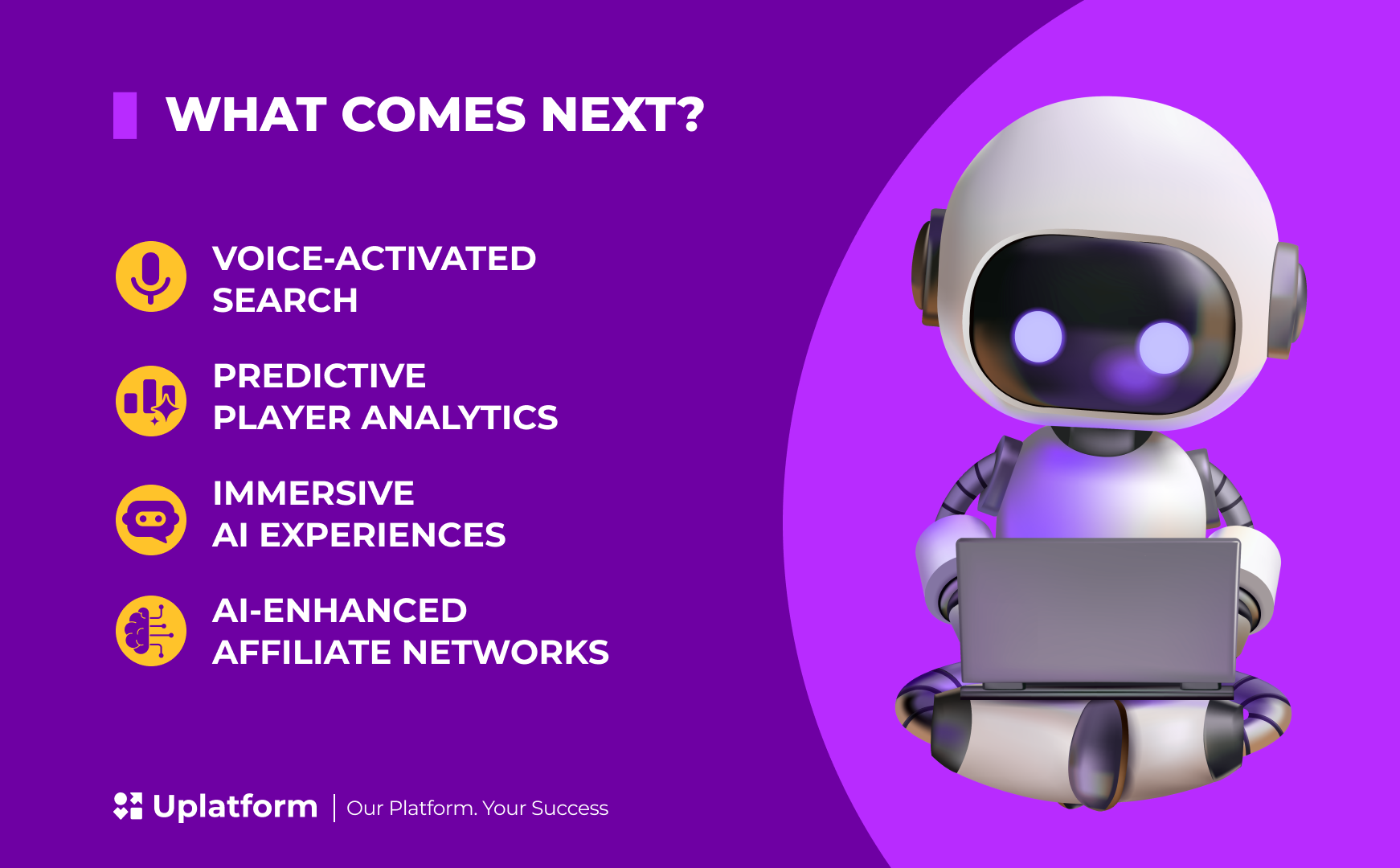
AI-generated answers will probably occupy a larger part of informational search. Conversational queries will become more normal. Search engines will increasingly combine multiple sources before presenting an answer. Publishers will pay more attention to whether they are cited as well as where they rank. And search analytics tools will continue developing ways to measure this new form of visibility.
AI agents may eventually move some searches beyond answering questions and toward completing tasks. Google has already started introducing agentic capabilities into Search.
How far this goes in regulated industries such as gambling is much less certain. Identity checks, jurisdictional restrictions, payments, responsible-gambling requirements and operator-specific rules make automated transactions considerably more complex than summarising information.
That distinction is important.
The future of iGaming search should not be treated as a list of technologies that might become popular. The more useful question is which parts of the search journey are already changing and which economic behaviours are changing with them.
Conclusion
Search is moving from a system that primarily finds pages toward one that can increasingly find, interpret and assemble information before presenting it to the user.
That changes how websites compete for attention, but it does not remove the need for websites, search optimization or authoritative content.
For the iGaming industry, the most defensible strategy is therefore not to chase every new AI acronym. It is to become a better source.
Companies that publish original information, maintain accurate and accessible websites, demonstrate expertise and make their claims easy to verify are well positioned whether the user encounters them through a traditional search result, an AI-generated answer or whatever interface comes next.
Other news
-

- The Dream That Stayed Awake in Lisbon
08.10.2026
- From Operator Wish List to Everyday Reality
28.09.2026
-
-