iGaming Personalization That Performs: A guide for Operators

TL;DR: Effective personalization starts with commercial priorities. Operators need to connect market localization, behavioral segmentation, journey orchestration and real-time decisioning to measurable outcomes such as first-time deposit conversion, repeat deposits, retention, ARPU and LTV. The value comes from testing relevance, controlling promotional cost and improving each stage of the player journey.
Personalization Starts with the Operating Model
Most operators already use personalization. They translate the interface, change the game lobby by market, create VIP segments or send a bonus after a player becomes inactive. The commercial problem is that these decisions often happen in separate systems, under separate teams, with separate definitions of success.
Acquisition teams may focus on first-time deposits, while retention teams measure success through repeat activity and campaign engagement. Product teams may focus on session depth, payments on approval rates and support on resolution time. Each metric matters, but the player experiences one connected journey. A relevant offer cannot compensate for a failed deposit. A localized homepage cannot rescue a slow mobile experience. A recommendation delivered after the player’s interest has passed has little value.
A useful personalization strategy therefore begins with three questions: Which commercial outcome needs to improve? Which player’s decision influences that outcome? Which data and product action can change that decision? This keeps personalization connected to the operator’s business model, target market and next growth objective.
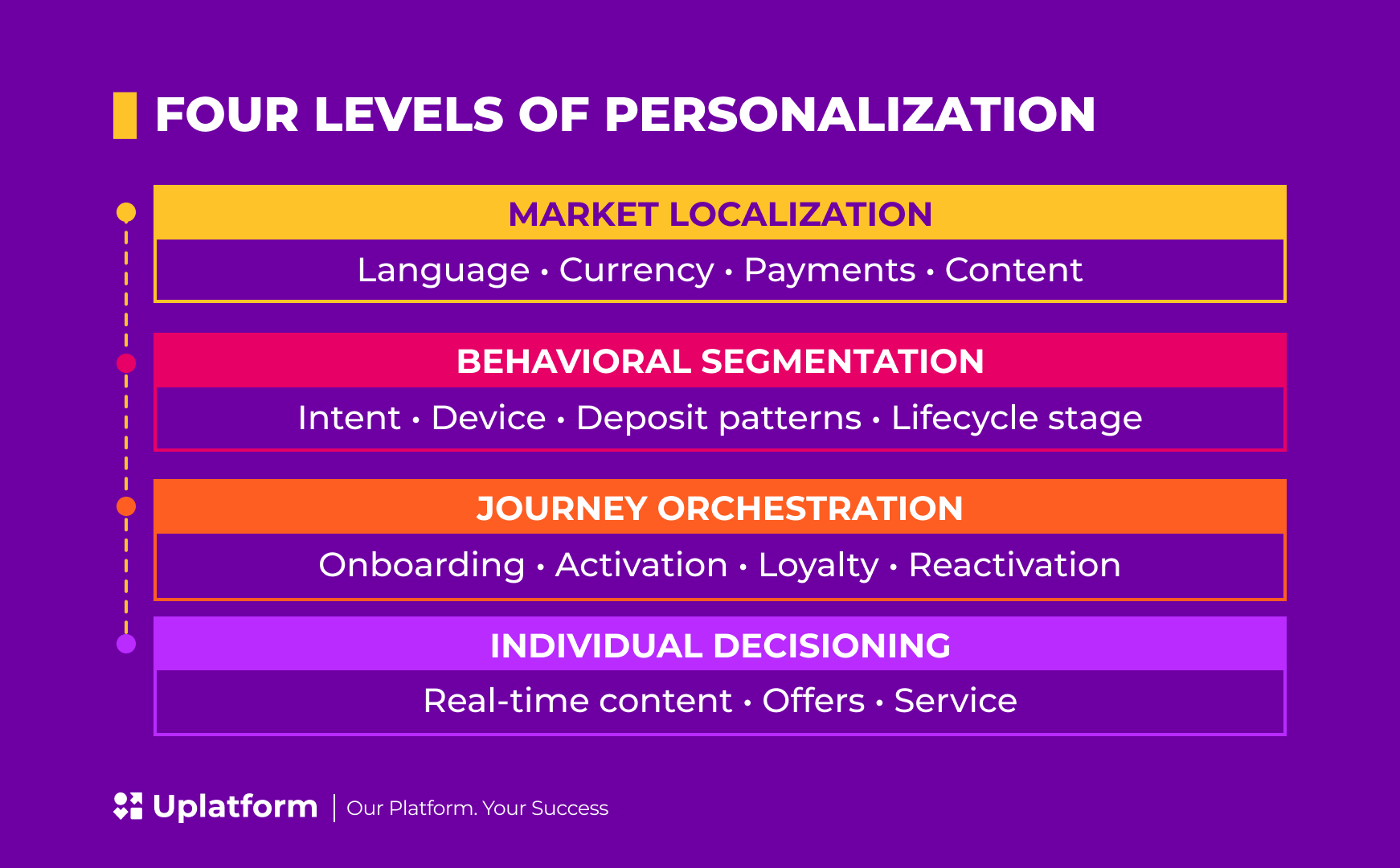
Four Levels of iGaming Personalization
Operators often use personalization and localization as interchangeable terms. They solve related problems at different levels. The following framework separates the decisions so that teams can assign ownership, choose realistic technology and measure the result.
| Level | Operator decision | Typical applications | Primary measures |
|---|---|---|---|
| Market localization | How should the product work in a specific country or region? | Language, currency, payments, odds formats, sports and games, support, promotional calendar | Registration completion, payment success, FTD conversion, load time |
| Behavioral segmentation | Which groups show meaningfully different intent or value? | Preferred vertical, device, deposit pattern, campaign response, lifecycle stage, churn signals | Campaign lift, repeat deposit rate, ARPU, churn |
| Journey orchestration | What should happen next at each stage? | Onboarding, first deposit, product discovery, cross-sell, loyalty, reactivation | Stage conversion, time to second deposit, D1/D7/D30 retention, LTV |
| Individual decisioning | Which experience is most relevant now? | Real-time recommendations, message timing, dynamic content, offer eligibility, service intervention | Incremental revenue, NGR margin, response latency, control-group lift |
1. Establish Market Relevance Before Adding Complexity
Market-level relevance has the widest reach because it affects every player in a target geography. It also exposes the costliest assumptions. Translating a website does not solve unfamiliar payment flows, unsuitable odds formats, weak local sports coverage, irrelevant casino content or support that is unavailable when players need it.
Operators should treat localization as a commercial configuration exercise. The product, payments, CRM, risk, support and compliance teams need one market-entry brief covering the player proposition and the operating requirements behind it. That brief should identify:
- The languages, currencies, payment methods and withdrawal expectations that shape trust and conversion.
- The sports, leagues, bet types, casino categories and promotional moments that deserve priority in navigation and campaigns.
- The devices, connection conditions and interface patterns that affect speed and usability.
- The licensing, responsible gambling, data-use and communication rules that govern the player journey.
- The operational KPIs that will indicate readiness, including uptime, API response time, bet-acceptance speed, payment approval and support resolution.
The objective is precision, not a smaller product. Broad sportsbook and casino coverage can be commercially valuable when sorting, search, recommendations and campaigns make the most relevant content easy to find. Without that layer, more content can increase discovery friction rather than improve engagement.
2. Build Segments Around Observed Behavior
Demographic labels and broad categories such as new player or VIP rarely explain what a player is trying to do. Behavioral segmentation is more useful when it groups players according to signals that can change an operator decision.
Those signals may include acquisition source, preferred sport or game type, mobile or desktop use, local time of activity, deposit frequency, response to previous offers, failed payment attempts, movement between sportsbook and casino, or the speed at which a player reaches a second transaction.
A segment should earn its place by producing a different action. If two groups receive the same content, offer, timing and service treatment, separating them adds reporting complexity without changing the player experience.
A practical example: Uplatform has reported a mobile-first Asian market scenario in which push notifications were timed around observed player activity. Over one month, churn declined by 6% and repeat deposits increased by 12%. This is a single internal example rather than a universal benchmark, but it demonstrates the standard operators should apply: define the behavior, change one decision and measure the commercial result against a baseline. Read the customer journey case.
3. Orchestrate the Full Player Journey
Personalization becomes commercially useful when it determines what happens next. Journey orchestration connects acquisition, onboarding, product discovery, payments, analytics, loyalty, support and reactivation instead of optimizing each touchpoint in isolation.
Consider a player acquired through a major football tournament. The first experience may need simplified navigation, familiar markets and clear bet placement. After the first wager, the next relevant step could be a related fixture, a live-betting feature, a responsible product explanation or a reminder timed to the team’s next match. If the player later explores casino content, the journey can widen. If a deposit fails, promotional messaging should pause while the payment or service issue is resolved.
This approach is especially important during onboarding. Registration progress, microcopy, payment instructions and device consistency can reduce avoidable friction, but each addition should answer a real player question. Gamification can help players understand progress or discover features; it should not make a regulated flow harder to understand.
Operators should map a limited number of high-value journeys first. A useful starting set is registration to first deposit, first deposit to repeat deposit, single-vertical to cross-vertical use, active to at-risk and inactive to reactivated. Each map needs an owner, entry criteria, decision rules, exclusion rules and a measurable exit condition.

4. Use Real-Time Decisioning Where Timing Changes Value
Real-time personalization carries higher technical and operational cost, so it should be reserved for moments in which timing materially affects the outcome. Tailored recommendations, a service response after a failed transaction or a relevant event alert before a match can lose most of its value when delivered hours or days later.
The requirement is not necessarily an elaborate predictive model. Rules based on recent behavior can outperform a sophisticated model that relies on incomplete data, responds too slowly or cannot be explained to the teams operating it. The decisioning layer should account for eligibility, frequency caps, channel preference, promotional cost, responsible gambling controls and the player’s most recent action.
Operators also need a latency budget. Event collection, profile updates, eligibility checks, content selection and message delivery all consume time. If the full chain is slower than the commercial moment, the personalization system is producing accurate answers too late.
5. Measure Incremental Commercial Value
GGR alone is an incomplete measure of personalization. A campaign can increase wagering while reducing NGR margin through excessive bonuses. It can improve response rates while attracting low-value activity or increasing support and payment costs. The correct measurement depends on the stage of the player journey.
| Journey stage | Commercial objective | Core KPIs | Diagnostic questions |
|---|---|---|---|
| Acquisition and onboarding | Convert relevant traffic efficiently | Registration completion, FTD conversion, CAC, Time-to-Revenue | Where do players stop? Is friction caused by UX, KYC, payment choice or performance? |
| Activation | Create a successful early experience | First bet or game, payment success, time to second deposit, D1/D7 retention | Which action predicts a return visit? Which guidance improves completion? |
| Engagement | Increase relevant product use | Sessions, product adoption, cross-sell, ARPU, bet acceptance | Is activity expanding naturally, or only when subsidized? |
| Retention | Protect sustainable player value | D30 retention, churn, deposit frequency, NGR margin, LTV | Which signals identify risk early? Which action changes the outcome? |
| Reactivation | Recover valuable inactive players | Incremental return rate, cost per reactivated player, post-return retention | Did the player return because of relevance, discounting or a temporary event? |
Every meaningful test should include a control or credible comparison group. Operators should record the baseline, target population, intervention, cost and measurement window before launch. A positive result also needs guardrails: bonus cost, complaints, opt-outs, payment failures, fraud indicators and responsible gambling outcomes.
This discipline prevents teams from crediting personalization for changes caused by seasonality, a major tournament, acquisition mix or a simultaneous product release. It also creates a shared commercial language across marketing, product, finance and operations.
6. Protect Trust, Privacy and Player Safety
Personalization depends on player data and often involves profiling, bringing responsibilities around how that information is collected, used and stored. Requirements vary by jurisdiction, so operators should establish an appropriate lawful basis for data use, clear retention rules, transparent explanations and access controls. Automated decisions also need appropriate oversight, particularly where they could significantly affect a player.
Player-protection signals must never become inputs for more aggressive commercial targeting. Indicators of harm, vulnerability or loss of control should trigger appropriate action through the operator’s responsible gambling and customer-interaction framework. Measuring the effectiveness of these interventions helps ensure that performance reviews account for player outcomes as well as revenue.
Trust is also part of the player experience. Players notice irrelevant messages, repetitive offers and recommendations that reveal more knowledge than they expected an operator to use. Frequency limits, suppression rules and clear controls over communication preferences can help protect that trust while improving campaign efficiency.
7. Build the Technology Around Decisions and Workflows
The technology foundation should make it possible to recognize the player, capture important events, update profiles, apply eligibility and safety rules, select content or an action, deliver it through the right channel and measure the result. Weakness at any point limits the commercial value of the whole system.
Within Uplatform’s ecosystem, Utools brings together CRM, back office, CMS, affiliate management and bonus tools, with 2-line support, while Upayment handles payments. The operational advantage comes from using those capabilities as one decision flow: player behavior informs a segment, the segment changes content or communication, rules govern eligibility, and reporting shows whether the intervention improved the intended KPI.
Configuration also affects Time-to-Market and Time-to-Revenue. Reusable market templates, local payment configurations, content rules and journey scenarios can reduce repeated setup work. Operators still need governance: naming conventions, approval rights, version control, testing environments and clear ownership when a rule affects multiple channels.
A Practical Rollout Sequence
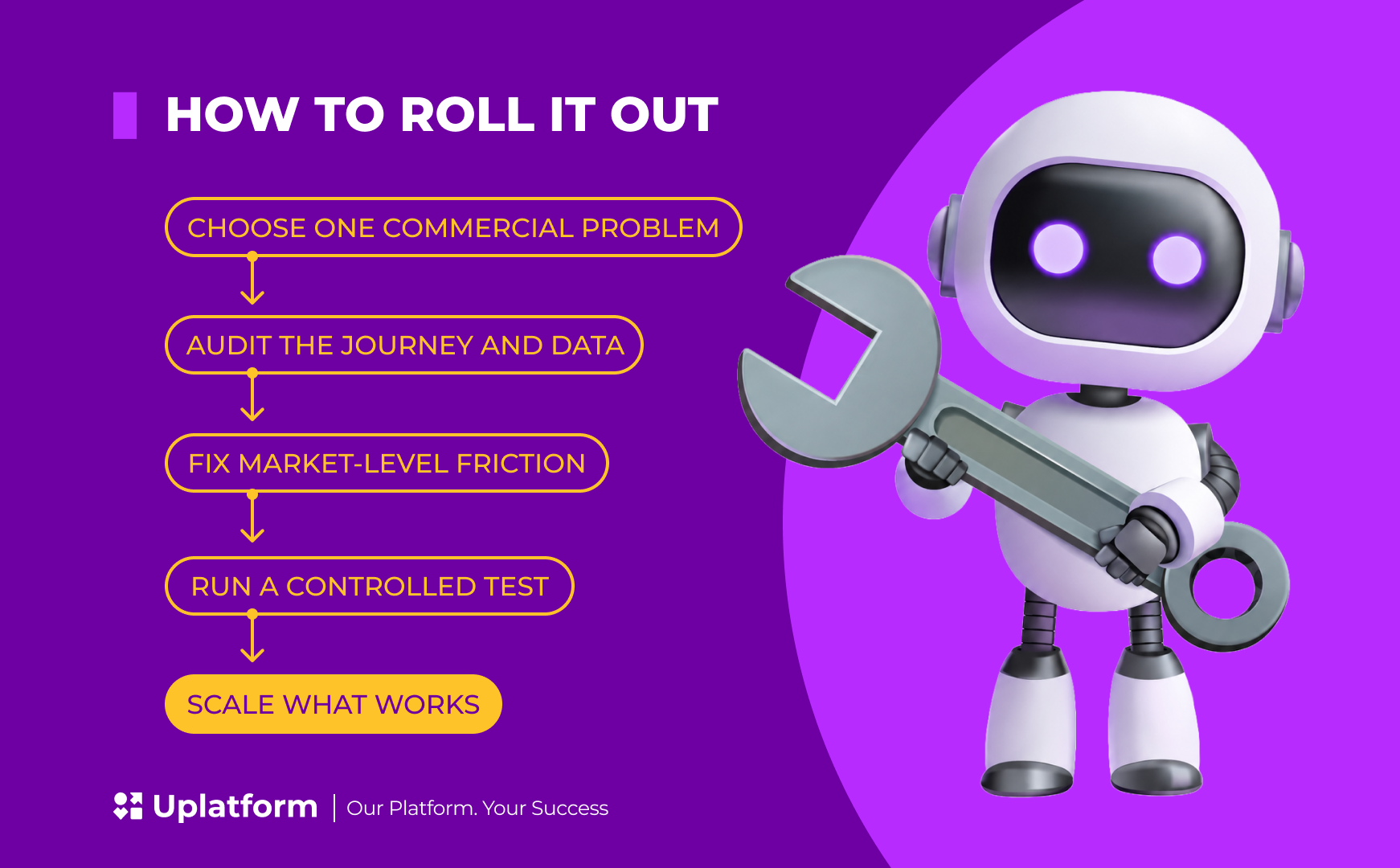
- Choose one commercial problem. Start with a measurable issue such as weak FTD conversion, low repeat deposits, early churn or inefficient reactivation.
- Audit the journey and data. Identify where the player experience breaks, which signals are reliable and which systems need to exchange information.
- Fix market-level friction. Address language, payments, navigation, speed, content relevance and support before investing in individual prediction.
- Run a controlled segment test. Change one decision for one defined group and compare the result with an appropriate baseline or control.
- Scale only after the economics work. Confirm incremental NGR, retention or LTV after promotional and operational costs, then extend the model to additional journeys or markets.
Relevance Has to Be Measurable
Personalization can influence conversion, engagement and retention, but only when it changes a real operator decision. The strongest programs connect local market requirements, observed behavior, journey timing, commercial economics and player protection in one operating model.
Uplatform provides connected infrastructure across sportsbook, casino, payments, player management and engagement tools. Operators still need to choose the outcome, design the intervention, test its incremental effect and scale what improves sustainable player value.
Other news
-
 From Operator Wish List to Everyday Reality
28.09.2026
-
- Player Engagement in iGaming: Operator Guide
01.09.2026
- SEO & AEO Strategies for iGaming in 2026
18.08.2026
-