How to Enter and Operate in Mexico’s iGaming Market: A Practical Guide for Operators
TL;DR
Mexico is one of Latin America’s most commercially significant online gambling markets. It offers scale, strong sports betting culture, and growing digital engagement. However, it is competitive and structurally complex. Operators must approach it as a long-term strategic market, focusing on local incorporation, payment depth, mobile optimization, and retention-led growth rather than bonus-driven acquisition.
Mexico on the Latin American iGaming Map
Mexico consistently ranks among the most significant betting and gambling markets in Latin America by revenue and player volume. Unlike Brazil, which is transitioning toward full regulatory clarity, or Colombia, which implemented a modern licensing system early, Mexico operates under a long-standing federal law structure that predates iGaming.
That sounds like a weakness. It is not necessarily one.
It means the market has evolved organically. Large land-based operators extended online. International brands partnered with existing license holders. Over time, a functioning digital betting region formed.
Today, Mexico represents:
- One of the largest Spanish-speaking betting audiences globally
- A deeply sports-oriented population
- A mobile-dominant user base
- A hybrid payment economy combining digital and cash
It is a structural opportunity with real competition.
Operator Regulation in Mexico
Online betting and gambling in Mexico operates under the Regulation to the Federal Gaming and Raffle Law of 2004, which amended the original 1947 Federal Gaming and Raffles Law. While the 1947 framework was designed primarily for raffles, games, and sporting activities, the 2004 regulation broadened the interpretation of permitted activities to include online gambling, bingo, and related formats under the legal definition of “raffles.” This regulatory evolution forms the basis for today’s online betting and gambling operations in the country.
A critical structural requirement is that any entity seeking to become a licensed operator in Mexico must be incorporated locally. Foreign companies cannot simply extend an offshore license into the market. Instead, participation requires the establishment of a Mexican legal entity and alignment with the existing regulatory framework. In practice, operators typically work in coordination with authorized permit holders, making proper due diligence and contractual clarity essential from the outset.
Many of the largest licensed operators in the country are members of the Asociación de Permisionarios de Juegos y Sorteos, an industry group that represents operator interests and participates in dialogue around regulatory and operational matters. While membership is not mandatory, it reflects the structured nature of the market and the presence of established stakeholders.
For operators evaluating entry, the main takeaway is practical rather than theoretical. Mexico is not a jurisdiction where a remote license model can simply be exported. It requires deliberate legal structuring, local incorporation, and early engagement with qualified advisors. Proper setup before launch significantly reduces operational friction and long-term risk.
Step 1: Structuring Your Market Entry
Entering Mexico typically involves three layers:
1. Legal Incorporation
You must establish a Mexican legal entity. This impacts:
- Corporate structure
- Tax exposure
- Banking relationships
- Payment integrations
Local incorporation is not optional.
2. Permit Alignment
Operators usually work through authorized permit holders. This requires:
- Due diligence on permit scope
- Clear contractual terms
- Defined operational responsibilities
- Transparent revenue arrangements
This stage determines your long-term operational stability.
3. Banking and Mexico iGaiming Payments Setup
Before marketing begins, you must secure reliable local payment processing. Without it, conversion collapses.
Mexico is unforgiving when payments fail.
Step 2: Building a Payment Strategy That Converts
Mexico iGaiming Payments are arguably the most underestimated operational factor. Many operators focus heavily on acquisition, bonus mechanics, or product mix, but in practice, payment infrastructure often determines whether a player converts, stays, or leaves permanently.
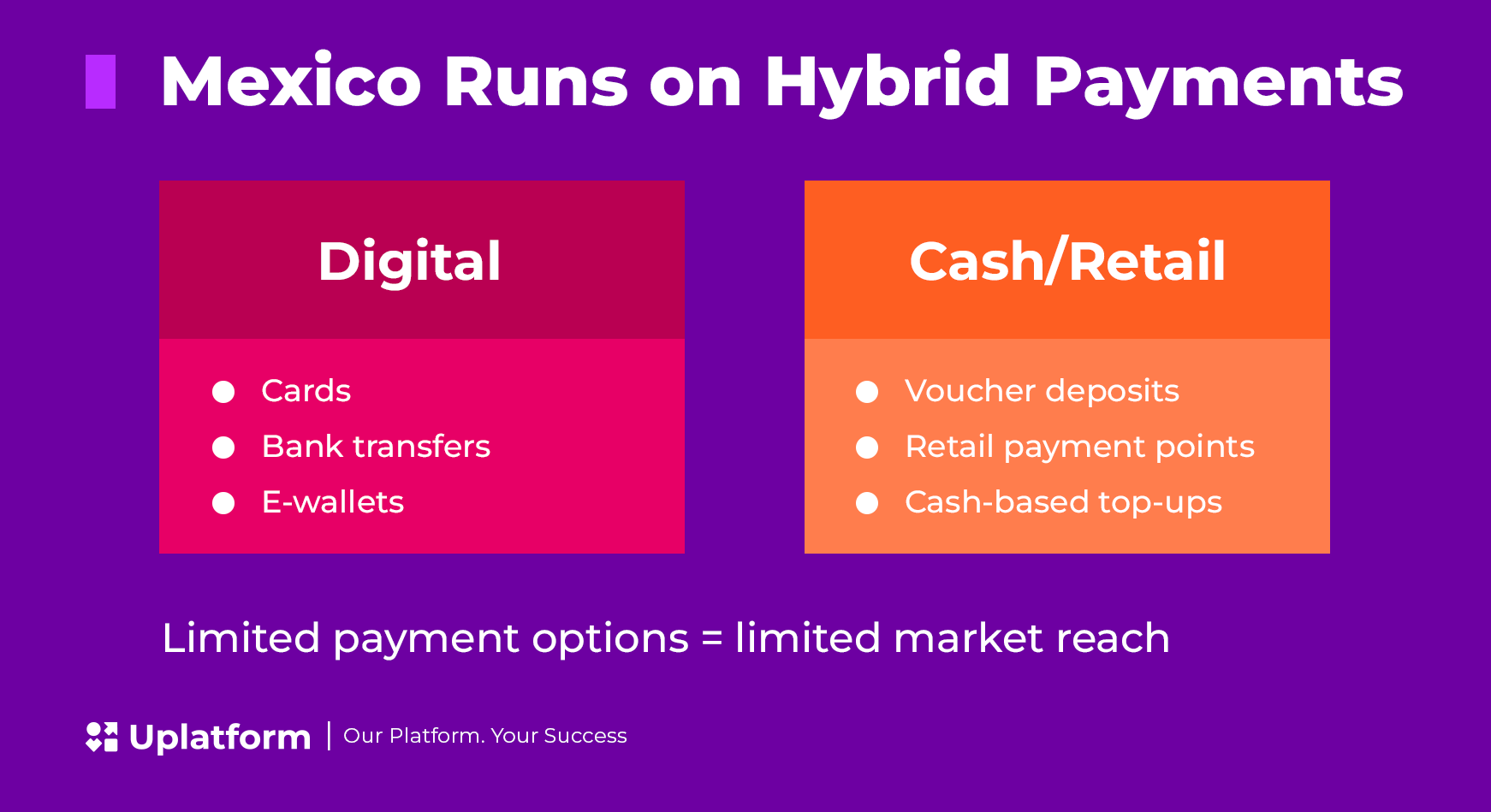
Mexico operates within a hybrid financial model. Card penetration and digital banking adoption continue to expand, particularly in urban areas, yet cash-linked retail systems remain deeply embedded in everyday consumer behavior. For many players, especially outside major metropolitan centers, depositing funds through familiar retail channels feels more secure than purely digital transfers.
This dual structure means operators cannot rely on a single payment channel. A limited payment offering does not just reduce convenience. It reduces market reach.
Mexican players generally expect:
- Immediate deposit confirmation, without extended processing delays
- Familiar and recognizable local payment brands that feel trustworthy
- Clear, transparent confirmation flows that leave no ambiguity about transaction status
- Fast and predictable withdrawals
Withdrawal speed, in particular, has a direct impact on retention. Players may tolerate friction during onboarding, but they rarely forgive payout delays. Slow withdrawals quickly erode trust, and negative experiences tend to circulate rapidly across social channels and community forums. In a competitive market, reputation damage spreads faster than recovery.
For operators entering or scaling in Mexico, payment strategy should be treated as a core growth lever rather than a technical backend detail. That means:
- Integrating both digital methods and retail-linked deposit options to cover behavioral diversity
- Establishing reliable connections with local banking channels where possible
- Designing internal processes that prioritize withdrawal efficiency
- Communicating fees, limits, and timelines clearly to avoid perceived hidden costs
In Mexico, payment trust and brand trust are inseparable. A smooth, reliable transaction experience strengthens retention and increases lifetime value. A weak one undermines even the strongest marketing campaign.
Step 3: Sportsbook Localization Beyond Translation
Launching a sportsbook in Mexico is not simply about translating the interface into Spanish and uploading an odds feed. Engagement depends on whether the structure of the sportsbook reflects how players actually bet.
Football is the primary driver of betting activity, supported by strong domestic competitions and year-round engagement. International tournaments amplify traffic, but consistent volume comes from local matches and regional narratives. Mexican bettors are particularly active in live betting, with in-play wagers forming a significant share of activity during football and boxing events.
Because of this, sportsbook localization must go beyond language. It requires thoughtful event prioritization, deep live coverage, and broad market availability that supports accumulators and dynamic betting behavior.
Product scale directly influences this.
Uplatform’s sportsbook includes more than 200 sports in line, covering major global disciplines as well as niche competitions that attract loyal audiences. Across these sports, the platform delivers over 1.5 million pre-match and live events annually and provides 5,500+ betting markets. This depth ensures constant availability, detailed market structures, and the ability to configure offerings around local demand rather than relying on simplified templates.
Beyond traditional sports, Esports is becoming increasingly important in Mexico. A young, digitally native audience actively follows competitive gaming and streaming projects, creating strong alignment with esports betting.
Uplatform supports more than 60 esports titles and games, offering over 9,500 pre-match and live esports events and 300+ dedicated esports betting markets. This allows esports to function as a fully integrated vertical within the sportsbook, expanding reach and strengthening long-term audience growth.
In Mexico, sportsbook depth across both sports and esports is not an optional enhancement. It is part of operational credibility. When players consistently find relevant matches, stable live markets, and broad coverage, engagement remains strong and lifetime value increases. Localization, therefore, is about aligning product architecture with real betting behavior rather than simply adapting language.
Step 4: Casino as a Retention Engine, Not an Add-On
While sportsbook often drives initial acquisition in Mexico, casino typically determines long-term value.
Many players enter through sports betting in Mexico but gradually diversify their activity. When the casino vertical is properly integrated, it increases session frequency, smooths revenue volatility between sports cycles, and strengthens overall lifetime value.
In Mexico, mobile slot play is expanding steadily, particularly among users who prefer shorter, more frequent sessions. Live dealers are also gaining traction, especially when streaming quality is stable and payments are reliable. In a market where trust and withdrawal speed strongly influence brand perception, live casino performance is directly tied to operational credibility.
Uplatform’s casino offering includes more than 16,000 slot games and 120+ live tables, supported by over 300 global and local providers. This breadth allows operators to balance globally recognized titles with regionally relevant content, adapting the portfolio to local audience preferences rather than relying on a narrow game mix.
Casino growth, however, does not happen automatically. It requires structured planning from the beginning.
First, the product mix must reflect user behavior. A balanced slot portfolio that includes different volatility levels allows operators to serve both casual players and higher-risk profiles. With a large catalog available, operators can fine-tune content selection instead of oversaturating the lobby.
Second, user experience must remain consistent with sportsbook flow. Switching between sports and casino should feel seamless, particularly on mobile. Uplatform supports multi-device access through web versions and dedicated apps for iOS, Android, and Windows, ensuring continuity across platforms.
Third, bonus mechanics should be transparent and flexible. With more than 30 promo types available and a wide selection of bonus configurations, operators can design structured campaigns aligned with player segmentation rather than relying on generic offers.
Finally, CRM strategy is critical. In-depth statistics and player segmentation tools allow operators to trigger contextual cross-sell campaigns based on sportsbook behavior. A player active during major sporting events, for example, can receive targeted casino incentives during off-peak sports periods. Cross-sell should feel relevant and timed, not intrusive.
Casino should therefore be built into the market entry strategy from day one. Treating it as a secondary expansion months after launch often results in missed retention opportunities and uneven revenue distribution.
In Mexico, sportsbook drives traffic. Casino stabilizes and extends value. When both are structured together, supported by deep content, multi-device access, and strong promotional flexibility, operators create a more resilient and scalable operating model.

Step 5: Mobile Optimization Is Mandatory
Mexico is overwhelmingly mobile-driven. For many users, the smartphone is not a secondary access point. It is the primary and often only device used for betting.
However, mobile-first does not simply mean responsive design. It means building the entire user journey around speed, clarity, and low friction.
Load time is critical, particularly in regions where bandwidth quality may fluctuate. Heavy interfaces, excessive animations, and unnecessary redirects increase abandonment rates. Fast page rendering and stable live updates directly influence both conversion and session duration.
Interface design should remain clean and intuitive. Overcrowded dashboards and complex navigation structures reduce engagement, especially during live events when users expect immediacy. A streamlined layout that prioritizes active markets and clear calls to action performs better than feature-heavy screens.
Registration and verification processes must also be optimized. Lengthy onboarding flows discourage first-time deposits. Identity verification should be efficient and integrated seamlessly into the journey rather than presented as a disruptive barrier.
Language clarity matters as well. Clear Spanish UX copy, transparent instructions, and unambiguous transaction messaging strengthen trust and reduce support requests.
In Mexico, speed is not a convenience feature. It is a performance metric. The smoother and faster the mobile experience, the stronger the conversion, retention, and overall lifetime value.
Step 6: Customer Acquisition vs. Retention Economics
In Mexico, scaling profitably requires more than strong acquisition.
Customer acquisition remains necessary, particularly around major sporting events and seasonal peaks. However, acquisition costs are increasing, and bonus-driven onboarding strategies alone rarely produce sustainable profitability. Generous welcome offers can create short-term spikes in registrations and deposits, but without structured retention systems, those players often churn quickly.
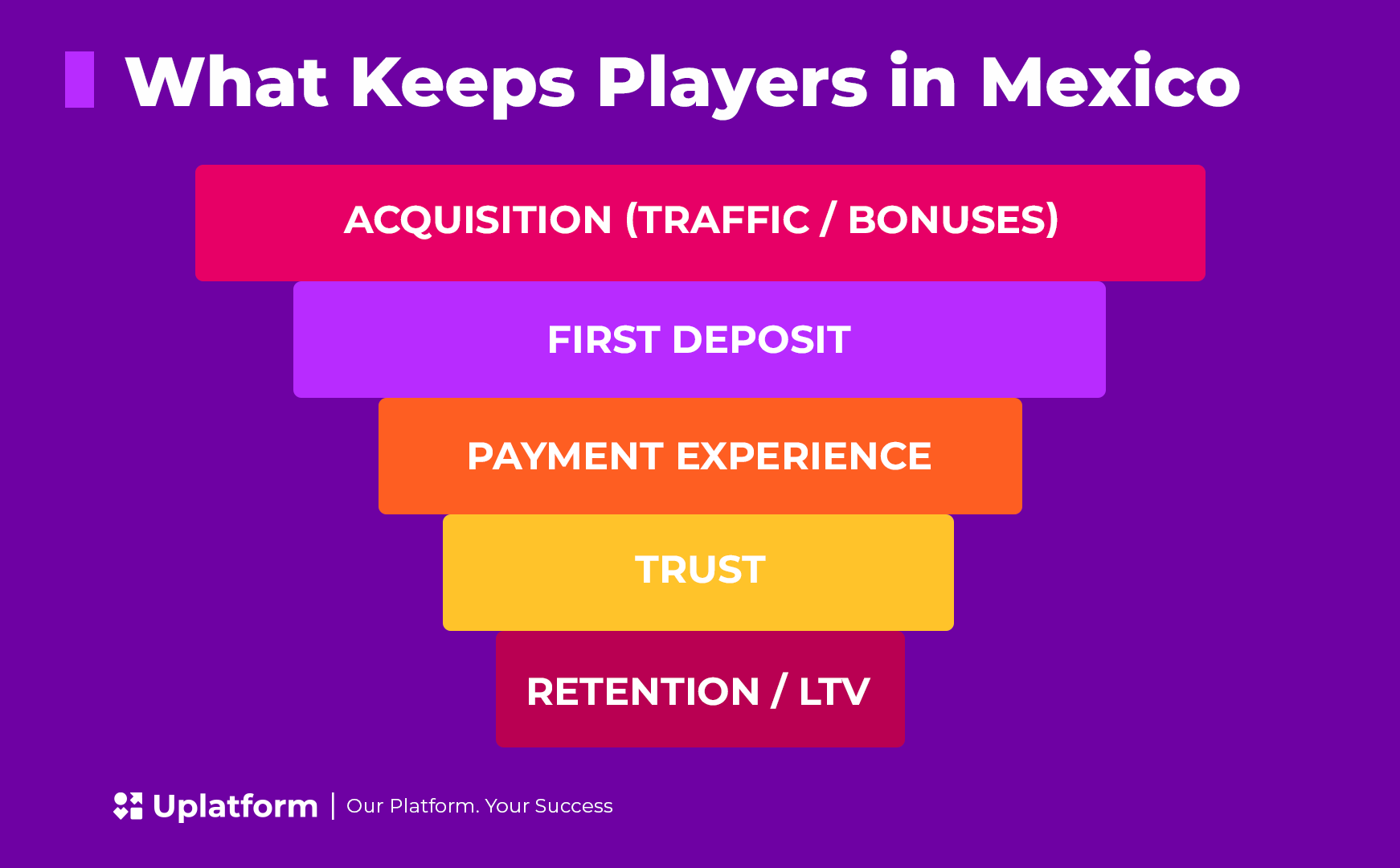
The real economic shift in Mexico is from acquisition-led growth to retention-led economics. This means operators must look beyond first-time deposit metrics and focus on player lifetime value from day one.
Retention in Mexico is closely tied to trust, payment reliability, and product depth. But beyond operational foundations, structured CRM becomes the primary growth lever. Segmented CRM campaigns allow operators to differentiate between casual bettors, high-frequency sports players, casino-focused users, and emerging VIP segments. A single promotional strategy cannot serve all behavioral profiles effectively. Precision increases relevance, and relevance increases retention.
Loyalty layering also plays a critical role. Structured reward systems, tiered benefits, and clearly communicated progression mechanics encourage ongoing engagement without relying exclusively on high-cost bonuses. When players perceive long-term value, churn decreases naturally.
VIP management is particularly important in markets where a relatively small percentage of players generate a disproportionate share of revenue. Dedicated account oversight, faster withdrawals, and tailored incentives can significantly stabilize high-value segments.
Fraud control alignment is equally essential. As acquisition expands, so does exposure to bonus abuse and transactional risk. Strong internal controls protect margin and prevent acquisition spend from being diluted by exploitation.
Responsible gambling tools should not be viewed solely as compliance requirements. In Mexico, visible responsible gambling features contribute to brand credibility and long-term trust. Clear limits, transparent controls, and accessible support options reinforce a perception of professionalism.
Instead of chasing raw registration volume, disciplined operators optimize for sustainable player value. Acquisition creates traffic, but retention builds revenue.
Step 7: Building Trust in a Competitive Market
Trust plays a central role in Mexico’s iGaming market. Reputation spreads quickly, particularly through social media, community groups, and informal word-of-mouth channels. Positive experiences travel fast, but dissatisfaction travels even faster.
Players evaluate brands based on practical signals rather than advertising claims. Withdrawal reliability is often the first and most important benchmark. When payouts are processed consistently and within clearly communicated timeframes, confidence builds. When delays occur without explanation, skepticism grows rapidly.
Bonus transparency is another key factor. Clear terms, understandable wagering requirements, and straightforward mechanics tend to outperform aggressive but complex promotional structures. Mexican players respond well to clarity. If bonus conditions feel misleading or difficult to interpret, trust erodes.
Customer support responsiveness also influences brand perception. Questions about payments, verification, or promotions require timely and competent answers. Spanish-speaking support is not optional. It is an operational baseline. Communication that feels natural and culturally aligned reinforces professionalism and reliability. For high-value players, dedicated VIP support with faster response times and personalized handling further strengthens trust and long-term retention.
Payment familiarity further strengthens credibility. When players see trusted local payment options and experience seamless deposit and withdrawal flows, the website feels stable. Every smooth transaction reinforces the brand.
Over time, these elements combine into a perception of operational seriousness. Brands that consistently deliver reliable payments, transparent promotions, responsive support, and localized communication build durable retention. In a market where switching between different operators requires only a few taps, credibility becomes a measurable asset.
In Mexico, trust is not built through campaigns. It is built through consistent execution.
Common Entry Mistakes Operators Make
- Underestimating payment localization
- Launching marketing before legal structure is stable
- Using generic sportsbook configuration
- Over-relying on bonuses without CRM depth
- Ignoring mobile performance optimization
Mexico punishes rushed entry.
Is Mexico Still Worth Entering?
Yes, but only with preparation.
Mexico is mature in competition but still growing in digital depth and player value.
The opportunity lies in operational execution, not market novelty.
Operators who treat Mexico as a strategic long-term market can secure meaningful share.
Operators who treat it as a regional add-on often exit quietly.
Other news
-
 From Operator Wish List to Everyday Reality
28.09.2026
-
- Player Engagement in iGaming: Operator Guide
01.09.2026
- SEO & AEO Strategies for iGaming in 2026
18.08.2026
-