SEO & AEO Strategies for iGaming in 2026

TL;DR
Following the March and May 2026 search algorithm updates, iGaming visibility has changed radically. Keyword-stuffed SEO and aggressive link-building now risk penalties, while AI Overviews – present on a growing share of queries – end most affected searches without a click. For B2C casino and sportsbook operators, success, especially in increasing Player Lifetime Value (LTV), now depends on AEO, E-E-A-T compliance, schema markup, semantic clusters, atomic answers, AI citations, and demonstrable website safety.
What is iGaming SEO?
SEO is the programmatic process of optimizing online casino and sports betting sites to maximize organic search engine visibility, fulfill user intent, and secure authoritative entity status. In 2026, it now employs traditional keyword indexing alongside answer engine optimization (AEO) to capture structured data for generative search architectures.
How has iGaming Search evolved in 2026?

iGaming search transitioned from traditional link-based SEO to AEO. Search visibility now requires strict E-E-A-T (Experience, Expertise, Authoritativeness, and Trustworthiness) compliance, advanced Schema markup, and intent-driven semantic clusters rather than keyword density and manipulative link building. This shift is being driven by several major changes in the market and search landscape, such as:
- Revenue Growth: According to The Business Research Company, global online gambling revenue will increase from $130.2 billion in 2025 to $143.17 billion by the end of 2026.
- Algorithmic Shifts: In Q1 2026, the online search space experienced unprecedented SERP volatility – widely characterized by analysts as the “Googlequake” – which culminated in the sweeping March Core and Spam Updates. This targeted algorithmic purge eliminated unmoderated AI-generated spam and aggressively penalized manipulative link schemes. The May 2026 core update, completed on June 2, extended this recalibration and was described by cross-vertical analysts as even heavier than the March rollout – a sign that the shift toward verifiable, primary-source content is here to stay.
- AI Overviews & AI Mode Expansion: AI Overviews now reach over 2.5 billion monthly users, and Google’s conversational AI Mode is growing even faster (we cover it in detail below). Players increasingly receive synthesized answers directly within the search interface, frequently bypassing traditional blue links entirely.
- Google’s Official AI Search Guidance: In May 2026, Google published its first official guide to optimizing for generative AI features in Search, stating plainly that “optimizing for generative AI search is optimizing for the search experience, and thus still SEO.” The guide prioritizes unique, non-commodity content and dismisses several widely sold “AEO hacks” which gives operators an official benchmark to check vendor claims against.
- Strategic Response: For casino and sportsbook operators, this means extending conventional SEO into AEO rather than replacing one with the other. This guide dissects the technical requirements, content frameworks, and compliance protocols necessary to navigate the 2026 search ecosystem and acquire high-intent players.
Why is iGaming SEO & AEO essential to success?
In 2026, the objective of iGaming SEO has evolved from generating sheer traffic volume to acquiring high-intent players focused on registration, deposits, and long-term value LTV. The critical reliance on organic acquisition is driven by these key market shifts:
- Affiliate Channel Restructuring: Rising operational costs are forcing affiliate networks to transition from immediate Cost-Per-Acquisition (CPA) models to Revenue Share (RevShare) agreements, strictly prioritizing player LTV over registration volume.
- Paid Acquisition Friction: Stringent advertising regulations across Europe and the Americas require complex pre-approvals for ad creatives, significantly reducing the scalability of paid channels.
- Cost Efficiency: Organic and AEO strategies provide consistent, high-intent traffic without the escalating marginal costs inherent to paid clicks.
- AI Citations as Trust Signals: Top organic positioning and citations by AI answer engines serve as primary trust verifications. For players researching odds fairness, payment methods, or legitimacy, AI-driven brand validation directly correlates with higher conversion rates and superior retention. Recent industry research shows that brands cited inside AI Overviews earn measurably more organic and paid clicks on the same queries than non-cited brands so citation share now carries direct commercial weight.
What are the Unique Challenges of iGaming SEO in 2026?
iGaming SEO has become more difficult in 2026 because search engines are applying stricter quality, trust, and compliance checks across industry-related content. The March 2026 Core and Spam Updates devalued manipulative link schemes and unmoderated AI-generated spam, and the May 2026 core update – completed in early June and felt even more broadly – reinforced the same trajectory.
Operators must now navigate “Site Reputation Abuse” filters and prove regulatory compliance through verified technical signals to maintain visibility.
To maintain visibility, casino and sportsbook operators must successfully navigate two main issues: immediate algorithmic & technical penalties and strategic & sector-specific realities.
Immediate Algorithmic Disruptions
- Massive SERP Restructuring: Following the March 2026 Core and Spam Updates, nearly 80% of top-three search results shifted, with approximately 25% of top-tier pages dropping out of the top 100 entirely.
- Penalties for Thin Content & AI Spam: Search engines specifically targeted “thin affiliates” and unmoderated AI content mills, resulting in traffic drops of up to 90%. Template-heavy comparison pages lacking unique information gain suffered declines ranging from 30% to 50%.
- Eradication of “Parasite SEO”: The updates aggressively enforced “Site Reputation Abuse” policies. The legacy tactic of purchasing subfolders on highly authoritative, non-gambling news domains was neutralized via stringent page-level authority assessment.
Structural Challenges Influencing iGaming SEO
- E-E-A-T Scrutiny in a YMYL Environment
Because online gaming involves direct financial transactions and player risk, search engines categorize the entire industry under strict “Your Money or Your Life” (YMYL) parameters. Algorithmic systems such as this apply strict validation protocols to ensure player protection, actively demoting the absence of Responsible Gambling (RG) tools and treating them as critical negative ranking factors. Securing organic visibility requires verifiable expertise, transparent ownership, and strict E-E-A-T compliance to prove consumer financial safety to the algorithms. - Capital Density and Search Competition
The barrier to organic entry in Tier-1 jurisdictions now demands multi-million dollar investments in licensing, proprietary technology, and digital PR before a single player is acquired. Given these capital requirements, broad keyword targeting is financially unviable. Operator ROI now relies entirely on highly strategic, intent-matched SEO focused exclusively on high-converting, bottom-of-the-funnel player queries. - Jurisdictional Compliance as an Algorithmic Signal
A monolithic global SEO strategy is structurally flawed. Search algorithms now treat regulatory compliance as a primary E-E-A-T metric rather than a mere legal requirement. Operators must deploy dynamic technical architecture–specifically jurisdiction-aware Schema markup–to clearly signal local licensing, tax compliance, and legal betting ages to AI crawlers. Mismatched regulatory signals between the operator’s site and the target jurisdiction immediately trigger algorithmic risk filters, suppressing visibility.
What are the Core Strategies for iGaming SEO & AEO Success?

Dominating the 2026 SERP environment requires a technical pivot toward AEO and verifiable E-E-A-T signaling. Operators must deploy the Atomic Answers framework to secure AI overview citations, leverage proprietary data for High Information Gain, and prioritize authoritative, editorial-led digital PR to satisfy AI-driven search models and navigate aggressive algorithmic filters. The following approaches have become essential for maintaining visibility and long-term search performance in 2026:
1. The Transition to Answer Engine Optimization (AEO)
AEO is the technical practice of structuring architecture and content so that generative AI models can easily comprehend, verify, and serve the information directly to users. Effective AEO implementation depends on the following practices:
- The Atomic Answers Framework: Formatting subheadings (H2/H3) as direct user queries (e.g., “How to evaluate online casino reliability in 2026?”) followed by a concentrated, jargon-free summary (40–60 words) remains a powerful editorial discipline – not because AI systems require pre-fragmented content (Google has confirmed they don’t), but because clarity, scannability, and unambiguous answers improve extraction accuracy across all answer engines and directly serve high-intent users.
- Intent-Driven Semantic Clustering: Search algorithms now utilize Large Language Models (LLMs) to map contextual relationships. Operators must abandon isolated keywords and build interlinked knowledge graphs. For example, a pillar page covering “Online Sports Betting in Peru” must be structurally linked to cluster pages detailing taxation rules, mobile app performance, and local payment nodes.
- Optimizing for LLM Data Consumption: Beyond traditional indexing, AEO requires clear, logical content hierarchies and ensuring that key data points (RTP, betting limits, licensing) are presented in clean, semantically structured HTML that both LLMs and classic crawlers can parse and verify against secondary sources. No special “AI formats” are required for Google’s systems – but precision, consistency, and verifiability of the data itself are non-negotiable.
- High Information Gain (Originality Scoring): AI engines actively filter out aggregated or replicated “me-too” content. To secure citations in zero-click searches, operators must inject proprietary data (e.g., internal statistics, real user testing metrics, or exclusive expert commentary) to provide unique value that LLMs cannot extract from competitor domains.
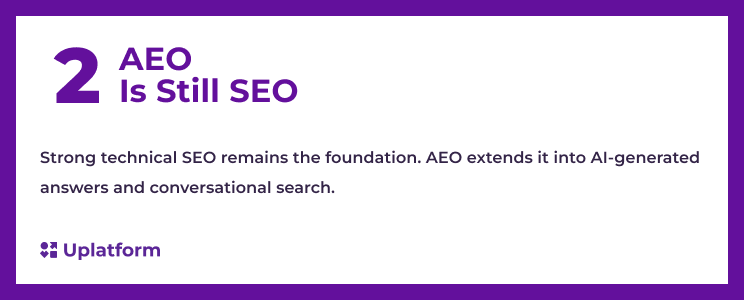
- AEO is still SEO: Google’s official 2026 guidance states that optimizing for generative AI features “is still SEO” – for Google, the same core ranking systems power blue links, AI Overviews, and AI Mode. AEO is therefore not a replacement for SEO but its extension across a fragmented answer ecosystem: Google’s AI surfaces, ChatGPT, Perplexity, and other assistants each retrieve and verify content through different pipelines. In practice, classic SEO remains the foundation, with engine-specific visibility work layered on top.
2. Establishing Unassailable E-E-A-T Signals
Given the YMYL (“Your Money or Your Life”) nature of iGaming, E-E-A-T (Experience, Expertise, Authoritativeness, and Trustworthiness) is a strict algorithmic filter. Search engines actively demote generic content lacking verifiable, experiential data. This is achieved through several key E-E-A-T optimization practices:
- Demonstrable First-Hand Experience: Algorithms measure “Information Gain” to filter out aggregated reviews. Content must include documented interactions: exact deposit/withdrawal timelines derived from live testing, KYC friction points, and original screenshots of UI/UX flows.
- Semantic Density & Niche Terminology (Expertise): To satisfy the algorithmic “Expertise” vector, content must utilize precise mathematical and industry-specific terminology (e.g., RTP volatility indices, Asian Handicap margins, implied probability calculations). LLMs parse these semantic clusters to distinguish true domain experts from generalized AI content generators.
- Data-Driven Authority: Operators must inject proprietary data and internal insights (e.g., localized betting trends, real-time withdrawal velocity metrics) to provide unique value that algorithms cannot extract from competitor domains.
- Trust by Association (Authoritative Citations): Search algorithms map outbound link graphs to verify factual accuracy. Operator claims must be anchored by direct citations to tier-1 regulatory bodies (UKGC, MGA), certified testing laboratories (eCOGRA, iTech Labs), or recognized industry research reports, establishing the domain as a credible informational node.
- Entity-Based Authorship: The 2026 update cycle heavily penalized anonymous editorial content. Authors must be treated as verifiable digital entities linked to professional networks (e.g., LinkedIn) to validate industry credentials within search engine knowledge graphs.
- Responsible Gambling (RG) as a Trust Metric: Beyond regulatory compliance, search algorithms parse domains for native RG architecture. Prominent age verification, accessible self-exclusion tools, and transparent bonus terms act as primary positive ranking signals.
3. Next-Generation Link Building and Digital PR
The 2026 algorithmic framework fundamentally redefined the link graph. Search engines now deploy strict anomaly detection for unnatural link velocity and actively penalize legacy link-building tactics. Here is how operators are adapting:
- The 1-to-100 Quality Ratio: The focus has shifted entirely from volume to editorial trust. A single contextual backlink from a highly authoritative Tier-1 publisher (e.g., financial media, sports networks, or regulated iGaming news) carries significantly more algorithmic weight than 100 low-quality placements.
- Devaluation of Foundational Links: Traditional mass-submission tactics–including web directories, generic listings, forum signatures, and automated company profiles–have been completely neutralized. These links no longer pass PageRank and act as toxic signals if built at scale.
- Data-Driven Digital PR: To earn algorithmic trust, operators must position their domains as primary data sources. Publishing proprietary, anonymized website data (e.g., regional betting trends, RTP variance reports, or demographic shifts) naturally attracts editorial citations from mainstream media and embeds the brand into LLM knowledge graphs.
- Anchor Text Toxicity: The aggressive use of exact-match commercial anchors (e.g., “best casino bonus”) now triggers automated spam filters. Link equity must be managed through a heavily diversified profile utilizing branded entities, naked URLs, and natural semantic context to bypass algorithmic scrutiny.
How Does AI Mode Change iGaming Visibility?
AI Mode is Google’s conversational search experience: instead of a list of links, users receive a synthesized, multi-turn answer generated by Gemini, with sources cited inline. Announced as a core experience at I/O 2026, it has surpassed 1 billion monthly users, with query volume more than doubling each quarter – although independent clickstream data shows that actual transitions into AI Mode are a small fraction of total searches. In short: AI Mode is growing fast, but it is not yet where most searches happen. For operators, three mechanics matter:
- Query Fan-Out: AI Mode decomposes a single user question into dozens of parallel sub-queries executed behind the scenes, then synthesizes the results. A query like “best betting projects for the Brazilian market” may trigger hidden sub-queries on licensing, payment methods, odds coverage, and app performance. Visibility therefore depends on comprehensive topical coverage across the entire cluster – an operator ranking for the head term but absent from the sub-topics will be invisible in the synthesized answer.
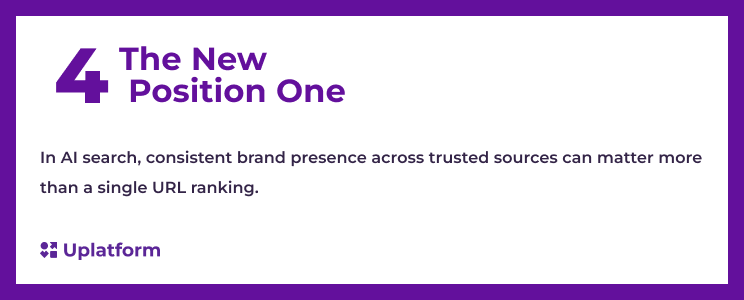
- Entity Presence Over URL Position: AI Mode reasons over entities, not rankings. Whether a brand is named in an answer depends on how consistently and authoritatively it appears across the knowledge graph – licensing databases, tier-1 industry media, review services, and structured data. Brand mentions in trusted contexts function as the new “position one.”
- YMYL Filtering at Full Strength: Because gambling queries carry financial risk, AI Mode applies conservative sourcing: answers lean heavily on regulator sites, established industry publications, and operators with verifiable compliance signals. Without the E-E-A-T and compliance architecture described throughout this guide, an operator simply doesn’t qualify for these answers.
What are the On-Page and Technical SEO Imperatives for iGaming in 2026?
Technical excellence is defined by instant interactivity and machine-readable transparency. Websites must prioritize an Interaction to Next Paint (INP) score below 200ms , deploy advanced Schema entity mapping, and maintain clean, crawlable architecture that allows both classic crawlers and LLM agents to extract data without friction. To remain competitive, operators must focus on several core areas of technical optimization. These include:
1. Core Web Vitals & Performance
Technical performance thresholds now function as a binary algorithmic filter: search systems prioritize sites that provide immediate feedback during high-intensity user sessions. So operators must optimize the following Core Web Vitals components:
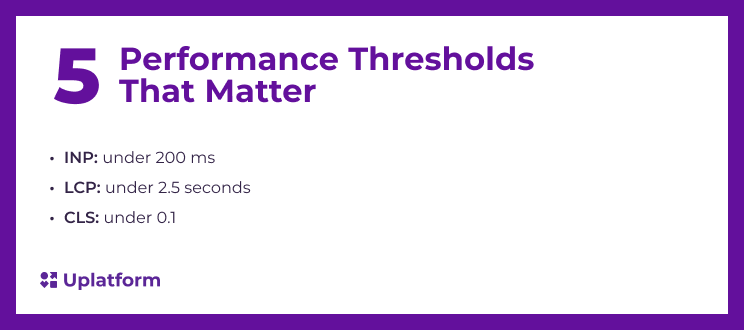
- Interaction to Next Paint (INP) Optimization: INP replaced the legacy First Input Delay (FID) as a Core Web Vital in March 2024 and remains the definitive responsiveness metric in 2026. Operators must maintain an INP score below 200ms. This requires minimizing JavaScript “Long Tasks” (>50ms) during odds refreshes in sportsbooks or game filtering in casinos. In simple words, this means the website must respond instantly when users tap, click, or interact with features like betting odds or casino filters, without delays or freezing.
This is why iGaming providers like Uplatform prioritize speed. When a player taps a button, selects a bet, or filters games, the page should respond instantly, within about 0.2 seconds. If the site feels slow or “freezes” longer than that, users will notice the lag, and search engines may treat your website as poorly performing. - Largest Contentful Paint (LCP): The main content (Hero blocks or live match lists) must render in under 2.5 seconds. To achieve this, technical teams should prioritize the loading of critical-path CSS and defer non-essential third-party scripts.
- Cumulative Layout Shift (CLS): To prevent accidental clicks – a common issue in dynamic sportsbooks – CLS must remain below 0.1. This is achieved by reserving space for dynamic elements (e.g., live odds grids, promotional banners) using CSS aspect-ratio or min-height properties.
- Continuous Auditing: Performance must be monitored via PageSpeed Insights to ensure all field data aligns with Google’s “Good” thresholds across all landing pages.
2. Mobile-First Architecture & “Micro-Moments”
With mobile devices, according to AGM Models, accounting for over 70% of global iGaming revenue in 2026, architecture must be designed around “micro-moments”–high-intent, short-duration user actions where speed and ease of use determine conversion. Here are a few tricks operators must take seriously:
- The 3-Second Rule for Micro-Moments: Mobile users often engage in “burst” sessions: checking live scores, verifying a payout, or claiming a time-sensitive bonus. The site architecture must allow these specific actions to be completed within 3 seconds of the landing.
- Thumb-Zone UX Navigation: Critical interactive elements (Deposit buttons, Odds selection, Account menu) must be placed within the natural reach of the user’s thumb to reduce friction and improve engagement metrics, which are now parsed as proxy signals for E-E-A-T.
- Layout Stability for Dynamic Content: Live data feeds must update without causing visual “jumps” in the UI. Stable layouts are essential to maintain user focus and trust during peak traffic periods.
- Adaptive Asset Loading: Implementing advanced image formats (WebP/AVIF) and lazy-loading for off-screen assets to preserve bandwidth on mobile networks without compromising visual quality for high-stakes players.
3. Semantic On-Page Framework
Content must be structured so that both Large Language Models (LLMs) and traditional crawlers can instantly map the page’s intent and hierarchy. Let us look at some insights:
AI-Optimized Metadata:
- SEO Title: Restricted to 30–60 characters. It must contain the primary keyword and an intent marker (e.g., B2B, Guide, API). Note: The H1 remains human-centric and can be longer.
- Meta Description: A concise “abstract” of 150–160 characters. It should function as a compressed TL;DR, including key data points or website features to maximize CTR in AI-driven snippets.
- Header Hierarchy (H1-H4) as Intent Nodes: H2 and H3 tags should be framed as direct user questions, immediately followed by an Atomic Answer (40–60 words) to facilitate easy parsing by AI answer engines.
Advanced Multimedia Optimization:
- Formats: Prioritize WebP and AVIF for standard imagery. SVG is mandatory for logos and UI icons to ensure resolution-independent clarity. PNG is reserved only for high-detail technical screenshots where lossless quality is non-negotiable. GIFs are deprecated; use short, looped MP4/WebM files for better performance.
- Video Integration: All video assets must implement VideoObject schema, including thumbnailUrl (returning a 200 status), uploadDate, name, and description.
- AI Vision and ALT Text: Images must feature descriptive ALT text containing specific data from the visual (e.g., “Chart showing 15% GGR growth in LatAm”).
- Discover Optimization: The max-image-preview:large meta tag is required in the <head> to qualify for Google Discover and AI Overview placement.

4. Schema markup & Authority Architecture
To ensure AI agents correctly categorize and trust a website, operators must translate their HTML content into machine-readable data using Schema.org. In the YMYL (Your Money or Your Life) iGaming sector, this structured data serves as the definitive “proof of identity” for both search engines and Large Language Models (LLMs).
- The Role of Micro-markup: Schema.org is a standardized vocabulary used to explicitly tell crawlers what an object is (e.g., a license, a person, or a product) rather than letting them guess based on text. For AI-driven search, this eliminates ambiguity and directly feeds the brand’s entity graph.
- Entity Mapping & sameAs Verification: Use the Organization schema to define the brand’s digital entity. The sameAs array must link to authoritative external nodes–specifically major industry review services (e.g., AskGamblers, Trustpilot) and official brand social media accounts. This validates the brand’s footprint across the global iGaming knowledge graph.
- Technical Credentialing (GovernmentPermit): To satisfy AI-driven legitimacy filters without impacting front-end design, license data must be embedded within the site’s JSON-LD via the hasCredential property. This backend signal–specifying the license type, issuing body (e.g., MGA, Curacao), and unique identifier–allows AI agents to instantly validate legality while remaining invisible to the end-user.
- FAQ Implementation for AI Extraction: Every informational cluster should feature an on-page Q&A section where questions mirror high-intent long-tail queries and answers stay within the concise 40–60 word format. The value sits in the content structure itself – clear questions paired with direct, verifiable answers that any answer engine can parse. FAQPage markup can still be added for semantic completeness, but don’t expect FAQ rich results from it (Google restricted those to authoritative government and health sites back in 2023), and it earns no special AI treatment on its own.
5. AI-Ready Infrastructure
In May–June 2026, Google settled a two-year industry debate. Its official guidance now states that you don’t need to create machine-readable AI files, Markdown versions of pages, or special markup to appear in Google Search, including its generative AI features – Google Search simply ignores them. This has direct consequences for how operators should prioritize their technical roadmap:
- For Google (AI Overviews & AI Mode): There is no special “AI entry point.” Visibility is earned through the same infrastructure that powers classic Search: crawlable, semantically clean HTML, fast rendering, valid structured data for rich results, and unique, verifiable content. The budget spent on parallel “AI-only” file structures for Google’s benefit is wasted.
- The llms.txt Standard: Useful, But Not for Google: llms.txt (a root-level Markdown summary of the key content, specified at llmstxt.org) is confirmed irrelevant for Google but is retrieved by some AI assistants and agent frameworks. Independent adoption studies, however, show that the vast majority of published llms.txt files are never fetched at all, and no statistically measurable citation effect has been demonstrated to date. Realistically, this is a low-cost, low-evidence experiment: publishing and maintaining the file costs little and may aid non-Google agents, but it must never displace fundamentals in the roadmap – and it should never be sold internally as a ranking lever.
- Where Machine Readability Actually Lives: The durable investment is in the pages themselves: logical heading hierarchies, data presented in parseable HTML tables rather than images, consistent entity naming across the site, and JSON-LD structured data validated against schema.org. These serve every crawler – Googlebot, GPTBot, PerplexityBot, ClaudeBot – from a single source of truth, with no parallel maintenance burden.
6. Technical Hygiene & Strategic Audit Checklist
Maintaining a stable search presence requires constant monitoring of technical integrity. In high-stakes iGaming environments, minor technical errors are often interpreted by algorithms as signals of website neglect or lack of expertise. Keeping your search presence stable means preventing minor backend errors from looking like a neglect; you can do this by auditing your technical setup against these key parameters:
- Robots.txt & AI Visibility: Beyond standard directory exclusions, the Robots.txt file must be configured to allow search engines access to JavaScript and CSS. Without these resources, crawlers cannot correctly render the page or calculate Interaction to Next Paint (INP) and other Core Web Vitals.
One trend our SEO team has been watching: some operators now add explicit Allow: /llms.txt and Allow: /llms-full.txt directives for AI user-agents. We have no data showing they affect visibility – but the practice costs nothing and keeps AI-crawler policy explicit. An observation, not a recommendation. - Hreflang & Global Mapping: For operators active in multiple jurisdictions (e.g., Brazil, Portugal, Canada), valid hreflang tags are mandatory. Misconfiguration here leads to regional cannibalization and prevents AI from serving the correct localized version to users.
- Canonicalization Mastery: Casinos and Sportsbooks should use explicit rel=”canonical” tags to consolidate link equity. This prevents algorithmic penalties for “Thin Content” which commonly occur when multiple operators use identical game descriptions or odds data.
- Structured Data Validation: Any syntax errors in JSON-LD Schema (e.g., missing commas, invalid properties) will cause the entire trust signal to fail. Regular validation through the Rich Results Test is mandatory to ensure E-E-A-T markers like GovernmentPermit are correctly parsed.
- Metadata Consistency: Duplicate or missing Title tags and Meta Descriptions lead to internal competition (cannibalization) and prevent AI from accurately clustering the site’s semantic nodes.
Beyond the text and structural code layers, technical hygiene also depends heavily on how your website handles visual media and asset indexing. Search engines utilize computer vision to grade your site, meaning image optimization requires strict backend rules:
Image Integrity & AI Vision:
- Broken Images (4xx/5xx): Direct negative signal for user experience and reliability.
- Missing ALT Text: Prevents AI vision models from understanding visual data (e.g., infographics, bonus tables), leading to exclusion from visual search and AI summaries.
Internal Link Health:
- Broken Internal Links: Disrupts the crawl path and drains “link equity.”
- Orphaned Pages: Pages without internal links remain invisible to most AI and search agents.
- Crawl Depth Architecture: AI crawlers allocate limited computational resources per domain. High-value semantic clusters, primary game lobbies, and specific Atomic Answers must be accessible within a maximum of 3 clicks from the homepage. Deeply nested architecture results in critical data being completely excluded from LLM knowledge bases and AI Overviews.
- AI Navigation (llms.txt) Integrity: The /llms.txt and /llms-full.txt files must return a strict 200 OK status and maintain flawless Markdown formatting. Syntax errors, broken internal links within the file, or a 404 status force AI agents to default to standard HTML crawling.
- Protocol & Security Hygiene: Resolving mixed-content issues and ensuring valid HTTPS across all subdomains is the baseline for preserving the “Trust” component of E-E-A-T.
How to Navigate Regulatory Compliance in iGaming SEO?
Regulatory compliance functions as a strict algorithmic E-E-A-T filter. Search engines technically verify operator legitimacy through structural license data and jurisdictional alignment. The absence of transparent wagering terms, functional age verification, or Native Responsible Gambling (RG) architecture triggers automated suppression in both traditional SERPs and AI Overviews. To navigate these strict algorithmic barriers, it is recommended that operators integrate compliance directly into their apps and websites. Here are a few ways to achieve this:
1. Algorithmic Jurisdictional Filtering
Search engines treat local licensing as a core authoritativeness signal rather than a mere legal formality. Operators must align their digital footprint with region-specific gambling laws and advertising regulations. Targeting users in regulated markets (e.g., the UK or specific US states like New Jersey) requires verified jurisdictional certifications to bypass automated algorithmic risk filters and avoid severe regulatory fines.
2. Technical Wagering Transparency
Algorithms prioritize websites that exhibit explicit transparency regarding betting activities. Operators must ensure that all terms, conditions, and necessary disclaimers are prominently displayed and machine-readable. Misleading promotional language degrades user trust and generates negative algorithmic signals that directly damage the domain’s Authoritativeness score.
3. Digital Certification Integration
Gambling licenses and testing certifications must be clearly integrated into the system’s architecture. Embedding this data (e.g., via GovernmentPermit schema) allows search crawlers and AI agents to instantly validate legality, building structural trust with search engines beyond standard front-end visual badges.
4. Native Responsible Gambling (RG) Architecture
The integration of player safety features is parsed as technical evidence of E-E-A-T compliance. Search algorithms actively scan for Native RG signals, making the presence of functional age verification protocols, accessible self-exclusion options, and links to support services a mandatory positive ranking factor.
Monitoring and Analysis of SEO & AEO Results
Effective performance evaluation requires a hybrid monitoring framework. Traditional SEO metrics (keyword rankings, backlink velocity) remain foundational but must be supplemented with advanced AEO tracking–specifically AI Visibility Scores, Player LTV, and Prompt Tracking–to accurately measure algorithmic trust and revenue generation. To create a comprehensive tracking system that serves both executive decision-makers and search engines, operators should structure their setup into three distinct measurement layers:
1. Baseline SEO Infrastructure
Standard monitoring tools remain necessary for diagnosing technical health and baseline search visibility:
- Google Search Console & Analytics: Essential for monitoring indexation status, organic CTR, baseline traffic patterns, and technical performance.
- Enterprise SEO services (Semrush / Ahrefs): Utilized for tracking traditional Keyword Rankings, analyzing backlink profile growth, and monitoring competitive link velocity.
2. Next-Generation AEO Tracking
Tracking raw traffic volume and isolated keywords now provides an incomplete picture of an operator’s digital health. Operators must augment classical tracking with AI-specific metrics:
- AI Visibility Score & Cited Pages: Operators must monitor how frequently their proprietary data, odds, and content are cited by generative AI models. An increase in cited pages serves as a leading indicator of growing topical authority and algorithmic trust.
- Prompt Tracking & Share of Voice: Tracking brand visibility, entity associations, and sentiment specifically within AI answer outputs and zero-click search interfaces.
3. Revenue & Behavioral Signals
- Player Lifetime Value (LTV): The ultimate measure of B2C SEO success is revenue generation. Operators must implement sophisticated attribution modeling to track the conversion rates of organic landing pages and the subsequent LTV of the acquired players.
- Indirect Engagement Signals: Search engines increasingly rely on indirect user behavior signals to evaluate page quality. Metrics such as dwell time, interaction rates with on-page UI (e.g., bet slips, sliders), and scroll depth inform the algorithm whether the user’s intent was satisfied. High engagement solidifies ranking positions, validating the effectiveness of the operator’s strategy.
Conclusion
Success in the current search environment depends on transitioning from keyword manipulation to structural and semantic authority. Operators must integrate AEO-ready content and infrastructure with strict jurisdictional compliance to secure long-term player LTV and algorithmic trust, forcing a fundamental shift from volume to value – where organic acquisition transitions from a game of raw traffic to a focus on high-intent, high-LTV player cohorts. To achieve this, machine readability must be built into the pages themselves: clean semantic HTML, validated structured data, and unique, verifiable content now serve every engine – Google’s AI surfaces and third-party assistants alike – from a single source of truth. At the same time, trust must be treated as a defensive asset, where transparent regulatory adherence and verifiable E-E-A-T signals serve as the primary defense against algorithmic volatility, supported by data-driven adaptation through a hybrid monitoring framework that balances traditional SEO metrics with AI Visibility and Sentiment tracking.
Other news
-

- From Operator Wish List to Everyday Reality
28.09.2026
-
- Player Engagement in iGaming: Operator Guide
01.09.2026
-