Player Engagement in iGaming: Operator Guide

TL;DR:
Next best action turns live player signals into one commercially relevant response: content, service, communication, suppression or safety intervention. The operator advantage is not more messages. It is faster, governed decisioning that improves incremental NGR, retention and player experience while controlling promotional cost, risk and regulatory exposure.
Why is the next decision now the operating problem?
Most iGaming operators do not have a shortage of player data. They have a shortage of coordinated decisions. Sportsbook activity sits beside casino history, CRM response, payment status, support contact and responsible gambling indicators. Operators need to understand that all these systems must work in harmony because the player receives a combined experience.
That experience often reveals the gap. A player whose deposit has failed receives a reload offer. Someone who has already returned is sent a reactivation message. A new sportsbook player is shown a casino promotion before completing a first bet. Marketing, product and service actions may each be logical in isolation while competing with one another in the same moment.
The challenge is not whether operators can personalize. It is whether they can choose the right action, avoid irrelevant messages, and respond while the moment still matters. That is where next-best-action decisioning comes in.
What does next best action mean in iGaming?
Next best action is a governed method for choosing the right response to a player’s current context. It selects from a defined set of eligible actions. It connects a signal to a business objective, applies operational and safety rules, and records the outcome so the decision can be evaluated.
The action is not automatically a promotion. It may be a relevant event or game recommendation, a clearer onboarding step, payment support, a service message, a responsible gambling interaction, suppression of commercial communication or no action at all. Doing nothing is a valid decision when another contact would add cost or friction without changing the outcome.
This distinguishes decisioning from broad personalization. Localization determines how a market should be served. Segmentation identifies groups with similar behavior. Journey orchestration maps what may happen across a lifecycle. Next best action resolves the immediate conflict: given what is known now, which single response deserves priority?
Which player signals are useful enough to act on?
A signal is useful when it is reliable, recent enough for the decision and connected to an action the operator can control. More data does not improve decisioning if teams cannot explain how it changes eligibility, priority or measurement.
| Signal type | Examples | Possible operator decision | Commercial measure |
|---|---|---|---|
| Context | Device, channel, location, local time, active session | Change format, timing or navigation | Completion, response latency |
| Behavior | Recent bets or games, searches, session pattern, vertical preference | Rank relevant content or continue a journey | Product adoption, retention |
| Transaction | Deposit status, payment method, withdrawal stage, bonus state | Resolve friction, change payment guidance or suppress offers | Approval, completion, NGR |
| Lifecycle | Registration stage, first action, repeat deposit, inactivity | Guide, engage, retain or reactivate | Stage conversion, D1/D7/D30 |
| Operations | KYC delay, support case, technical error, account restriction | Prioritize service over promotion | Resolution, complaints, churn |
| Player safety | Spend, time, behavior, contact and account indicators | Stop commercial targeting and route to review or interaction | Interaction effectiveness, safer outcomes |
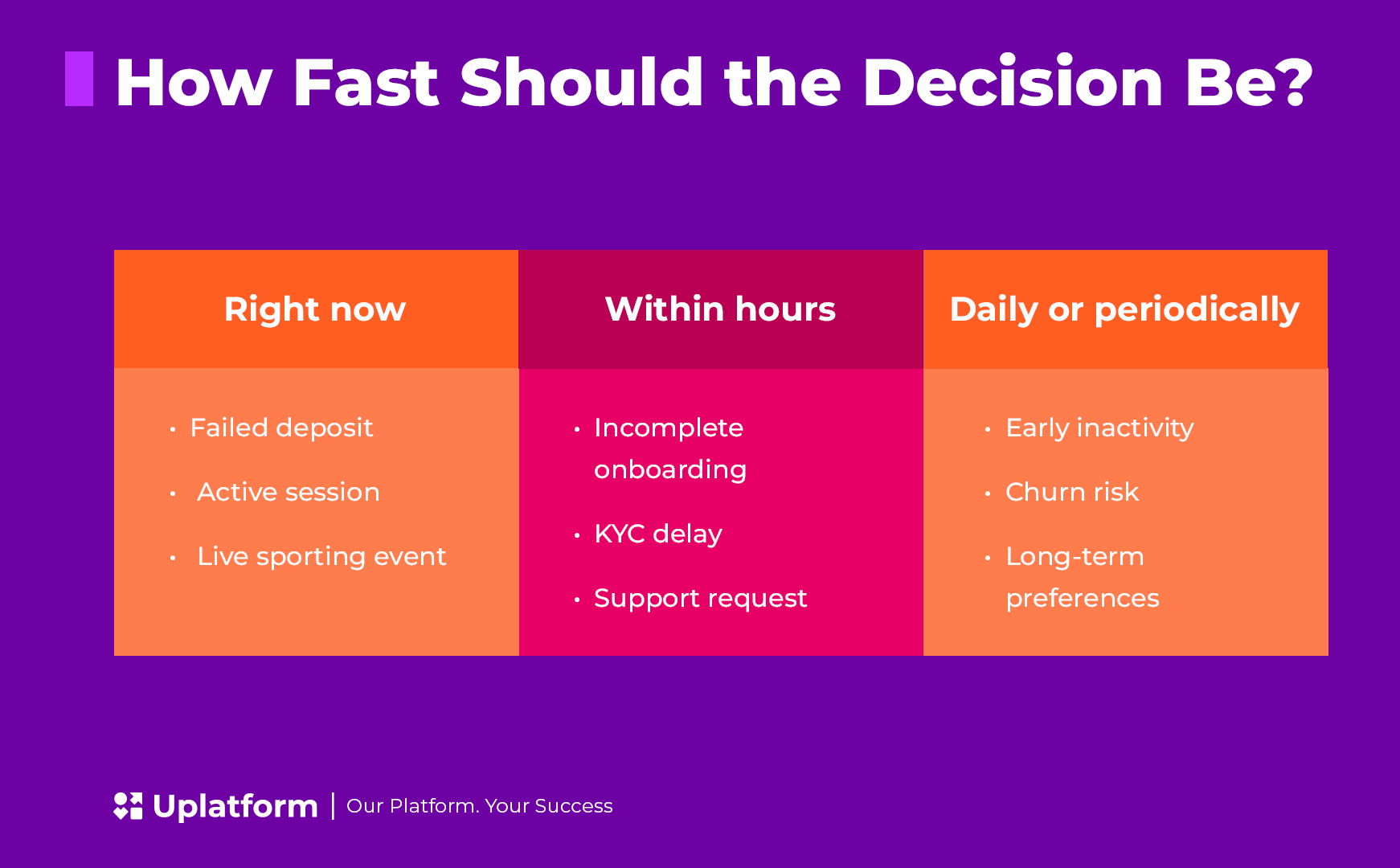
Recency has to match the moment. A failed deposit can change the next interaction immediately. A preferred sport may remain useful for weeks. A churn score can be refreshed periodically. Treating every signal as real time adds cost without necessarily improving the decision.
Where does real-time decisioning create commercial value?
Decisioning creates value where a timely response can remove friction, improve discovery, prevent wasted incentives or protect the relationship. Operators should start with high-volume decisions that already have a clear owner and measurable economics.
| Use case | Next action | Primary KPI | Required guardrail |
|---|---|---|---|
| Incomplete onboarding | Continue the exact step, clarify the requirement or offer help | Completion; time to first action | Do not add messages that make KYC or terms less clear |
| Failed deposit | Explain the status, offer support or present an eligible local method | Payment completion; FTD | Suppress unrelated bonuses until the issue is resolved |
| Content discovery | Rank a relevant event, market, game or category | Next action; product adoption | Maintain variety, eligibility and margin controls |
| Cross-vertical journey | Introduce a related product only after positive engagement | Incremental cross-sell; retention | Frequency caps and market restrictions |
| Early inactivity | Send a relevant reminder, service check or no message | Incremental retention; NGR | Control group and contact limits |
| Potential harm | Suspend commercial actions and trigger the operator’s safety process | Timely review; interaction effectiveness | Safety rules override commercial scores |
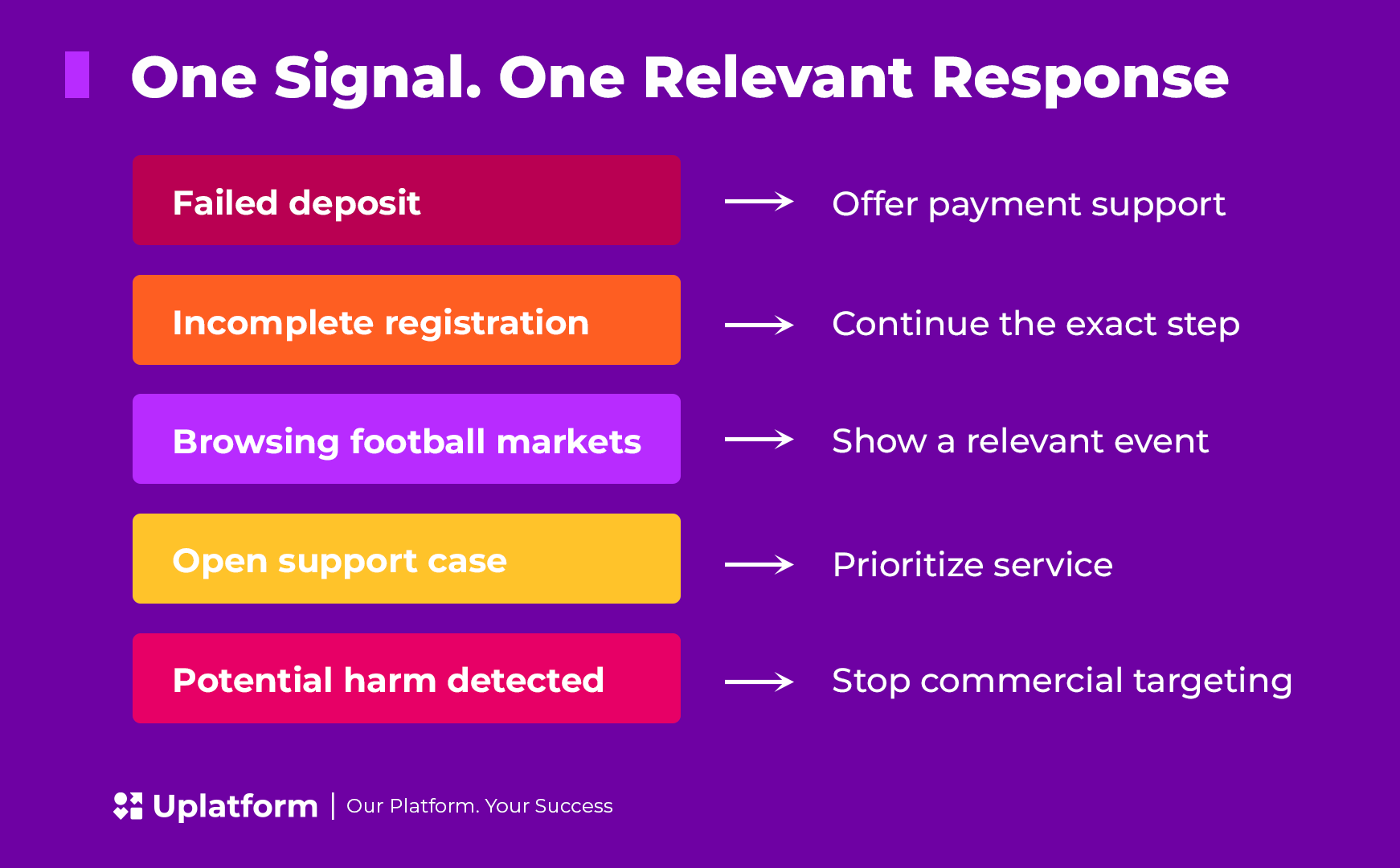
The same signal can justify different actions depending on context. Inactivity after a payment failure is a service problem before it is a retention problem. A player browsing football markets before a major fixture may need better discovery, not a bonus. An existing support case may make silence more appropriate than another campaign.
How fast does a decision need to be?
Real time should be defined by the commercial moment, not by a technology label. During an active session, after a transaction error or around a live sporting event, the decision may need to arrive within the same interaction. For lifecycle communication, an hourly or daily update can be sufficient.
Operators need a latency budget across the full chain: capture the event, update the player context, apply rules, select an action, deliver it and record the result. If any stage is slower than the moment being served, the system can produce an accurate answer too late.
Speed also increases the cost of mistakes. Fast decisioning needs versioned rules, testing, fallbacks and monitoring. When the profile is incomplete or a dependent system is unavailable, the safest outcome may be a generic experience or no action—not an unverified offer.
Does next-best-action decisioning require AI?
No. A rules-based approach can be commercially effective when the decision is narrow and the signals are clear. Eligibility, market, lifecycle stage, payment status, contact frequency and recent behavior can establish a strong first policy without a predictive model.
AI or machine learning becomes useful when the operator has enough reliable outcomes to rank several eligible actions, estimate the probability of response or predict longer-term value. Even then, the model should not own the entire decision. Compliance, player protection, budget, availability and operational suppressions remain explicit rules.
Complexity must earn its place. A model that improves click-through but increases incentive cost, lowers NGR margin or repeatedly selects the same action is not making a better commercial decision. Teams need an explainable objective, stable data, monitoring for drift and a clear route to human review where the use case demands it.
How should operators measure the result?
Measure incremental contribution, not raw response. A decision can increase engagement while destroying value through unnecessary bonuses, channel cost, fraud exposure or operational workload. The primary KPI should match the problem, and a control group should show what would have happened without the intervention.
For a commercial use case, the practical calculation is incremental NGR minus incentive, channel and additional operating costs. Retention, ARPU and LTV show whether value lasts. Response latency confirms whether the action arrived in time. Complaints, opt-outs, failed payments, repeated contacts and player-safety outcomes act as guardrails.
Record the decision itself, not only the campaign. Operators need to know which actions were eligible, which rules excluded alternatives, what was selected, when it was delivered and what happened afterwards. Without that trail, teams can see an outcome but cannot explain or improve the policy that produced it.

What infrastructure turns signals into action?
The minimum architecture is operational rather than fashionable: consistent player identity, event capture, a current profile, a rules or decision layer, connected delivery systems and outcome reporting. CRM, CMS, bonus, payments, sportsbook, casino, support and back-office data need clear responsibilities and controlled interfaces.
Uplatform brings sportsbook, casino, payments, player management, marketing tools and operational support into a connected platform environment. For an operator, the relevant question is not how many modules exist. It is whether a player event can move through those modules as one governed workflow.
Within Uplatform’s Utools, CRM, bonuses, CMS, back office and payment capabilities can help put each decision into action across the player journey. That still requires a clear operator-defined policy covering:
- the objective
- eligible actions
- priority rules
- exclusions
- response-time targets
- ownership
- measurement
Integration cannot compensate for unclear ownership. Marketing may own campaign economics, product may own onsite ranking, payments may own recovery flows, support may own service intervention and safer-gambling teams must own safety responses. A shared decision policy prevents one function from undoing another function’s work.
How can operators start without rebuilding everything?
Start with one decision where the signal, action and outcome are already visible. The first implementation should prove that coordinated action is more valuable than another disconnected campaign.
Choose one commercial decision. Define the exact moment, such as a failed first deposit, incomplete registration or early inactivity, rather than starting with a broad objective such as improve retention.
Audit the available signals. Confirm identity, freshness, consent, data quality and whether each signal changes eligibility or action priority.
Create the action set. Include service, content, communication, suppression and no-action options—not only bonuses.
Define overrides and ownership. Player protection, account restrictions, market rules, payment status, frequency caps and open support cases should be resolved before commercial ranking.
Set the latency target and fallback. Decide how current the context must be and what happens when data or delivery is unavailable.
Run a controlled test. Compare incremental contribution and guardrails against a control group, then examine performance by player cohort and action.
Scale the policy, not just the winning message. Reuse the decision framework across channels and journeys only after the economics and controls are stable.
How should operators protect trust and player safety?
Commercial decisioning must stop where player protection begins. Signals associated with potential harm or vulnerability should never increase promotional pressure. They should suppress commercial actions and route the account into the operator’s responsible gambling and customer-interaction process.
The UK Gambling Commission’s remote customer-interaction guidance requires systems and processes that embed identify, act and evaluate, use a range of indicators and take timely action when vulnerability indicators are found. The exact regulatory duties vary by jurisdiction, but the operating principle is broadly useful: detection is incomplete unless the response and its effectiveness are also governed.
Profiling also requires data governance. The Information Commissioner’s Office guidance explains that organizations should be transparent about automated decision-making and profiling, document the relevant basis and safeguards, enable review where required, and check systems for accuracy and bias. Operators should apply the law and regulator guidance in each licensed market rather than treating one framework as universal.
Trust is also a commercial asset. Frequency caps, preference controls, sensible suppressions and restrained use of sensitive context reduce wasted contact and make the experience easier to understand. The best action should be relevant to the player, not merely convenient for the campaign calendar.
The advantage is coordinated judgment
The value of next best action does not come from reacting to every signal. It comes from choosing which signals deserve a response, resolving competition between actions and measuring the result after cost and risk.
Operators that build this discipline can move from campaign scheduling to decision management. That means fewer contradictory messages, faster service recovery, more relevant discovery, better control of incentives and clearer evidence of what actually improves sustainable player value.
Talk to Uplatform about connecting player data, engagement tools, payments, sportsbook and casino operations around the decisions that matter most to your business.
Other news
-

- From Operator Wish List to Everyday Reality
28.09.2026
-
- SEO & AEO Strategies for iGaming in 2026
18.08.2026
-