AI in iGaming: How Players Use Artificial Intelligence to Gain the Edge
TL;DR:
AI is reshaping player behavior in iGaming. Bettors use predictive models for sportsbetting, casino players run slot simulations, and poker grinders rely on real-time solvers. But no matter how advanced the tools get, AI still can’t erase the house edge. This article explores how players use AI today, its real limits, and what this shift means for operators.
Introduction
Artificial Intelligence (AI) is no longer a tool used only by operators to manage odds, automate risk, or analyze player segments. It has now moved to the other side of the table: into the hands of the players themselves. From casual bettors running open-source models to experienced poker pros using real-time assistants, AI is changing how decisions are made in every vertical of iGaming.
This isn’t a doomsday scenario for operators—but it is a fundamental shift in player expectations and behavior. Understanding how AI is used on the player side has become not just a security concern, but a strategic necessity for anyone building or running an iGaming business.
AI in Sportsbetting: A Numbers Game Evolving
Sportsbetting has always been driven by data, but AI has changed the scale and speed at which players can act on it.
Predictive Modeling and Simulation-Based Betting
Modern bettors can now run thousands of simulated outcomes for a single event using lightweight AI models. These models process:
- historical match statistics
- player fitness, injuries, or travel fatigue
- offensive and defensive efficiency ratios
- weather and venue data
- live odds movement across sportsbooks
A bettor with no coding skills can now plug CSV files into public AI tools, request ROI projections, and get instant recommended bets.

Real-Time Odds Sniping
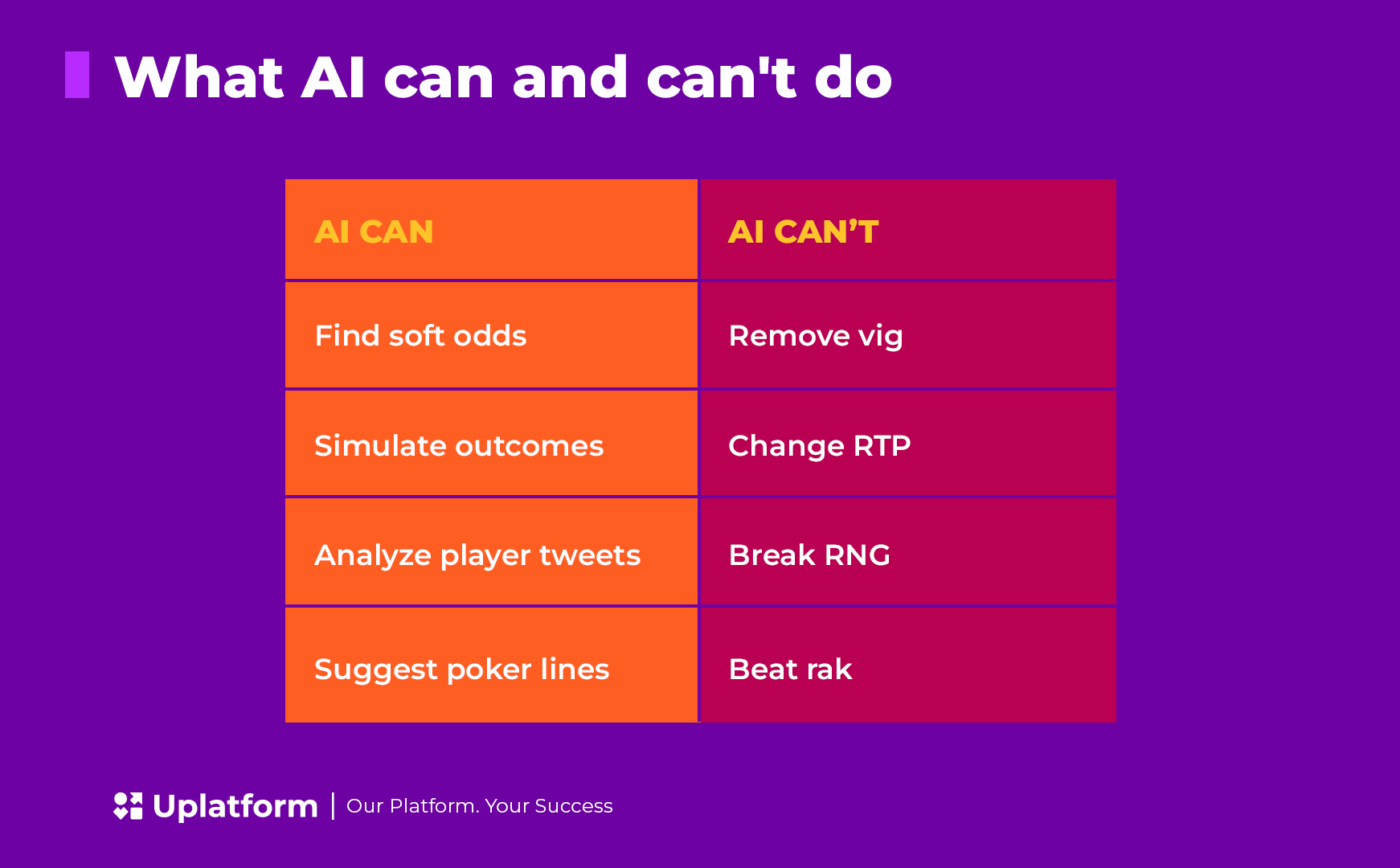
Where humans used to rely on manual line-shopping, AI bots now scan odds across hundreds of sportsbooks in milliseconds, highlighting:
- arbitrage spreads
- soft lines before correction
- price drops due to slow-moving books
- middle opportunities in live games
This makes the “find value before the market adjusts” window much smaller.
NLP and “Hidden Signal” Analysis
Some players use Natural Language Processing (NLP) to scan coach interviews, player tweets, press leaks, or fan-forums to detect signals before they reach public feeds.
Sportsbooks aren’t competing only with intuition anymore—they’re competing with sentiment scraping, data mining, and automated decision engines.
Compliance Note: AI ≠ Always Allowed
Most sportsbooks classify automated betting bots, live-odds scrapers, or auto-executed wagers as a violation of Terms & Conditions. Even if the tool performs analysis only, not placing the bet, accounts can still be flagged for abnormal betting behavior.
AI gives players more information—but it doesn’t grant immunity from operator policy.
AI in Casino Games: Smarter Players, Same Math
Unlike sportsbetting, casino games are built on fixed house edge and Random Number Generators (RNG). AI doesn’t change the math—but it is changing how players think about the math.
Slot Simulations and Volatility Mapping
Players can now record thousands of demo spins and feed them into AI models to chart:
- RTP deviation over time
- bonus round frequency
- volatility curve behavior
- streak clusters
Some communities even generate “slot heatmaps” to decide when a title feels “cold” or “worth entering.”
The issue? Every spin is still independent, and the long-term EV never turns positive.
Strategy Bots and Bonus Pattern Tools
Even basic AI models now advise casino players when to switch machines, how to run bonus hunts, or when to stop a session before variance burns the bankroll.
Again: strategy improves control, not odds.
Knowledge-Sharing Networks
Telegram, Discord, and forum groups now exchange AI-generated volatility logs like trading signals. That creates something new: collective pattern-based casino play.
But it still doesn’t beat the house. It just changes the psychology of losing.
AI in Poker & Skill Games: The Most Advanced Battlefield
If sportsbetting is data-driven and casino is probability-driven, poker is logic-driven—and AI has deeply influenced it.
GTO Solvers and Real-Time Assist
Poker solvers can now:
- identify the correct play for any board texture
- calculate mixed betting frequencies
- show exact EV differences between move options
- run full hand-tree analysis while a live hand is in progress
Some players even pipe solver suggestions into hidden overlays or side monitors. This is where most platform bans now happen.
Computer Vision and Dealer Pattern Reading
In live or camera-based formats, some users use computer-vision AI to:
- detect dealer hand rhythm
- track shuffled deck patterns
- log repeated motion behavior
These methods are rare—but they exist.
Botting in Social or Unregulated Poker Apps
Where regulation is weak, entire tables can be made of bots farming daily rewards or converting bonus chips into crypto.
Where AI Stops: The Limits That Still Protect the House
Even the best AI cannot neutralize core factors in gambling:
1. The House Edge Is Permanent
- Casino games: fixed EV
- Sportsbetting: vig built into the line
- Poker: rake over time
AI can optimize input—but can’t adjust the math.
2. AI Needs Clean Data, and Players Rarely Have It
No real-time official feed = educated guess, not guaranteed edge.
3. Human Bias Still Leaks In
People override AI because of emotion, tilt, ego, or “gut feeling.” The weakness is rarely the model—it’s the operator of the model.
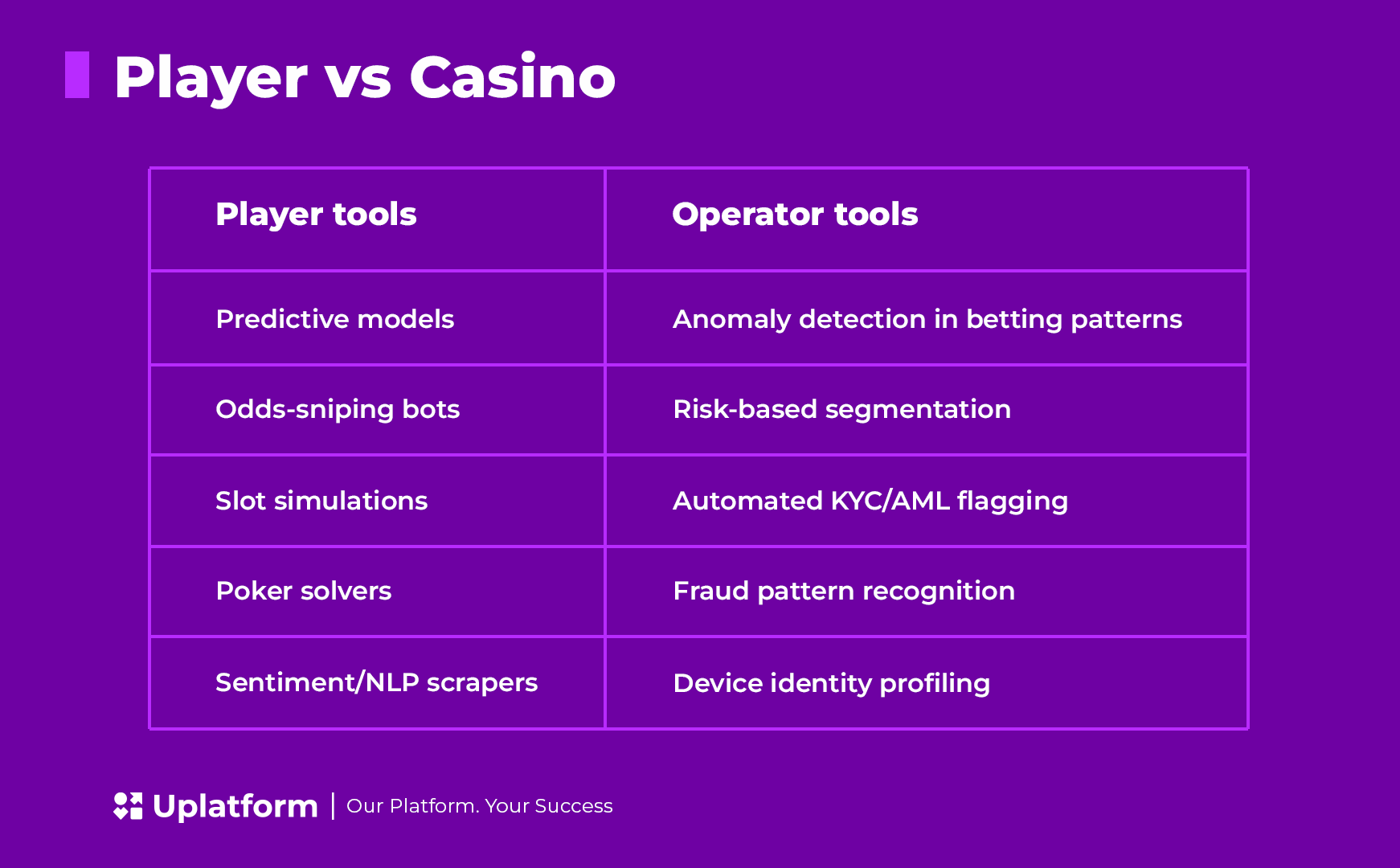
4. Operators Also Use AI
Modern platforms now run:
- bet pattern anomaly detection
- bot-traffic fingerprinting
- solver-like move consistency tracking
- device and latency identity checks
The race is no longer manual vs manual—it’s AI vs AI.
What This Means for Operators
AI-assisted players aren’t going away. The real question is: will operators adapt passively or strategically?
Some key shifts:
| Player Expectation | Operator Response |
|---|---|
| “I want data transparency” | Show RTP ranges, volatility, stat layers |
| “I want smart tools” | Offer official dashboards, not force black-market ones |
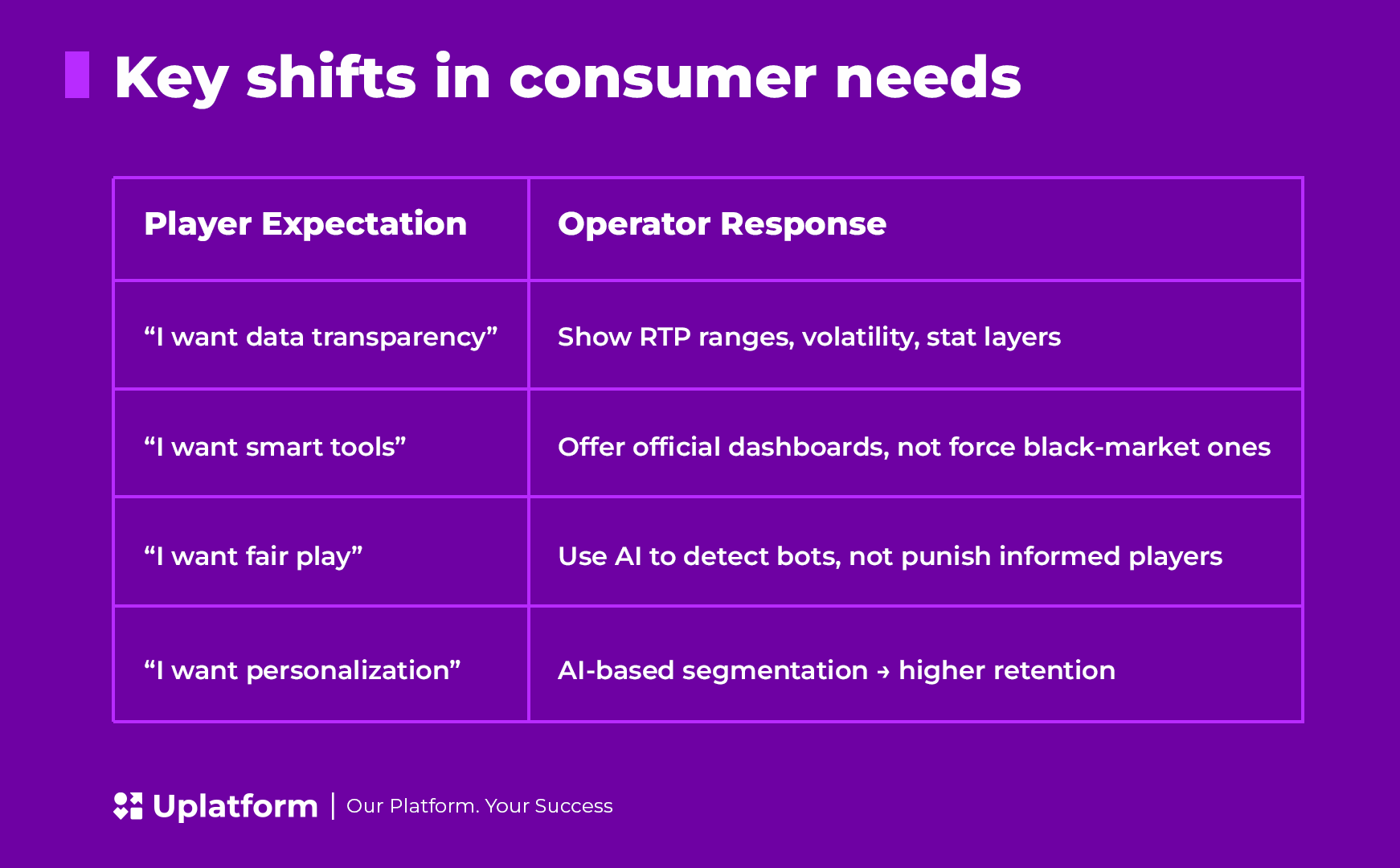
| “I want fair play” | Use AI to detect bots, not punish informed players |
| “I want personalization” | AI-based segmentation → higher retention |
Final Thoughts
AI is not destroying iGaming—it is raising the intelligence level of the average player. Where “sharp bettors” were once a minority, AI is now making data-driven behavior mainstream. This forces operators to move beyond the old model of “the house knows everything and the player guesses.”
The winners in this shift won’t be those who fight AI, but those who study it, regulate it, and build with it in mind. The industry is moving toward a future where fairness, transparency, and control are no longer features—they’re expectations.
The question for operators isn’t “How do we stop players from using AI?”
The real question is: How do we remain relevant in a world where they already do?
Other news
-
 From Operator Wish List to Everyday Reality
28.09.2026
-
- Player Engagement in iGaming: Operator Guide
01.09.2026
- SEO & AEO Strategies for iGaming in 2026
18.08.2026
-