Casino Platform Selection: How to Look Beyond the Game Catalog

TL;DR: For Heads of Casino and CRM teams comparing suppliers, a casino platform should connect game availability with player segmentation, campaign controls, payments and reporting. Test how the team changes content, measures repeat play and accounts for reward cost after launch. Catalog coverage matters, but the buying decision also needs evidence that these functions work together.
What is a casino platform?
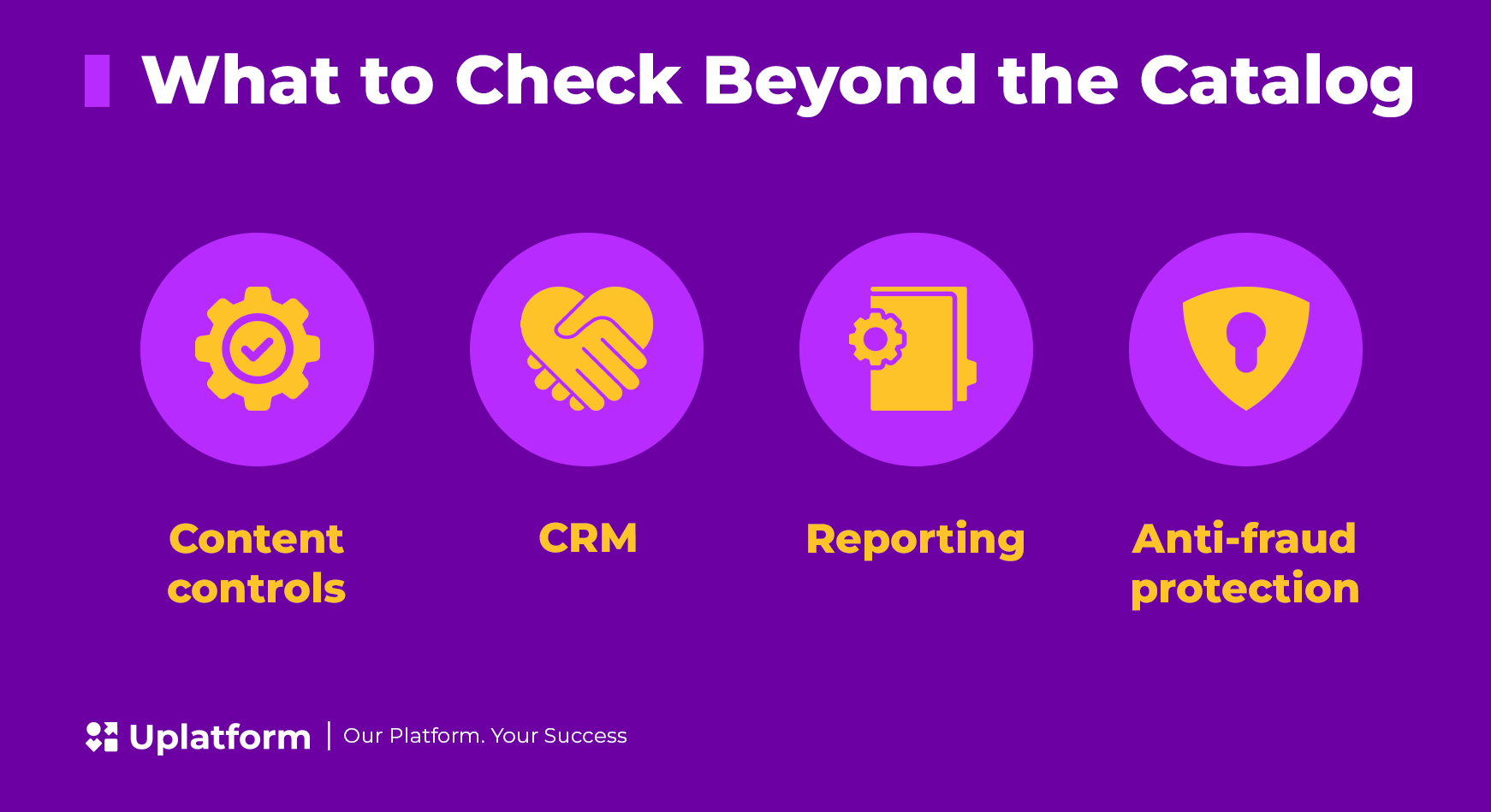
A casino platform is the software and operating environment used to manage an online casino’s player accounts, content presentation and associated services. Its scope may include payments, CRM, reporting and controls, depending on the supplier and implementation. Operators should establish which functions are included and how they connect. Uplatform’s Turnkey platform can be launched as a casino-only project, with CRM, bonus tools, Back Office and payments included.
That matters because content performance depends on context. A title can earn its place in one market and mean nothing in the next, or win a first session and never get a second. Some games only really work for one segment and add little to the wider lobby. Hunting for a universally best game wastes time. The value is in better calls on placement, audience, timing and follow-up.
We suggest a practical buying test. Can the team identify which content to feature, define the eligible audience and review what the activity cost? If those decisions require several disconnected exports, ask the supplier to demonstrate the data connections before using catalog size as the deciding factor.
Why does casino platform selection go beyond the catalog?
A casino game catalog establishes which providers and titles an operator can access. It does not establish how the team will place content, apply market restrictions or measure repeat play. Casino platform selection should therefore test both availability and the operational controls that remain necessary once those games are live.
So ask a second question after “How many games can we connect?” Ask how much control you’ll have once they’re connected. That covers how titles are surfaced by market, how the team changes the lobby, how a CRM campaign can send a player to relevant content, and how reporting separates real demand from activity a reward paid for.
Table 1. Move the buying conversation from access to operation
| Catalog question | Operating question | Why it matters |
|---|---|---|
| Which providers and titles can we connect? | Which titles are licensed, relevant and maintainable in each target market? | A long list only helps if the content can be offered, localized and supported where you plan to sell. |
| Where is the game available? | Can the lobby, language, currency and game rules change by market or player context? | Market fit is part of the product. Treat it that way from day one instead of leaving it for a post-launch cleanup. |
| How quickly can content go live? | Who owns release, rollback and support when a provider changes something? | Speed includes being able to fix a bad launch without waiting for a custom development cycle. |
| Can we attach an offer? | Can a campaign be targeted, suppressed and measured with reward cost visible? | Promotional tools should support a player and content decision. They shouldn’t hide what it cost. |
| Did the game perform? | Can we connect exposure with starts, deposits, play, repeat activity, margin and risk signals? | A result becomes useful once it tells the team what to feature, change, limit or retire. |
That’s why casino content selection, and your wider casino content strategy, is a casino platform decision too. An aggregator provides the foundation: access to providers. The operator also needs a way to run that content as a portfolio that keeps changing. The catalog gets you to launch. Whether the launch turns into a business depends on the operating loop.
Select content by market and player context
Choose casino content against the target market, permitted audience, device behavior and lobby structure. Confirm that each title can be offered and supported under the operator’s agreements and applicable rules. Then identify the segment and placement to test. Provider popularity alone does not establish that a game fits a particular player group.
Before promoting a title, run it through four checks:
- Market fit. Is the game available, permitted, localized and commercially relevant in the target market?
- Player fit. Which segment is most likely to get the game, try it and come back without a lot of prompting?
- Placement fit. Where does the title belong: the lobby, a CRM message, a landing page or a next-best-action flow?
- Operating fit. Can the team change its visibility, watch its performance, and stop or adjust activity when the context changes?
This also clarifies what promotions are for. A free-spin message, mission, tournament or personalized offer can help a player discover a title. It doesn’t prove the title is right. That shows up after the reward ends. Does the player come back because the content fits, or did you just pay for one more session?
Connect casino CRM audiences to content decisions
CRM adds player context to casino content selection by connecting an eligible audience to a message, content destination and measurable outcome. The operator still needs valid permissions and suppression rules. A campaign should show which players received it, what they did afterward and whether the response continued when the reward ended.
Think of the difference between a campaign tool and a learning loop. A campaign tool hands out a reward. A learning loop shows who was eligible, who saw the message, who opened the game, who deposited or played, who came back, and what the activity cost once incentives and service friction are counted. The commercial team needs that second kind of information for the next content decision.
Responsible reward design requires the operator to apply exclusions and risk rules before sending a promotion. Review account status, communication preferences and the requirements of the target market. Test whether suppression reaches every campaign channel and whether the team can verify that it took effect. The stop process needs to work as reliably as the launch process.

Measure content performance and promotional cost
Casino reporting should connect content exposure with game starts, repeat play and net contribution by title, market and player segment. Define each measure before comparing results. A game with strong gross gaming revenue (GGR) may still have weak repeat demand or high promotional cost, so reporting must support a decision about placement, testing or removal.
| Metric | Definition and interpretation |
|---|---|
| Game start rate | Unique exposed players who launch a game divided by unique eligible players exposed to its placement or campaign. Keep the exposure definition consistent across titles. |
| Repeat play rate | Players who return to the same title within a defined follow-up window divided by that title’s initial player cohort. Separate rewarded returns from activity without another incentive. |
| Net contribution | Revenue less the cost categories agreed with finance, such as provider fees, rewards, payments and applicable taxes. Show the definition; gross gaming revenue alone does not establish profitability. |
Compare performance by title, provider, market and segment. Include campaign exposure, starts, repeat sessions and the direct costs relevant to the decision. Payment failures and support contacts can explain why demand did not turn into play. Where attribution is incomplete, state the limitation instead of presenting every return visit as a campaign result.
Table 2. Turn casino signals into operating decisions
| Signal | Question to ask | Likely next action |
|---|---|---|
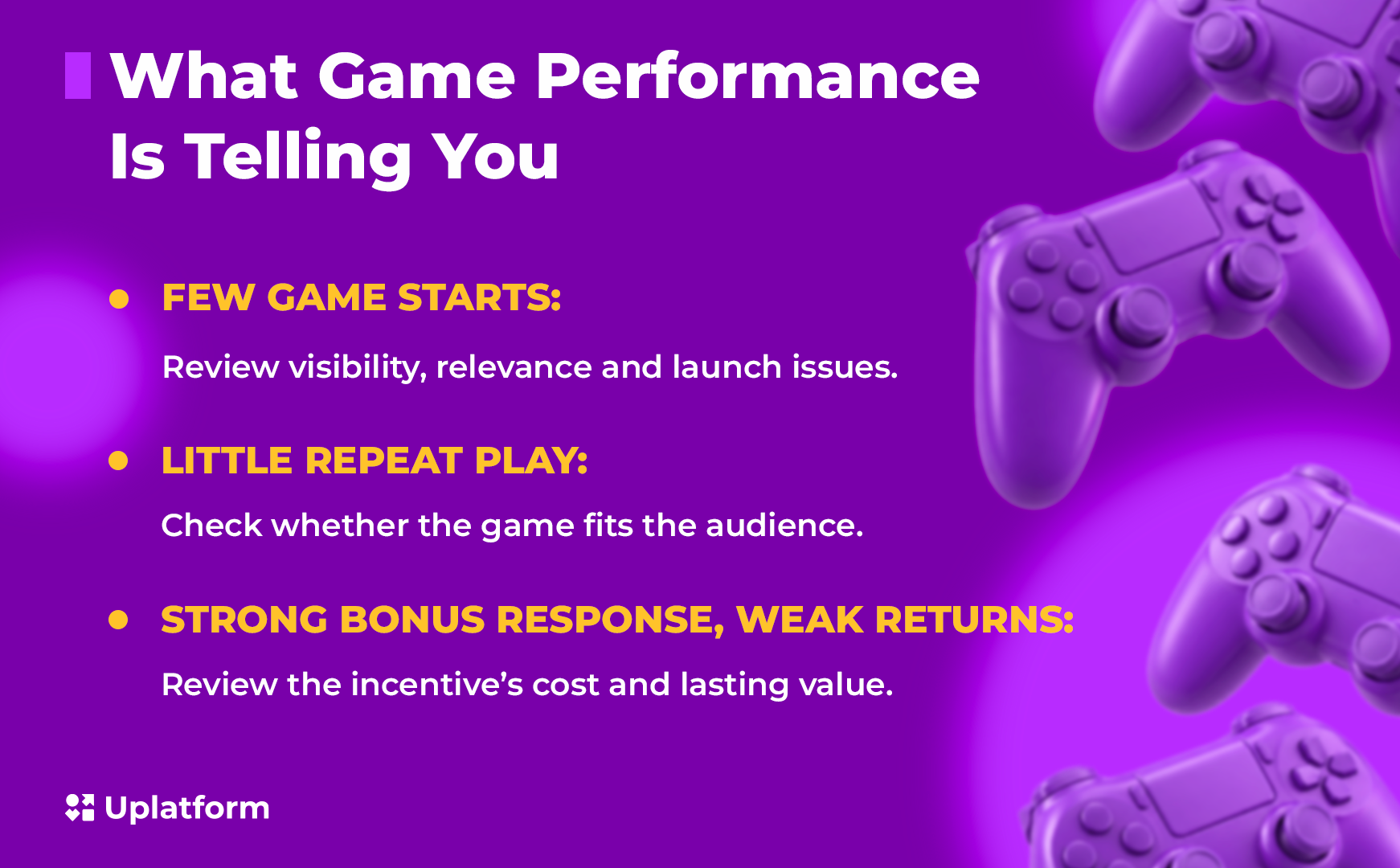
| Many impressions, few game starts | Was the message relevant and the destination clear? Is lobby, device or payment friction getting in the way? | Fix placement, message, campaign flow or content fit before adding more promotion. |
| Many starts, little repeat play | Did the title deliver what the player expected, and was it right for that segment? | Review content quality, segment fit, UX and what the campaign promised. |
| Good GGR concentrated on one title | Does the result hang on one provider, market, device or player cohort? | Test a broader portfolio before calling it a lasting trend. |
| Strong reward response, weak organic return | Did the offer buy one session instead of giving the player a reason to come back? | Separate reward cost from later margin, then revise the flow or incentive. |
| High activity with risk signals | Is more promotional pressure appropriate for this player and market? | Suppress, adapt or route the flow through the relevant responsible controls. |
The awkward question to ask about any promotion is what it bought. A high claim rate can sit right next to weak repeat play, rising payment friction, or a group of players who shouldn’t get more pressure. Reporting earns its keep when it puts those trade-offs in front of the team early enough to act.
How should operators test a casino platform?
Test a casino platform with a target-market content scenario, covering availability, lobby changes, CRM eligibility, reporting and campaign suppression. Ask the vendor to show the operator’s permissions and data access as well as the player screens. The objective is to establish how the team can act, measure and recover when a routine flow fails.
1. Confirm content availability in the target market
Have the vendor show how titles, providers, language, currency and local restrictions are managed for one target market. Get the assumptions in writing.
2. Change the lobby and test removal
Ask how the team can feature, limit, replace or remove a title. Find out who owns the change when a provider or regulator adds a new constraint.
3. Build a permitted content campaign flow
Use a defined segment, a permitted channel, a content destination, a reward or message, a suppression rule and a follow-up event. You’re there to see the handoffs work, so don’t get distracted by how the campaign builder looks.
4. Trace the campaign into cost reporting
Follow that same flow from exposure to game start, deposit, play, repeat activity, reward cost, margin, and any support or payment friction. Ask about refresh timing and attribution rules.
5. Test suppression and review its audit trail
Ask how fast the team can suppress a product, segment, campaign or communication when a risk signal, local rule or operational incident appears. Ask to see the audit trail.
Keep the evidence practical: a market-level catalog view, a sample data map, a working flow, a report export, access rules and a clear owner for each change. Content access is the foundation. A vendor who also handles the other four tests is describing an operating model.
Evaluate Uplatform against the operating requirements
Our CRM, included in our Turnkey platform, provides player segmentation, reporting and communication tools. It offers 200+ segmentation filters and 30+ reports. Use those capabilities to test a concrete casino platform requirement: select an eligible audience, send it to suitable content and inspect the outcome with reward cost visible.
Our Back Office provides financial reporting and operational account information. Our casino aggregator connects content access with reporting on player activity, games and providers. Confirm how these views connect in your implementation, which fields your team can export and how quickly changes reach the lobby and campaign tools.
Our casino aggregator gives access to 10,000+ games from 80+ global and local providers, from slots and live casino to baccarat, roulette, blackjack, bingo and skill-based titles, through one contract and a single integration. Bonus tools include free spins, tournaments and jackpots, and our team recommends providers that will work for your audience.
Review our casino aggregator against the provider, title and market detail your commercial team needs.
Rewards are one action within the wider content and CRM process. When comparing our setup, check whether product selection, audience permissions, payment context and reporting support the decisions your team actually makes. A useful demonstration shows the same campaign from audience selection through repeat activity, including the cases where promotion must stop.
We would review the integration boundaries, market coverage and reporting definitions against your operating model. Ask us to run the same scenario as the other suppliers you are considering. Evidence of a working flow is more useful than a list of features whose ownership and data connections remain unclear. Our Turnkey platform combines an in-house Sportsbook, extensive casino content, 600+ payment solutions, and essential tools & services — fully localized, scalable, and built for long-term profitability. It also includes 2-line support: 24/7 assistance for both your team and your players. To arrange the demonstration, contact us at [email protected].