iGaming Player Retention After the Welcome Offer

TL;DR: After the welcome offer, players come back for relevant content, payments that work and support that solves problems, not just another bonus. Make the next visit easy, and give every CRM message a clear purpose. Track return rates alongside bonus costs and player value to see what brings players back without another incentive.
What is iGaming player retention?
iGaming player retention is an operator’s ability to keep an acquired player cohort returning over a defined period. It can be measured through repeat visits, deposits, bets or casino sessions, depending on the agreed activity definition. Incentive-driven returns count as retention, but should be assessed separately when evaluating loyalty and profitability. Put simply, the real test starts when the first bonus runs out.
Consider what a player finds once the welcome offer ends. The league they follow may be easy to reach, their preferred payment method may work and a previous support problem may have been resolved. Those details give the product a reason to earn another visit. A generic reload offer does not show which of them needs attention.
This article focuses on what happens immediately after the welcome offer. For a wider view of lifecycle decisions, see Player Engagement in iGaming: Operator Guide.
Dina, Uplatform’s Head of B2B Projects, makes the product test clear:
“Sometimes the issue is not marketing, the product simply does not resonate with the audience.”
Read her interview for more on product fit and retention.
What brings players back after the welcome offer?
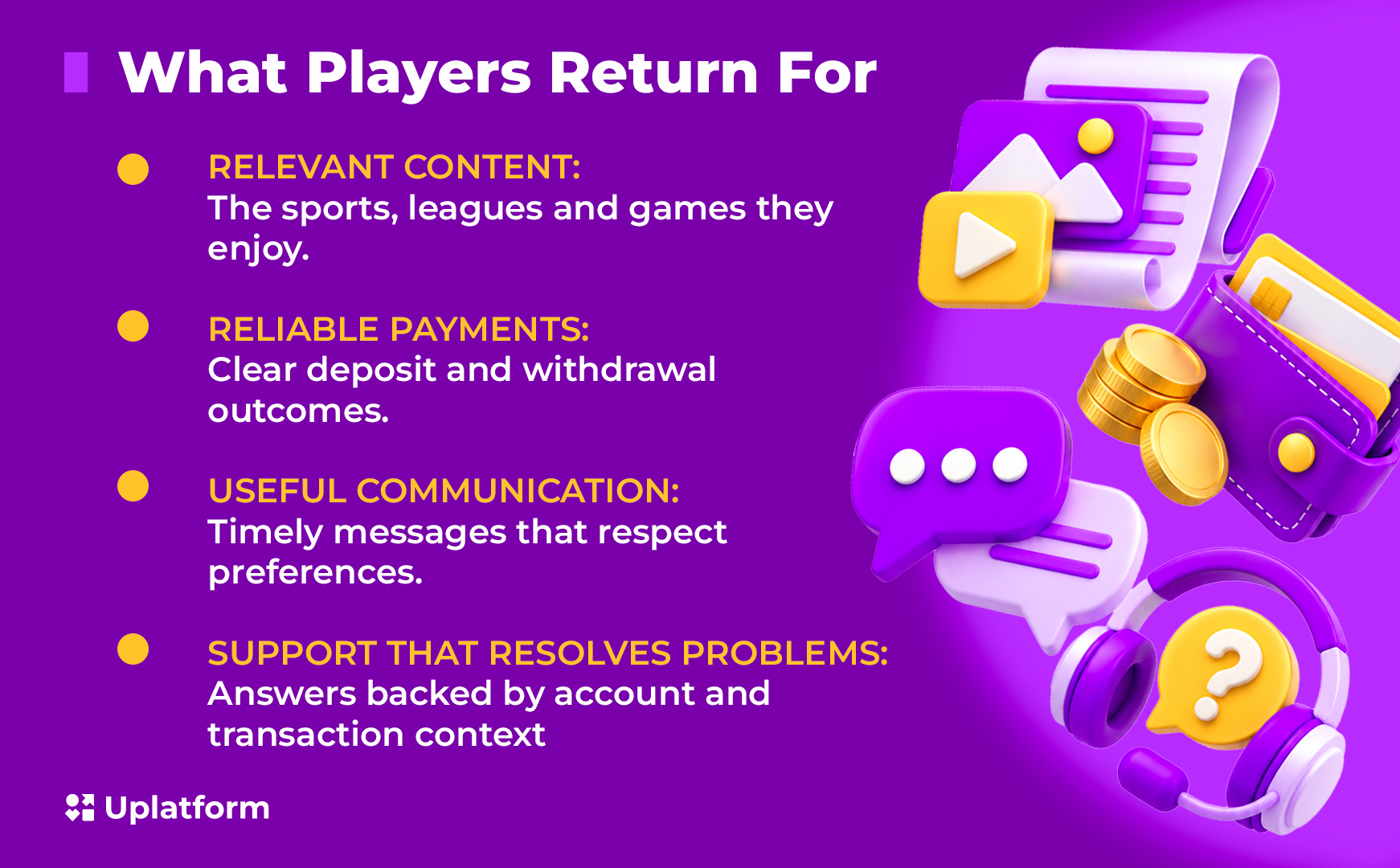
Start with what is missing when a player returns. A hard-to-find league, a stalled withdrawal or an unanswered ticket each needs a different fix. Another reload offer will not solve them.
Relevant sportsbook and casino content
Few players open the app just to browse. They come back for something specific: an ATP draw, a club they follow, a bet builder they like putting together, a live blackjack table, a provider whose games they know. Let behavior decide what goes at the top. A tennis bettor shouldn’t land on the same home screen as someone who only watches football. A live-blackjack regular shouldn’t have to scroll past a wall of slot tiles to find a seat. Uplatform’s Sportsbook covers 200+ sports and sorts sports, events and national teams by the bettor’s location.
Make the next choice obvious. Cross-sell when the player’s activity points that way; a campaign calendar that wants every player to see every product is a poor guide.
Payments that behave predictably
A deposit fails minutes before kickoff. A withdrawal stays in ‘pending’ with no explanation. Either can turn the next visit into a support problem. Show players which local methods work, what their limits are and what happens next when a transaction fails. Uplatform offers 600+ payment solutions, so operators can provide methods players already know in their markets.
A return experience with less work
Every login should answer one question: what can I do here today? Usually the answer is in recent activity. Reopen the last league or game the player used, and keep preferences such as stake presets and odds format. Account status should be readable at a glance. Keep menus fast on mobile. Then go through bet placement, game launch, cash-out, withdrawal and limit-setting yourself, and remove every dead end you hit.
Support that protects trust
Support joins the retention team the moment something breaks. A KYC check stalls. A bet settles differently from what the player expected. A payment gets reversed, or a withdrawal runs past the promised time. A link to the terms and conditions is not an answer. Agents need the account and transaction history in front of them before they reply, and the team should be measured on time to resolution and repeat contacts. Uplatform provides 24/7 two-line support for both operators’ teams and their players. One clear, fast reply can keep a player. An ignored ticket makes every promotion that follows look insincere.
CRM messages with a job to do
Every CRM message needs a reason to exist. The competition a player follows starts tomorrow. A payment status changed and needs explaining. Someone might need reminding where the limit tools live, or a new casino title resembles what they already play. Those are reasons to send something.
Segment by what players actually do and which products they prefer. Check contact preferences, cap frequency and exclude people who shouldn’t receive offers. Send a service update to solve a problem; send a promotion only when it matches a player’s interests.
Trust and responsible interaction
Some players need help, not another offer. If activity drops alongside risk signals, stop promotional messages and check account restrictions. Route the case to support instead of treating every quiet account as a reactivation target.
How operators can improve retention after acquisition
Start with the first days after the welcome offer ends, then give the team five practical jobs before sending another bonus.
1. Define the period after the welcome offer
Mark the day the welcome offer ends and decide what the player should find next: an event they follow, a game they already like, a quicker route to the cashier, an account feature or a support follow-up. Leave that step undefined and the bonus becomes the whole experience.
2. Build segments from relevant player behavior
Split players into newly activated, habitual, lapsing, reactivated, high-value and at-risk groups, using signals that describe what they actually do. A VIP label can’t tell the team whether someone needs better content, a payment fix, a faster support reply or a pause in promotional contact.
3. Fix recurring product and service friction
If a player can’t withdraw, can’t find the event, doesn’t understand a settlement or can’t get a straight answer from support, a bonus will probably just hide the problem for a few days. Give every recurring failure point one named owner.
4. Test useful communication without another bonus
Write messages around the sports calendar, recent play, new content, account education and service recovery. Before assuming a bigger incentive is needed, test whether a timely reminder or a clear explanation changes the player’s next meaningful action.
5. Review cohort returns, NGR and player value
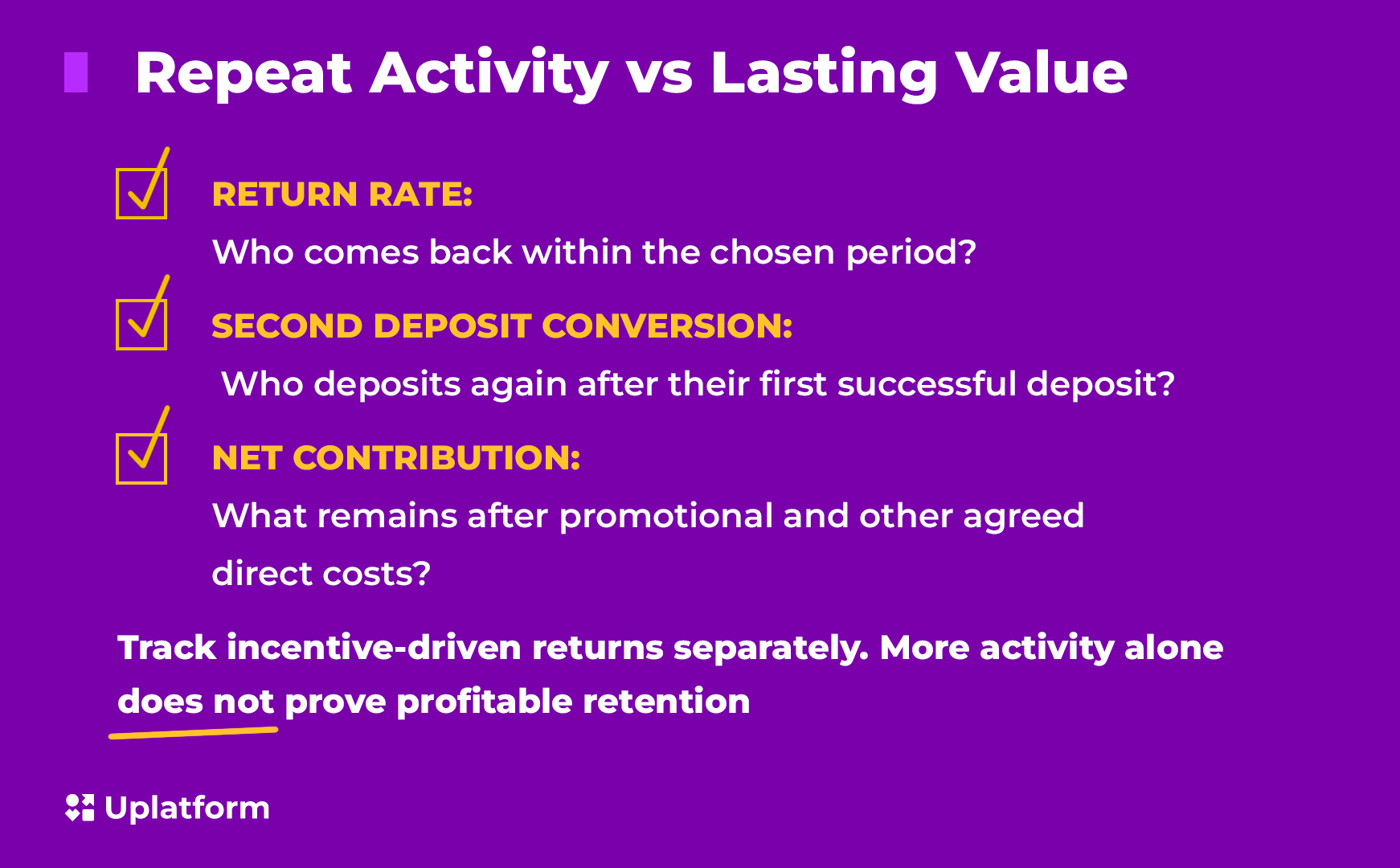
Start with a cohort whose welcome offer has ended, and measure repeat activity over the same period. Compare returns and second deposits with NGR (net gaming revenue), bonus spending, payment fees and support costs. If you report contribution after additional direct costs, define those costs once and keep the calculation consistent. Use a holdout group where possible to test whether a campaign caused more returns.
Use Back Office reporting to compare campaign activity with financial results. Agree the reporting window and cost definitions with finance before calling a change an improvement.
| Metric | Definition and interpretation |
|---|---|
| Cohort return rate | Eligible players returning for a defined meaningful action divided by the starting cohort. State the observation window and show incentive-driven and non-incentivized returns separately. |
| Second deposit conversion | First-time depositors completing another successful deposit within the agreed window divided by the eligible first-depositor cohort. A deposit is a behavioral event, not revenue. |
| Player value after direct costs | Contribution per acquired player after the agreed provider, incentive, payment and other direct costs. Report alongside NGR, and keep the calculation consistent between cohorts. |

Connect player data across Uplatform’s Turnkey platform
Uplatform’s Turnkey platform connects the in-house Sportsbook, casino content, 600+ payment solutions and Utools, including CRM, bonuses and Back Office. CRM, payments and support work with the same player data, making it easier to understand what happened after a welcome offer.
For example, if a deposit fails, the team can see the payment problem alongside recent player activity. It can resolve the issue before sending another reload offer. That is more useful than treating every missed visit as a request for a bonus.
What healthy retention looks like
- Players keep making meaningful visits after the welcome offer ends, and bonus claims aren’t the main reason.
- Second deposits, bets and casino sessions grow faster than promotional cost.
- Return behavior can be split by content, acquisition source, market, payment method and player segment.
- Campaign results share a screen with payment success, withdrawal turnaround and support resolution.
- Each CRM test has an action, an audience, an owner and a measurement window, plus suppression rules for players who shouldn’t be contacted.
- NGR and cost-adjusted player value are reviewed alongside retention before a campaign is called successful.