The Data Science Behind The Casino Content Portfolio Mix

TL;DR
A casino content portfolio mix is a data-driven approach to selecting and sequencing games across player cohorts. By balancing volatility, session length, and familiarity, and tailoring exposure by region and maturity, operators increase retention, stabilize revenue, and reduce churn.
Introduction
In today’s competitive and regulated online casino markets, acquiring new players is not enough to keep a business growing. Long-term success depends on how well players are kept engaged over time. One of the most important factors in this is the mix of games an operator offers.
Choosing games to offer is not just about creativity, branding, or keeping suppliers happy. It is a practical decision that directly affects how long players stay, how often they return, and how predictable revenue becomes. Most operators offer thousands of slots, live casino games, and other games from many different studios, all designed in various ways. Without a clear plan, this variety quickly becomes a burden instead of a benefit.
What Does A ‘Content Portfolio Mix’ Really Mean For An Operator?
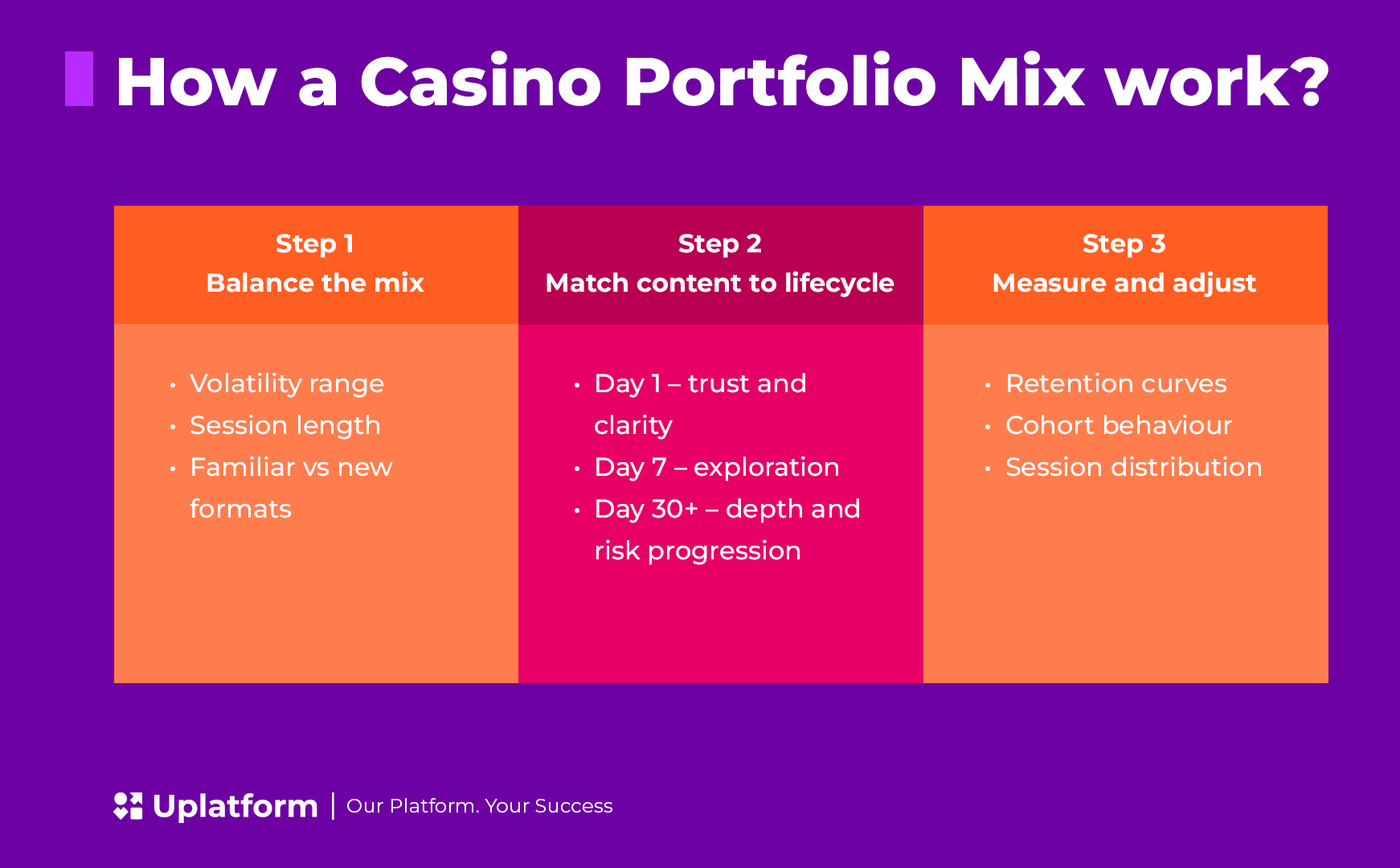
A content portfolio mix is the deliberate balance of game types. This includes how risky the games feel (volatility), how often players see results, how long a particular session lasts, and the split between familiar formats and new mechanics.
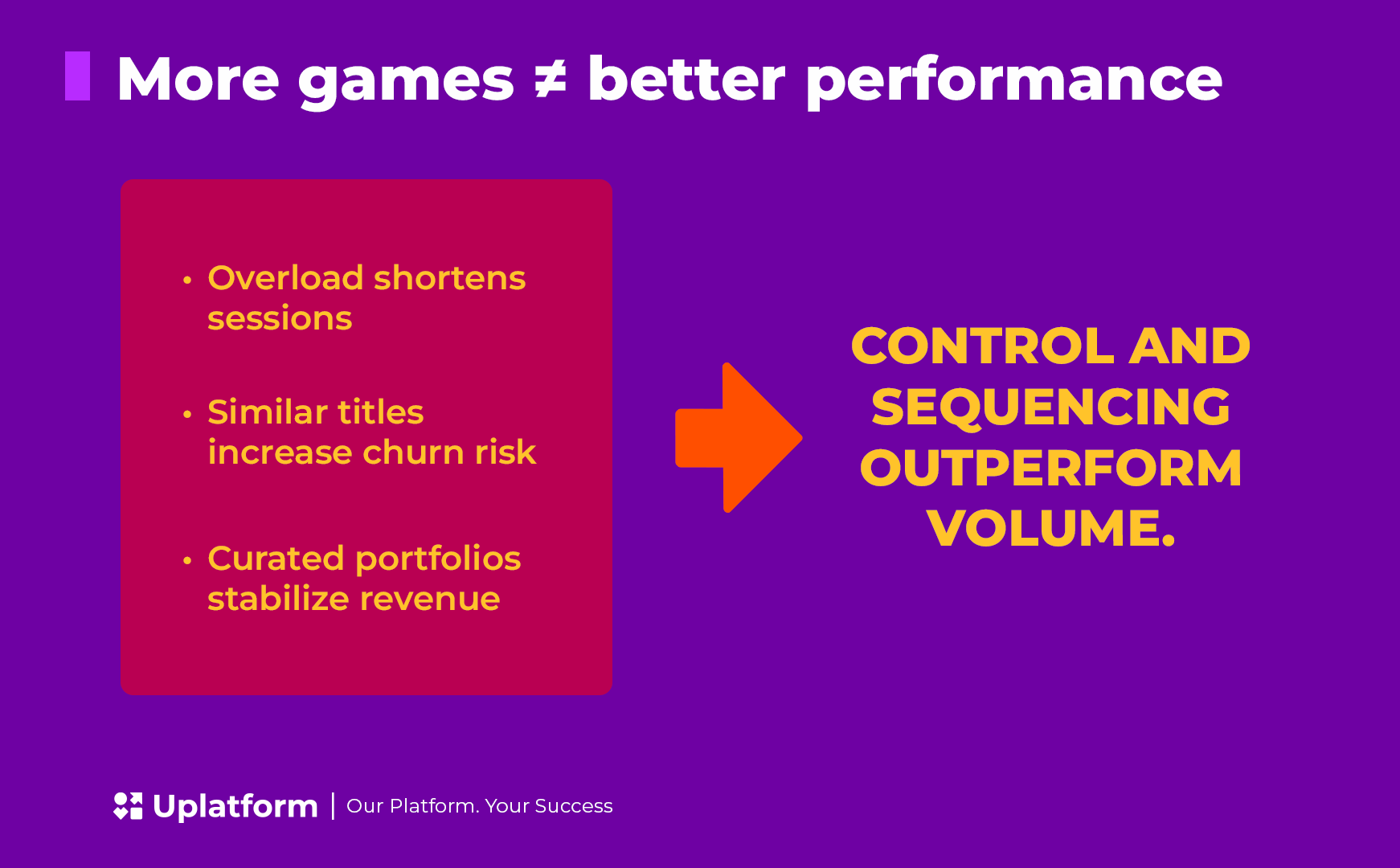
The aim is not to give players unlimited choice. Too many similar options can actually push players away. The real goal is to support different play styles and different stages of the player lifecycle.
Each game plays a different role in player behaviour. Some games are good at convincing first-timers to try real-money play. Others keep players engaged for longer sessions. Some help reactivate players after a break. When an operator relies too heavily on a single type of game or a dominant style, performance may spike early. Still, it usually becomes fragile and declines as novelty fades or player preferences shift.
In practice, you judge the mix by tracking how many players return after 1, 7, and 30 days. A balanced portfolio keeps those return rates steadier over time while also making revenue less vulnerable to sudden shifts in taste, competition, or regulation.
Using Player Groups To Shape Content Portfolio Structure
Players are often grouped by age, region, or spending level, but those labels rarely explain how they actually behave on a casino site. A more useful approach is to segment players by how they interact with games over time.
Some players leave soon after signing up. Others play frequently but stake small amounts. Some stay for months but get bored when nothing new comes up, while others are consistently active players who contribute significantly to predictable revenue.
Each group of players responds to different content. Newer players typically prefer simple, familiar games with clear mechanics and frequent outcomes that build confidence. As players gain experience, many start exploring higher-volatility titles, deeper features, and new formats, if the operator makes that progression feel natural.
If an operator shows the wrong content at the wrong stage, players lose trust, shorten sessions, or stop returning. Aligning the game mix with player maturity helps retention grow and increases value over time without relying on pressure tactics.
Why Variety Helps Reduce Churn
Many operators assume variety means adding more games or partnering with more providers. In reality, variety only matters when it changes player behaviour or helps different cohorts find something that fits their preferred pace, risk level, and session style.
A strong game mix typically includes:
- Games with different levels of risk and reward (volatility range)
- Options for short sessions and longer play
- Familiar formats alongside more unusual mechanics
- Reliable favourites combined with carefully tested new releases
Problems arise when too much play or revenue depends on a small set of similar game types. If preferences shift, a competitor launches a stronger alternative, or regulations affect a category, performance can drop quickly.
A balanced mix spreads this risk. It smooths player behaviour over time, reduces churn triggers, and helps revenue stay more stable through market changes.
Building Trust In The Early Stages
Many operators lose most of their potential value in the first weeks after a player signs up. This does not usually happen because bonuses are too small. It happens because the experience feels confusing, unpredictable, or uncomfortable.

Early-stage players respond best to games that feel familiar, move at a steady pace, and provide frequent outcomes. These games reduce early uncertainty and help your new audience understand the experience faster and stay engaged longer.
When new players are pushed too quickly toward complex or highly risky games, excitement may increase briefly, but trust suffers. Losses feel sharper, learning feels harder, and players leave sooner.
A well-planned portfolio introduces stability first, then gradually expands into richer and higher-volatility experiences as players mature. Done well, this improves early-cohort retention (Day 1/Day 7) and increases the share of players who progress to longer-term engagement (Day 30+).
Adjusting The Casino Content Mix By Region
Player behaviour differs by region, but smart operators do not rely on stereotypes. Instead, they look at how players in the region actually engage their product.
In parts of Latin America, players tend to return regularly and stay loyal when games feel consistent. Over-rotating content too frequently can reduce long-term engagement. Familiar formats often perform better here.
Across many mobile-first African markets, players prefer quick games with fast outcomes. Sessions are short, but return visits are frequent. In these markets, fast time-to-outcome and frictionless re-entry matter more than visual themes or complex features.
Asian markets are more mixed. Some players enjoy games that reward long-term progress and deeper interaction. Others prefer fast, repeatable play. Operators need flexibility rather than a single default mix.
European players are often open to a wide range of risk levels but lose interest quickly if the experience feels repetitive. Here, balance matters more than volume.
The key point is that regional differences are about usage patterns, not culture. Data from real behaviour leads to better decisions than assumptions.
How Player Risk Preferences Change Over Time?
One overlooked aspect of game planning is how a player’s appetite for risk changes as they gain experience.
Most players start with games that pay out safely, offer smaller wins, and incur fewer losses, allowing them to learn without incurring heavy losses. This stage is critical for building confidence.
As players become more familiar with the brand, many start looking for greater excitement, and their tolerance for results increases. If the game mix does not evolve with them, boredom sets in.
Operators who track these changes can introduce slightly riskier or more feature-rich games at the right moment. This keeps players engaged without pushing them too far, too fast.
Guiding players through this natural progression helps prevent sudden drop-offs and reduces the chance they will look elsewhere for variety.
The Problem With Too Many Games
A common belief is that adding more games always increases engagement. In practice, this stops being true very quickly.
Once a catalogue becomes too large, players struggle to find something new that feels meaningful. Recommendations become weaker, choices feel overwhelming, and sessions become shorter.
This issue is usually seen on mobile, where players want quick access and minimal effort. Too many similar options create frustration instead of value.
The solution is not to add more games. But identifying which games truly add value and which repeat the same experience, and then diversifying to reduce clutter.
Curated libraries help players focus, improve discovery, and strengthen retention. Removing underperforming or redundant titles often improves overall engagement rather than harming it.
Using Providers To Reduce Business Risk
Working with multiple game developers is important, but not simply for adding variety. When too much engagement or revenue depends on a small number of games, operators face the risk of content concentration. If a key developer encounters regulatory issues, slows its release cycle, or changes commercial terms, player behavior and performance can be affected quickly.
Casino aggregators matter because they remove integration friction. Instead of connecting to providers one by one, you integrate once and get access to a wide range of studios. From there, you decide what players see, when they see it, and how it performs across segments.
At Uplatform, our casino aggregator gives you access to 10,000+ games from 100+ providers through a single connection. That cuts down technical work and speeds up launch. As you grow, you don’t need to rebuild or re-integrate. You simply expand the portfolio and adjust your strategy inside the same setup.
Everything is managed from one admin panel. You control positioning, categories, exposure, and recommendations. Our game recommendation service helps surface titles based on player behavior, so content placement is not random. You can push new releases, highlight proven performers, or tailor visibility by market without involving developers each time.
On the player side, the experience stays consistent. They get access to both the latest releases and established global providers. Games load quickly, run smoothly across devices, and support multiple currencies. Whether traffic is low or scaling, performance remains stable and predictable.
The goal is simple: give you content at scale and the tools to manage it properly, without adding operational complexity.
Measuring The Real Impact Of the Game Mix
Looking only at performance revenue hides many problems. To understand the real impact of a game mix, operators need to observe how different player cohorts behave over time.
From a data science perspective, operators evaluate the game mix using cohort analysis, retention curves, session distributions, and reactivation rates rather than relying solely on revenue.
With these signals, operators can make small, continuous adjustments instead of large, disruptive reshuffles. This keeps the portfolio aligned with player needs as they evolve.
Why Careful Game Selection Guarantees Competitive Advantage?
An extensive library helps, but only when it’s usable. The real advantage goes to operators who curate, diversify, and personalize, offering the right games at the right time for each cohort.
Careful selection turns a static catalogue into a living system. Variety is controlled, not chaotic. Players feel supported rather than overwhelmed.
A balanced game mix improves retention, reduces revenue swings, and builds long-term confidence in the project.
Retention has long been recognized as one of the most powerful drivers of long-term revenue growth. Research discussed in Harvard Business Review shows that small improvements in retention can significantly increase profitability.
Conclusion
Online casino strategy is never just for new players. Keeping your audience engaged over time now matters more than ever. Balancing risk levels, offering effective variety, and adjusting the game mix based on behavioural patterns are essential for sustainable growth.
Other news
-
 From Operator Wish List to Everyday Reality
28.09.2026
-
- Player Engagement in iGaming: Operator Guide
01.09.2026
- SEO & AEO Strategies for iGaming in 2026
18.08.2026
-