What Asian iGaming Market Really Demands
TL;DR
Asia offers enormous iGaming potential, but success requires far more than translating a website. Operators need country-specific iGaming localization, mobile-first performance, local payment methods, and a strong understanding of regional regulations and player behavior. Uplatform’s Turnkey solution with 68+ languages, 550+ payment methods, regional market expertise, is built for exactly this kind of precision entry.
There is a version of Asia that operators imagine when they want to enter this region: one enormous market, a billion-plus hungry players, and a website they have already built. They translate the homepage, add a couple of payment options, maybe run a Lunar New Year banner, and wait for revenue. It rarely comes or it comes briefly, then collapses under the weight of everything they failed to understand.
Asia is not a market. It is fifty-plus markets wearing the same geographic label, each with its own legal architecture, payment culture, language stack, and player psychology. The operators succeeding here are not the largest or the best-funded. They are the most precise.
The Numbers Are Genuinely Extraordinary, But Read Them Carefully
For now let’s talk about Asia as a whole to gain a perspective on why it’s so lucrative and at the same time hard to get in. Asia Pacific’s online gambling market was valued at roughly $23.9 billion in 2024 and is projected to reach $56 billion by 2033, growing at a CAGR of around 9.5%. Some projections are even more optimistic: Grand View Research estimates the region hitting $39 billion by 2030 on a 12.8% CAGR, driven by sports betting, which is already the largest segment, accounting for over 45% of regional revenue.
What do these numbers tell us?
These numbers reflect structural change. Mobile penetration, rising disposable incomes, and a generational shift in how younger players in Asia relate to gambling and betting are compressing what would normally take decades into a five-to-seven-year window. The Philippines alone posted record industry-wide GGR of PHP 410.5 billion ($7.16 billion) in 2024, a 24.6% increase year-on-year, driven overwhelmingly by the e-games sector which grew 165% in a single year. India’s online gambling market, valued at $6.91 billion in 2024, is projected to nearly double to reach $16.83 billion by 2033.
But what don’t they tell us?
It’s the fact that the most important feature of Asia’s iGaming market is not its size. It is its fragmentation. Some of the region’s largest markets by population operate near-total prohibitions on gambling. Others have legally complex but fast-growing frameworks following recent regulatory reforms. Several markets combine world-class digital infrastructure with heavy restrictions limiting activity to foreign visitors. Across Southeast Asia, significant markets carry an enormous appetite for iGaming while leaving most activity in legal grey zones.
Growth in this region is not uniform. It is uneven, jurisdiction-specific, and conditional on things operators often underestimate: regulatory intelligence, cultural fluency, and payments catered to local players
Quick reference to what Asian iGaming actually means:
- What share of Asian iGaming revenue comes through mobile? 75–85%, higher in Southeast Asia
- What’s the dominant payment method in Asia-Pacific? Digital wallets at 70% of all e-commerce transaction value (Worldpay, 2023)
- Which games do Asian players prefer? Baccarat, sic bo, mahjong derivatives, hunting and fishing games, live dealer formats
- What’s the biggest sports betting segment in Asia? Sports betting at 45%+ of regional revenue; cricket across South Asia, football regionally, Esports growing fast
- How big is the APAC market? $23.9B in 2024, projected $56B by 2033
Mobile Is the Market.
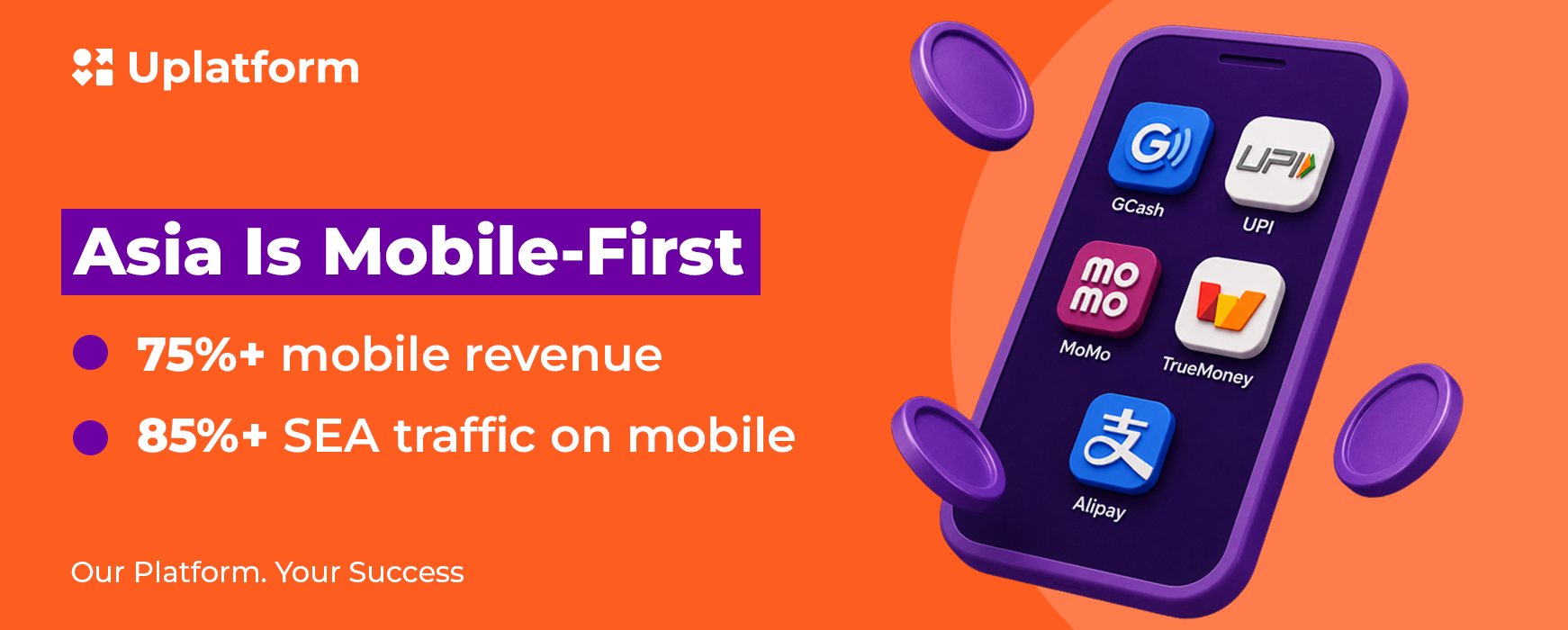
In Asia, mobile is where the market lives. Over 75% of online gambling revenue for Asian operators comes through mobile channels, and in Southeast Asia specifically, mobile’s share rises even higher, some estimates place it above 85% of all online gambling traffic. There were more than 1.5 billion smartphone users across Asia in 2023, and that number continues to climb.
Mobile-first iGaming means more than making a website fit smaller screens. Many players across Southeast Asia use mid-range Android phones on unstable 4G connections, so performance matters. Heavy game files and slow loading times quickly drive users away. If a game takes five seconds to load, many players will simply switch to a competitor.
It also means that mobile payment integration is a prerequisite for market entry. Digital wallets dominate in ways that have no parallel in European or North American markets. According to Worldpay’s Global Payments Report, digital wallets accounted for 70% of all e-commerce transaction value in Asia-Pacific in 2023, the highest share of any region in the world. The wallet stack varies sharply by country: GCash and InstaPay in the Philippines, and a range of dominant local wallet solutions across Southeast and South Asian markets. Offering Visa and Mastercard as primary payment methods is not localization. It is abdication. Uplatform supports more than 550 payment methods across our platform, including the major digital wallets active across the region, so operators can go live in a new market with the payment systems already in place.
Cryptocurrency is increasingly relevant across the region as well. According to Chainalysis’s 2024 Global Crypto Adoption Index, seven of the top 20 countries by grassroots crypto adoption are in Central and Southern Asia and Oceania, with several Southeast and South Asian markets ranking among the highest globally. For operators navigating markets with banking restrictions or players who prioritize transaction privacy, crypto-compatible payments are not a niche feature.
Most operators understand that they need to offer their website in local languages. Fewer understand that language is the easy part.
Asia’s linguistic diversity is extraordinary. Each major language carries entirely different conventions of how interfaces should feel, how trust is communicated, and what a good gaming experience looks like. Mandarin is spoken by over a billion people; Hindi by roughly 600 million. These are full product decisions.
Beneath language sits culture, and this is where most iGaming localization efforts fail quietly. Game preference is radically localized. Asian players broadly favor baccarat, sic bo, mahjong derivatives, and hunting and fishing games, interactive arcade-style titles that have almost no presence in Western markets but dominate playtime across Southeast Asia. Culturally embedded gaming formats in Northeast Asian markets carry weight that generic slot libraries do not approximate. Live dealer formats carry outsized weight across the region because real-time interaction with a human dealer replicates something close to the land-based social experience that is big in the Asian region.
Sports betting is similarly nuanced. Cricket dominates across South Asia. Football is universal but specific, bettors in lower-tier leagues want local match coverage, not just Champions League odds. Basketball runs deep in the Philippines. Esports, particularly Mobile Legends, DOTA 2, and League of Legends, is a category unto itself. Asia contributes around 54% of worldwide esports betting revenue, and the demographic is young: roughly 78% of esports bettors in the region are between 18 and 25.
Promotional timing, too, is a localization decision. A bonus campaign timed to Lunar New Year, Diwali, Eid, or Hari Raya is not a regional marketing slop. It is a sign that your product understands the rhythm of your player’s year, which is a form of trust that generic quarterly promotions cannot build.

The Regulatory Environment Rewards Patience and Punishes Assumptions
Operators accustomed to European licensing frameworks, where the rules are strict but knowable, often underestimate how differently regulation operates in Asia. The landscape is not just complex; it is genuinely inconsistent, and it shifts.
The Philippines has built one of Asia’s more mature regulatory environments through PAGCOR, which has progressively reduced iGaming license fees, from over 50% of GGR in 2023 down to 30% by January 2025, a deliberate policy to draw unregistered operators into the regulated market, and one that tripled the number of licensed operators from 49 to 174 in a single year. Several Northeast Asian markets have legalized or are actively developing integrated resort frameworks, with major infrastructure investments targeting tens of millions of annual visitors. Other regulated markets in the region operate tightly controlled licensing models with strict AML requirements and responsible gambling obligations baked in.
Elsewhere the picture is less orderly. Several large South and Southeast Asian markets take a state-by-state or regionally inconsistent approach, with real-money gaming legal in some jurisdictions and prohibited in others, and boundaries shifting regularly. A number of Southeast Asian markets carry strong player demand with limited legal pathways for operators, leaving most activity through offshore websites in uncertain legal territory. Some of the region’s largest markets by population enforce active prohibitions, with payment crackdowns and enforcement actions a consistent feature of the operating environment.
The through-line is this: operators who treat regulatory compliance as a cost center rather than a strategic capability will find themselves either locked out of regulated markets or exposed in grey ones. Working with local legal counsel is the foundation on which everything else sits.
What Separates the Operators Who Win
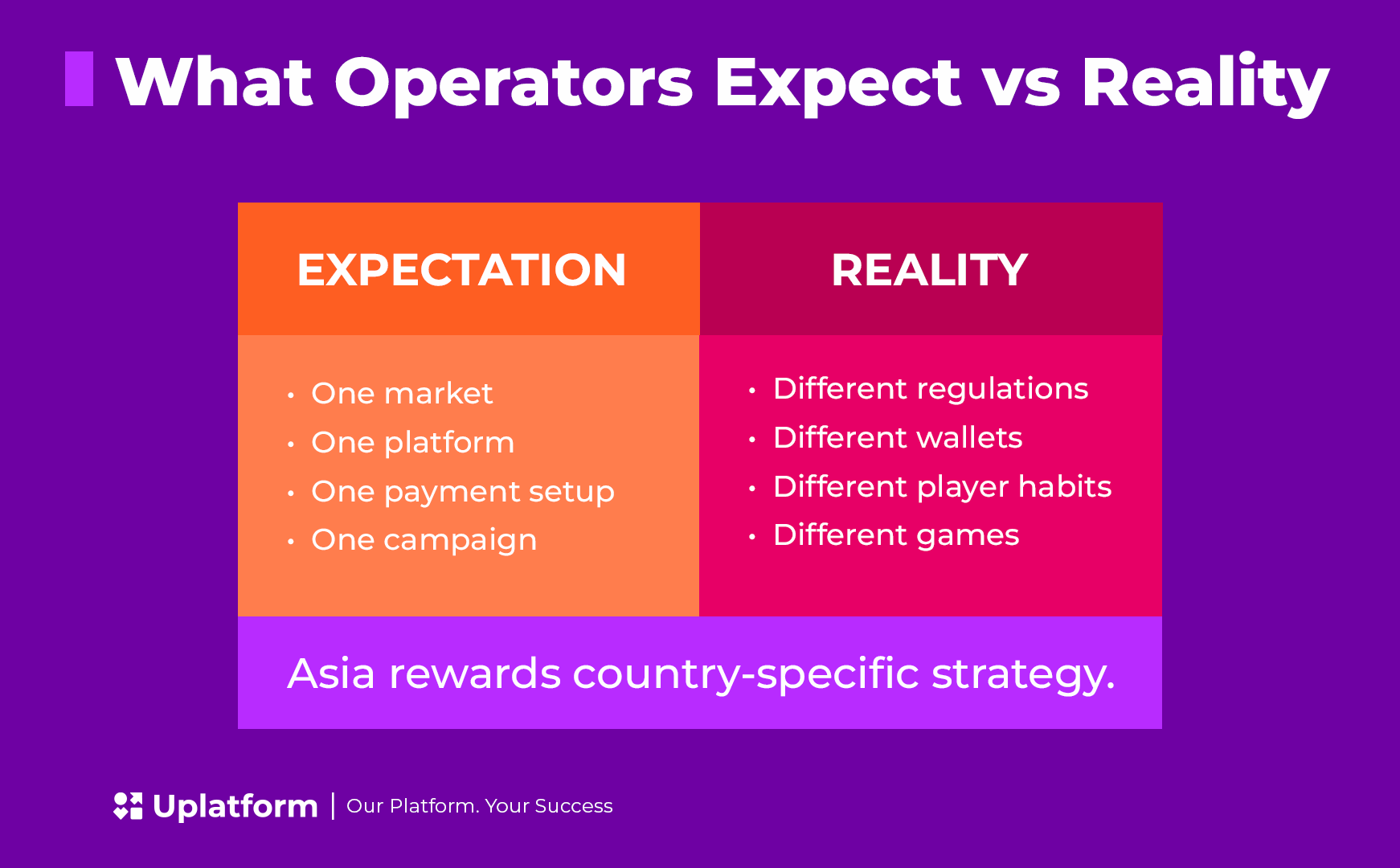
The Asian iGaming market is not short of ambition. It is short of operators who have done the actual work: the proper localization, the payment infrastructure that varies country by country, the regulatory relationships, and the product decisions that treat players across different markets as fundamentally different users.
The brands gaining traction in Asia tend to share the same fundamentals. They build around country-specific sportsbook offerings, treat mobile performance as a core product requirement, and integrate payment methods players already trust and use daily. Just as importantly, they build cultural relevance into everything from promotional calendars to game selection and UX, because the way trust is established in a gaming experience varies significantly from market to market.
Asia rewards operators who treat it with precision, and this market does not forgive the assumption that what worked elsewhere will work here.
Uplatform helps iGaming operators enter and scale in Asia with the infrastructure that actually performs: widest sports and esports coverage with more than 260 titles, casino game providers well known and respected across the region, support for 68+ languages, 550+ payment methods including the major digital wallets across Southeast and South Asia, and in-depth market knowledge built from experience across the region.
Other news
-
 From Operator Wish List to Everyday Reality
28.09.2026
-
- Player Engagement in iGaming: Operator Guide
01.09.2026
- SEO & AEO Strategies for iGaming in 2026
18.08.2026
-